
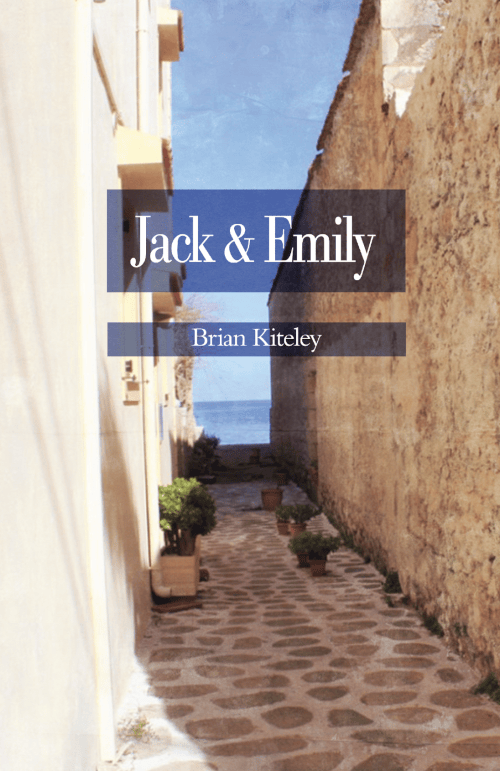
It is 1988. No one can imagine that the Cold War will soon “end” in the sense that the Soviet Union will soon dissolve. It is the best of the times and the worst of the times to be a spy and in love. That, in a nutshell, is the setting, premise, and plot of Brian Kiteley’s new novel Jack & Emily.
Jack is in Crete, Greece. On the one hand, it has been, in parts, one of the most continuously inhabited places for the last five thousand years. On the other hand, it “is the least safe country in non-communist Europe, has too many borders, too many islands, too much water access, the tenth largest coastline in the world, and the current government seems purposely oblivious to Middle Eastern bad actors, as if to antagonize the U.S.” As a case officer with the CIA, Crete is the current hub for him in a career that takes him and others everywhere from Washington D.C. to Karachi to Cairo to Crete of course. However, it is not as happening as it sounds; he does not know what it means to endear someone or experience emotion. Everyday conversations for him are about Iranians, Saudis, and Israel. Non-state mercenaries who “are quickly becoming their own autonomous armies,” and later became infamous as the al-Qaeda make an appearance in these conversations.
No James-Bond-like stunts populate the pages of the novel. Jack is almost kidnapped once. Other than that, his job does not sound very different from any other corporate job: one has to watch one’s colleagues and one’s own behavior. In a way, anybody’s life is full of double agents.
But then enters Emily in his life one day when he is at a beach: “At one point, a woman in a black one-piece bathing suit stands up and approaches me. For an instant, I think she’s walking toward someone east of me, but there is no east of me. She stops and introduces herself. Emily is American. Her wide-open eyes should go with laughter, and she’s looking right at me. She’s made the first move, and I love her for this.” Emily is writing a novel. Her family—father, stepmother, and stepsister—gives him a peek into what it might mean to live a normal, non-CIA life and he realizes he wants more of it, even if that means giving up being a spy. She is “a wonder” who assures him: “You’re not fucked up. Nor am I, or not all that badly. We are bruised but I can tell you are a mostly whole and healthy-minded person.”
In this sense of longing for companionship, Jack & Emily, touted as a spy novel, turns out to be an anti-spy novel. Yes, it has moments of Khomeini, Hezbollah, and memories of blasts, all the actors in the Cold War, but more than all these, it is about imagining the psyche of people who think about the game of Cold War and its players. It is not the story of a CIA agent intercepting something and setting out to one of those impossible missions of saving the world. It is the story of how to rescue oneself from the burden of history, to choose to love.
The form of diary entries, written by Jack in first person and in present tense, brings us in proximity with how Americans looked at the world in and before 1988. Those who remember the years are likely to feel nostalgic as well as surprised while looking at the year from contemporary times: does geopolitics change beyond bits and pieces? How much of the past exists in the present and vice versa?
Perhaps the use of diary as form should be read as a take on the espionage genre’s obsession with secrecy and evidence. The diary here is a private space containing reflections from different days spread over quite a few months. It’s also a layering bare of how much is left out of a certain document paraded as evidence: each document contains autobiographical traces in different ways and Jack’s fragments are a testimony to the presence of doubt, speculation, and emotion in everything. So what’s likeable about Jack & Emily is its aspiration towards almost an anticlimax: terrorism can wait because love must come first, always.
Jack & Emily, by Brian Kiteley. Vermilion, South Dakota: Astrophil Press, January 2026. 154 pages. $20.00, paper.
Soni Wadhwa teaches literature studies at SRM University, Andhra Pradesh, India.
Check out HFR’s book catalog, publicity list, submission manager, and buy merch from our Spring store. Follow us on Instagram, Bluesky, and YouTube. Disclosure: HFR is an affiliate of Bookshop.org and we will earn a commission if you click through and make a purchase. Sales from Bookshop.org help support independent bookstores and small presses.

