
At a recent art exhibition titled after my recent memoir, I overheard a group of women: “What does Getting Dressed in the Dark have to do with anything? I don’t get it. Oh, it’s the title of a book. It still doesn’t make any sense.” They joked with one another, unaware of my presence. I gently let them know that I’d be happy to answer any questions about the exhibition. They quickly changed the tone of their commentary, offering sheepish and conciliatory remarks: “Oh, we love the colors!” For the next couple of days I couldn’t help but wonder at my encounters with the unfamiliar and so-called sense, which after all, is the point.
How to Get Dressed in the Dark
I picture rising early, before my family. Trying not to awaken anyone as I fumble through the closet guided by touch and memory. If I’m honest, I don’t imagine complete darkness because the street lamp shines past the bare winter dogwood branches and through the bedroom window and sometimes the moon joins in brightly. And this really is just a feature of my imagination because I don’t, in fact, do this. My husband does however, and I’m the one he tries not to awaken. And usually he lays out his clothes the night before, hangs them in the bathroom even, although sometimes he forgets things and needs to use the soft yellow glow from his booklight to rummage in a drawer in the small cherry dresser opposite the foot of the brass bed.
Quiet attends even this semi-dark, as sleep is as much a friend of silence as it is dark’s companion or even a coconspirator, (if we consider sleep a secretive state where physical darkness might admit other more personal forms of darkness). In this way, I surely belong to darkness for half of my life and must navigate, whether by design or accident, and light would be an impediment to this activity.
Perhaps considering getting dressed, in the simplest way, and if we don’t take into account any aspect except the ones imperiled by darkness, we may end up adorning ourselves in not the usual way. Perhaps backwards or inside out or in colors not well suited to one another. I suppose I’ve assumed something else in my imagination: that I’m headed out of the house and for some professional engagement at that. Otherwise, why would I be up at such an hour and why am I imagining stakes to my sartorial decisions? So clothing, getting dressed, implies a context, implies a relationship with the world and that is complicated indeed and how much do I give to that complication; certainly much more than my eyesight and somewhat less than my conscious attention. Dressed may be the state most common to human bodies. It is a fundamental connection with the world, the way we touch it, physically and psychically.
A little over twenty years ago, I bought an old one-room school house in rural Maine. Much of the interior I removed, piece by piece. Plaster walls and wooden wainscotting flecked with mold. An ad hoc ceiling dropped in a poor attempt at holding in whatever meager heat radiated from a blackened coal stove. I saved the chimney bricks, one by one, and later used them in the garden tracing out seven raised beds beyond the leech field and in the shade of the forest. In the first year I grew tomatoes and the plants towered well over my head, lush and fed by manure from the neighbor’s cows, but they didn’t yield much in the way of fruit and I soon moved on to plants that could thrive in the shadow of the trees, most especially green beans, kale, and swiss chard. I planted ornamentals too, since many species were more apt to thrive in part sun than most edible varieties. It took me years, this dismantling of the chimney and stacking bricks and then restacking them to build the raised beds. Then the planting of several sun-loving plants, just to see if they could yield and tending the soil, conditioning it with compost turned in the nearby pile. Weeding and of course tending to the pests, mostly slugs because of course it was damp in the shade and the clay soil made sure to hold on to that dampness. So ideal for the slugs while less so for the plants themselves, at least the ones I was trying to grow. I often had a scissors with me when harvesting, and while many neighbors recommended small containers of beer left out to attract and then drown the slugs, I never found that method successful and instead would simply snip the slugs apart in what was a fraction of a second and move on to clipping the outermost leaves of kale and chard for that night’s dinner.
Later, and after much time spent in the garden, I’d see that clipping, even when engrossed in other parts of my day. Should my eyes close or my mind drift while chopping vegetables or running the sewing machine over some cotton yardage, I’d see those slugs. Not even “see” because of course my eyes were closed and not even was it fully bringing the image to mind, but something more visceral, textural, indeed dreamlike, and in that way perhaps of the darkness. I’d made this gesture and image one thing and brought it inside and I was no longer using my eyes at all. My own darkness wasn’t mute or empty, devoid of content as I might’ve suspected. What is that architecture, the formation that persists inside, shaped by our experiences? What are our senses if not acculturated? To Shakespeare, “Love looks not with the eyes, but with the mind.” But certainly the eyes must never serve only themselves in the matter of looking.
Slugs have a nervous system to react to stimuli, to recoil for example, and generally avoid such things that would cause them immediate harm when they sense them, however they lack a prefrontal cortex which is understood to play a critical role in pain processing. It is theorized that without the prefrontal cortex one couldn’t process an awareness of pain as such, which calls into question the whole experience.
Pay attention. To pay is to make due return for services rendered or property delivered. And attention? A selective narrowing or focusing of consciousness and receptivity and/or the act or state of applying the mind to something. Without making due return by applying the mind, one receives no meaning, no sense as it were, no services or property, just as the slug making no due return, paying no attention in a cognitive manner, remains as impervious to pain as one may remain to sense.
What application of attention should we make when we find ourselves lacking our dominant sense? In simpler terms, let’s say that the darkness is unknown to us, or it is perhaps the known transformed into mystery. This is the case when I imagine myself getting dressed in the dark. I must seek out other senses and other tools, inside and outside.
I have new gardens now. I no longer live in the old school house in Maine, but the gardens are as hard won and I still contend with shade and clay soil. Now, I find myself much more entranced by native northern sea oats, also known as Chasmanthium latifolium, waving, even through the winter, their pale and desiccated seed heads, one blade next to the next tracing one unreplicable line after line, almost a repetition, but not quite. I remove, albeit somewhat hopelessly, the Japanese stiltgrass, Microstegium vimineum, which appears single minded in its vigorous consumption of the forest floor. I do this because even the grass has a context and one species collaborates while the other dominates, taking more than it gives. I know this not with my eyes, but because I’ve given my attention to those who’ve given their attention to the matter and while opaque to my immediate senses, I now have this other sense, this wariness of acculturated tastes, of manicured lawns and barberry bushes, English Ivy creeping along stately brick, wrapping around oak trunks and cedar fences, drowning even the black walnuts that lay nested as eggs in the tangle. I watch the petals of the Hydrangea quercifolia, or the oakleaf hydrangea, clustered and then dotted with raindrops and set against a backdrop of more large flower clusters, layered deep into the shrub’s interior. In the dark I see small bits, aligned, but not quite, and overlapping until they fade completely away, overshadowed by what comes next, by what comes closer. These plants don’t frame themselves in portraits or landscape, but appear to repeat endlessly into their surroundings, one pattern giving way to another over the space of the garden.
What happens when we close our eyes to see what we have taken in? What do we leave to sleep and to the mind to replay and recollect? What have we acculturated from the outside to press, to impress, to the inside?
What do these works on paper and canvas, named after Getting Dressed In The Dark, a book about a life of art-making, have to do with this impairment, this mystery, this navigation, this vulnerability, this intimacy, this feeling our way, this questioning of vision, this cultivation of new senses, this questioning of the frameworks of apprehension, this exploration of where the inside forces meet the outside ones, this faith that we’ll be safe in our curiosity, this trust that our attention might be met with in kind, that we are visible in the dark and can in fact sense others there, that this sensory body is commensurate, no, no, no more than that, it is a part of everything around us. No love is not from the mind at all, love is the opposite. It’s in the body and in the senses that would do nothing but extend us into space both inward and outward. How can we excavate this architecture? But that is a mind question.
Perhaps the world is to us like pain to the slug. Except that we can remember our dreams, we belong to mystery, we can close our eyes and see in the darkness. We can give our attention. Perhaps, we have that missing organ, one that would tell us our connection to something greater, make our existence fluid into the space we inhabit, our clothing yes, and our art woven into the dark like energy through atoms, entangled.
Mini-interview with Gabriella D’Italia
HFR: Can you share a moment that has shaped you as a writer (or continues to)?
GD: A text-heavy, “Great Books” undergraduate program left me with fundamental epistemological questions about writing, so much so that I moved into mystical and embodiment practices, as well as visual art for the next two decades of my life. These questions and this work continue to drive my writing practices and interests.
HFR: What are you reading?
GD: I often read multiple books at once and find inspiration in the intersections. Right now I’m doing a visual artist residency focused on outdoor space and gardening. For that reason, I’m reading H Is for Hawk by Helen Macdonald, Beauty: The Invisible Embrace by John O’Donohue, Planting in a Post-Wild World by Thomas Rainer & Claudia West, and Violence Beside by Jade Lascelles from Essay Press.
HFR: Can you tell us what prompted “How to Get Dressed in the Dark”?
GD: I wrote this piece while in residence at The Visual Art Center of New Jersey focusing on their gardens aka parking lot surrounds. I wrote this in response to an overheard conversation about my visual art that I couldn’t shake. It was driven by questions about how we make meaning whether encountering art objects, text, garden space, or a parking lot. Meaning doesn’t offer itself, but we often tacitly behave as if it does.
HFR: What’s next? What are you working on?
GD: I’m thinking about ways to connect my work in visual art, gardening, and writing. I’m interested in how writing can transform under the influence of embodied, material, and process-oriented work.
HFR: Take the floor. Be political. Be fanatical. Be anything. What do you want to share?
GD: There will have to be a revolution in art to meet this moment. Style is how we see.
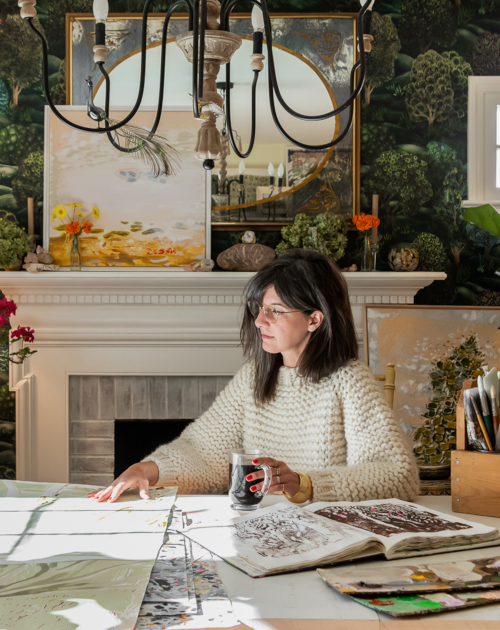
Gabriella D’Italia is an interdisciplinary fine artist, writer, and Master Gardener. Her visual work is exhibited internationally and belongs to both private and public collections. Her writing includes a memoir, Getting Dressed In The Dark: An Artist’s Way Home, from Unsolicited Press (2025), and can also be found in Hobart, Poetries in English, UMVA Quarterly Journal, and Depot Magazine. She serves on the Advisory Council for Mildred’s Lane, an experimental cultural organization fostering collaboration at the intersections of art, ecology, science, and history. D’Italia grew up in Morristown, New Jersey. She holds an MFA in Intermedia from the University of Maine, Orono. She lives with her family outside of New York City.
Check out HFR’s book catalog, publicity list, submission manager, and buy merch from our Spring store. Follow us on Instagram, Bluesky, and YouTube. Disclosure: HFR is an affiliate of Bookshop.org and we will earn a commission if you click through and make a purchase. Sales from Bookshop.org help support independent bookstores and small presses.

