
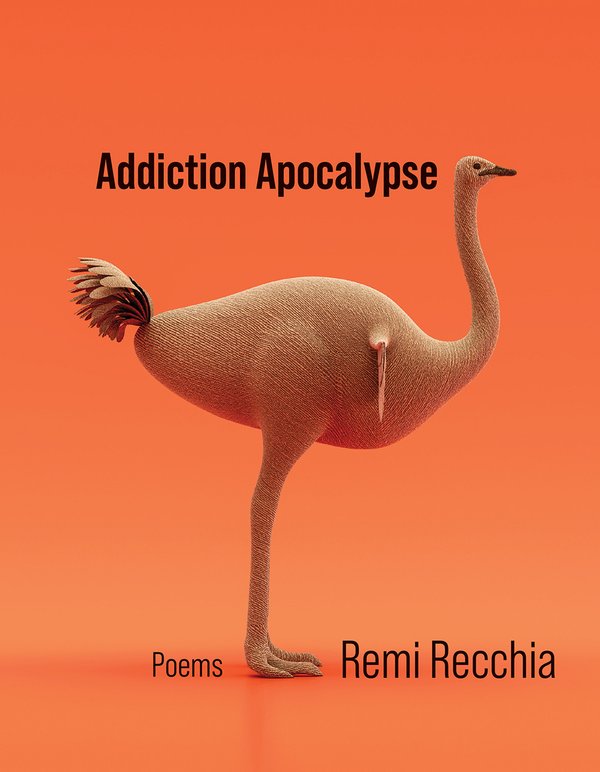
There are many ways to terraform the body. The trans experience might provide a range of tools—some easily accessible, others less so—to transform the body, to expand or reinterpret the materials one was given. But where a transgender embodiment may provide expansion or reinvention, addiction subtracts. Remi Recchia’s Addiction Apocalypse is a vibrant and often surprising collection of poems that manages to bear witness to so many ways that the body gets shaped and reshaped.
In “Tabernacle”, Recchia writes “Is my body a war? This strange vestige / of uterus and penis? Is my clitoris a dick / just because I say it is?” Before we enter this space of war, the poem begins with the narrator’s mother teaching the child “how to eat clam,” a “short lesson of desire and constraint.” The clam is obviously just a clam, a moment to refine the palate of a child, and it’s also the stand-in for whatever we will project onto it. We are not surprised to arrive at the question of the body. Clam is vaginal, and it’s also the “white secret creamy against my tongue,” and it’s also “another man’s / white offering.” And still, it is the clam.
But just as the clam cannot just be the clam, the body is not just the body. To ask “is my body a war” is to acknowledge the body is a battleground for autonomy. As a cis woman I cannot speak to the personal journey (or war) of someone who is transgender, but as a witness to the U.S. government boldly and repeatedly stripping trans rights, I recognize a battleground when I see it. But that would be a one-note if all the poems played in this space, and Addiction Apocalypse chooses nuance instead.
Beyond war, these poems are rife with the very real and very tender challenges of what it means to be a person. In “When We’ve Been Married Nearly a Year, My Wife and I Share a Toothbrush for the First Time,” Recchia writes of a narrator unable to conceive with his wife. He catalogs some of the Bible’s many famous promises to women around conception:
No baby to comfort during the storm.
No baby no time.
And God said to Rachel.
And God said to Mary.
He does not say to us.
The poem calls out the uselessness of the off-screen weatherman, who Recchia’s narrator imagines “at home with his perfect family,” the weatherman who “is probably taking his penis for granted.” What the narrator seems to want—beyond a different biology—is a sense of ease in being able to do things that seem so openly promised to others.
Substances promise a false sense of ease. In “There’s Nothing Quite Like Taking a Shot of Bottom-Shelf Whiskey,” the narrator is taking shots while a sister on the phone euthanizes the family cat. The cat seems shared between the siblings, but the narrator pushes away that feeling of responsibility and connection: “It’s just a cat, you want to tell her. Cats can’t even talk.” There is a tension between trying to be present for a loved one, but not present enough to truly feel the bite of the loss. If one can’t be physically there to share the experience, one might as well not be totally present emotionally either.
In “Triptych: To the People I Never Hit Drunk-Driving,” Recchia writes of the losses that don’t totally happen, but that haunt. A penitential voice revealing all to anyone who dares look:
… I hope you know—though I know you’ve no way
of knowing this—that I don’t drink anymore. That I don’t even have a car. That I surrendered my license willingly. I’m without a picture.
It would be a mistake to tie a trans person’s experience to substance abuse just because these poems are in the same container. The connective thread may be there, just as substance abuse happens across all bodies and traumas. But to be “without a picture” has added weight in poems that are so largely about embodiment and visibility. Still, repentance eclipses the body.
In “My Brother Died,” a haunting prose poem with the title refrained throughout, we learn the narrator’s brother dies from overdose. The world responds with an obliviousness bordering on humorous. The narrator Googles “my brother died” as if expecting some other answer. A telemarketer offers a bereavement package in the Bermuda Triangle. A priest forgets himself and gasps. If earlier poems asked, “Is my body a war?” this poem answers with sometimes, yes. Death is a final transformation of the body—barring no new resurrections. And we’re reminded that addiction subtracts from the body, sometimes more than the body can give.
Addiction Apocalypse is just as much about transformation as addiction and loss. But these themes aren’t tied together in one neat narrative. The narrator’s voice remains consistent but stretched across disparate experiences. This is a good thing. Humans are not the embodiment of one solid pat reply. A man can be sexy and broken and healing and falling apart, and in therapy about all of that (see also: “Your Therapist Has Surfer Dude Energy”). In “How Will We Go on Living” Recchia writes of how becoming looks a lot like un-becoming: “A shroud I see and I am the shroud, I wrap a body and lie in the coffin.” Lines like these give gentle surprise, draw us into a discomfort as the recognizable is subverted—the person as a shroud, to wrap the body, to become the corpse, an alpha and omega of sorts. It’s a unified theory, if you think about it—where everything transforms into one thing or another.
Addiction Apocalypse, by Remi Recchia. Huntsville, Texas: Texas Review Press, February 2026. 86 pages. $21.95, paper.
Miranda Dennis is a Brooklyn-based poet, novelist, and product marketer. She is also on the board of the Poetry Society of New York and co-hosts a Brooklyn-based reading series called Warm Bodies, if you ever want to catch her in the wild. Her work has been featured in Granta, The Hollins Critic, storySouth, Meridian, Luna Luna Magazine, and more. Most recently, her chapbook, All the Vessels, is out with Bottlecap Press.
Check out HFR’s book catalog, publicity list, submission manager, and buy merch from our Spring store. Follow us on Instagram, Bluesky, and YouTube. Disclosure: HFR is an affiliate of Bookshop.org and we will earn a commission if you click through and make a purchase. Sales from Bookshop.org help support independent bookstores and small presses.

