
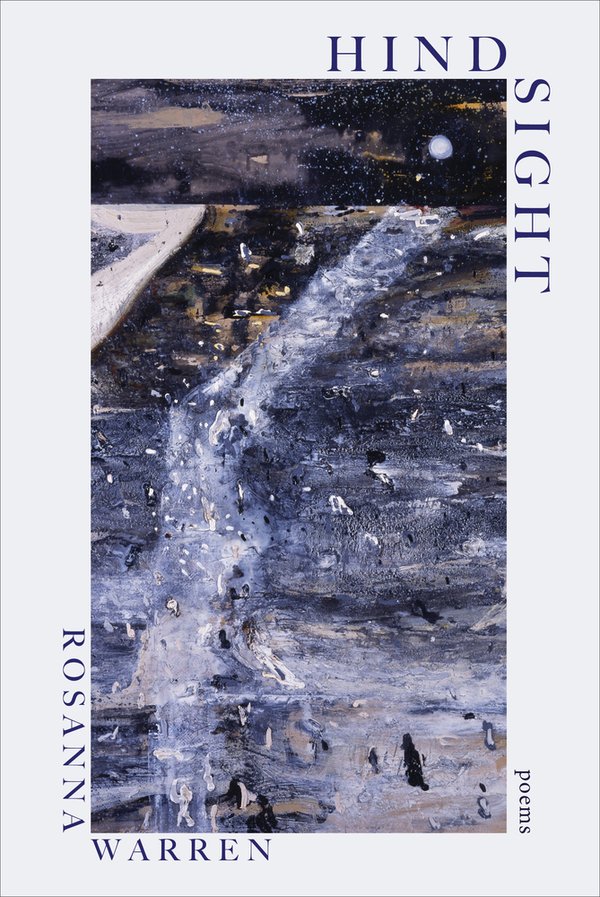
Hindsight, Rosanna Warren’s seventh collection of poetry, looks back as it moves forward. A whiplash of recognition, we follow a speaker growing older alongside a country growing apart.
The collection opens with “A New Year,” which features our speaker watching the landscape shift from behind the smutty windowpanes of a westward-bound train. She wonders whether she is the one being “left behind” or if “the country [was] letting go of itself?” The poem moves through “frozen fields … laid out / in an ancient, foreign, indecipherable script,” descriptions rendered with Warren’s characteristic exactitude. The frozen fields are American fields, yes, but they are also the fields of memory, of hindsight. Thus, Hindsight begins as a retrospective ride in urgent motion: we’re on a train from the Hudson to Indiana, a country is crumbling, and our speaker is “aging faster than the engine’s hurtle.”
The journey, at first, appears grim. We move through roadsides where graffiti on “sheds pledge revenge” and “angry signs slash … shadows.” Death appears in multiple forms: through literary references that span from Theseus and Iphigenia to Don Quixote, and in more ordinary encounters with rat snakes and stags. Friends, too, are lost. We find ourselves at the center of varying social collapses, from the 430 BCE Plague of Athens to the COVID-19 pandemic as our speaker and her partner rise early for the “senior pandemic shopping” at the supermarket. The speaker’s body also becomes a site of critical investigation as an EKG monitor transforms her life into snowfall on a screen.
“Snow” features our speaker in a medical office, her heart examined in the same way she has examined the personal and political. In “Snow,” the snow is medical, not philosophical, but in poems like “In the City,” the snow is “hectic” and “crowded” and moves in “slow determined flakes.” It is the snow of agency. Snow protests. Erases. Performs its falling with purpose. Throughout Hindsight, snow acts like powdery reflections of the population. “Sway” features slush that “wants to be seen” like snow but isn’t snow. It must negotiate with the rain, find a form in which it can survive. The perpetual descent of snow throughout the collection functions as a symbol of time itself: age made visible as it falls. So we have a speaker who is aging, and with age comes wisdom, and our speaker shares that wisdom, meaning she does not speak alone. When writing about the plague, Warren calls on Athenian historian and general Thucydides; she quotes from Genesis, the Book of Common Prayer, Genesis Rabbah 39:6, John Burroughs, Thomas Hardy, Ruskin, Simone Weil; she calls upon her mother, the writer Eleanor Clark, who referred to her daughter’s depression as “melancholia,” echoes Bill (William Arrowsmith) on Sophrosyne, and even gives herself a voice, telling us:
“I don’t have time,” I told
myself, “to kill myself: I have
to write a paper on Rimbaud.”
Such sentiments echo throughout the book: Stop? Why should our speaker stop? She’s still learning.
For Warren, reading and writing are continuous acts of learning. Hindsight asks us to recall our knowledge of Euripides’ Iphigenia at Aulis and brush up on John Burroughs. That is, we must prepare to look back and see ourselves and all we’ve learned a little differently, hopefully, a little better. And isn’t that the way we learn? By looking back? Letting go? Isn’t that the beauty of hindsight?
Sometimes hindsight isn’t pretty. Warren merges the mythic with the bureaucratic in poems like “Theseus,” where the tragic king reeks of contemporary privilege and administrative power. And there are all sorts of animals invading the speaker’s spaces, whether it’s snakes sneaking through cracks in the “top most slate” of the foundation or bears with “Roman snouts” getting into her garbage. Then there is COVID-19. And the body, growing frail.
So yes, the journey of hindsight is at first grim, but it is not without consolation. Comfort materializes through ritualistic acts, like when the speaker and her partner burn an old mattress or when she grabs a shovel and digs a grave to bury the snake she found tangled in a trap intended for a mouse. Having already deemed the snakes living near her home patient house guests, the poem “Small Dead Snake” weeps for the helpless creature and for the traps we unknowingly set for ourselves. (Longtime readers of Warren may recall her poem “Simile” when reading “Small Dead Snake” where a similar structure holds grief and tenderness in careful balance.)
“Cirrus,” the penultimate poem, moves from memory to the present. Our speaker begins by remembering a time when she “could hardly tell / the difference between hospital and classroom” only to bring us into the immediate present where “Joel prods the slow, / private smolder in the pile of damp brush” which “rips laughter out of its own current.” Joel is there. There is laughter. The ground beneath changes yet again, but this time it’s ripe with the promise of spring. Whether it is the speaker leaving a former self behind or a country letting go of itself, “Cirrus” ends by recognizing how “each stalk swells with the pulse of a blossom-to-be.”
Hindsight sometimes requires slow, cold work. Warren’s collection, Hindsight, looks back to myth, to history, to science, and to the speaker’s own paths as a step towards moving forward.
Hindsight, by Rosanna Warren. New York, New York: W.W. Norton & Company, September 2025. 96 pages. $26.99, hardcover.
Abriana Jetté is an internationally published writer whose writing has been supported by the New Jersey State Council for the Arts, the Sewanee Writers Conference, the Community of Writers at Squaw Valley, and can be found in Best New Poets, PLUME, Tampa Review, Teachers & Writers Magazine, Poetry New Zealand, and other places.
Check out HFR’s book catalog, publicity list, submission manager, and buy merch from our Spring store. Follow us on Instagram, Bluesky, and YouTube. Disclosure: HFR is an affiliate of Bookshop.org and we will earn a commission if you click through and make a purchase. Sales from Bookshop.org help support independent bookstores and small presses.

