
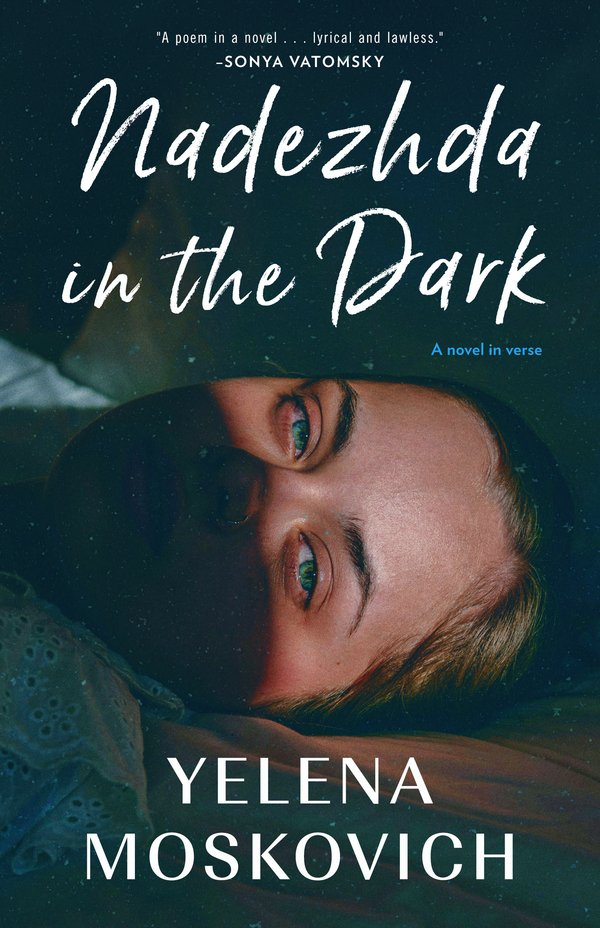
Yelena Moskovich’s Nadezhda in the Dark begins in a room so still it almost seems sealed: two women in bed in Berlin, the lights off, neither speaking. From that nearly immobile setup, the book builds extraordinary motion. The narrator, a Jewish émigré from Ukraine, lies beside her Russian girlfriend, Nadezhda, while the dark fills with memory, literary association, private grievance, Soviet residue, queer history, and the current war’s unbearable pressure. The novel is less interested in silence as absence than in silence as congestion. Nothing is said aloud because too much is already there. The couple’s impasse is not simply emotional; it is historical, linguistic, and diasporic. Even before one reaches the title’s obvious question—what it means to hold on to Nadezhda, whose name means hope—the book has already made clear that hope here is inseparable from contradiction.
What gives the novel its charge is the refusal to separate intimate life from political life. Moskovich does not stage history as background material that explains the lovers from a safe distance. History is in the bed with them. The book moves through Yiddish maxims, contraband jokes, post-Soviet queer life, Jewish diaspora, pop music, club raids, and the death of a beloved friend without letting any of it harden into “context.” These things arrive instead as the very texture of consciousness: the mind’s habit of moving by association, resentment, longing, and return. The result is a form of compression that feels less like summary than saturation; the novel keeps showing how private life becomes crowded with what it cannot shut out.
That movement is clearest in the passages that return obsessively to perception itself. Early on, the narrator lies awake with the blinds not fully shut, looking at “a dark milky sky,” then worrying the image into variation: “a pauper’s sky,” “a dreamer’s sky,” “a prisoner’s sky,” and finally “a doomed sky.” The sequence is one of the book’s best demonstrations of how thought works under emotional pressure. A sky is never just a sky here; it becomes social, carceral, historical. Repetition does not stabilize the image but thickens and darkens it. Each return makes the phrase less atmospheric and more exacting, as if perception were being forced to confess what it already knows.
Another striking moment arrives through the novel’s discussion of Margarita Khemlin’s Klotsvog, especially the brutal scene in which a mother tries to force her son to abandon Yiddish for Russian, leaving him to cry in the dark unless he speaks the sanctioned language. Moskovich’s gloss on this scene—“sometimes when you survive you fall in love with the language / that almost killed you”—clarifies much of what the novel is doing elsewhere. Language here is not only inheritance or expression. It is coercion, shame, attachment, survival, and afterlife all at once. The novel’s references to Russian and Ukrainian literature, to Yiddish sayings, to popular culture and remembered speech, do not read as ornament. They register the self as something made in and by injury, unable simply to choose its own linguistic ground.
The Berlin setting gives the novel a hard visual grammar for this emotional weather. On the balcony on Ilsestraße, there is frozen soil in half-empty flower containers, the remnants of Santolinas, dwarf spruces planted because they reminded Nadezhda of Moscow, and lavender prized for “its scent and loyalty.” It is a beautiful detail because it is so compromised: loyalty appears not as a virtue but as something wintry, residual, half-buried in a box of dirt. The passage ends with the line, “I don’t need to turn my head to see the past,” which feels like the book’s governing principle. The past is not elsewhere in this novel. It is what the room, the plants, the body beside the speaker, and the language in her mouth have already become.
The relationship at the center of the book is compelling precisely because Moskovich refuses to sentimentalize its asymmetry. Nadezhda is not merely a beloved figure; she is also a historical problem the narrator cannot solve. One of the novel’s sharpest moments comes when Nadezhda says, “I like Jews,” and the narrator hears in the remark not innocence but the long afterlife of Soviet blindness. What hurts is not only prejudice but the demand that love absorb misunderstanding without remainder. The novel understands that intimacy can sharpen difference rather than dissolve it. To know someone’s body, habits, and griefs is not the same as knowing the history that formed them. Moskovich keeps the lovers close enough for tenderness while refusing to let proximity stand in for comprehension.
Because the book is a novel in verse—and effectively one long, unbroken syntactic movement—its form can keep carrying one thought into another without offering false closure. That seems crucial to the novel’s emotional logic. Resolution would be the wrong shape for this material. Moskovich needs a form that can accumulate, double back, and refuse clean borders between lovers’ quarrel, inherited fear, and geopolitical violence. The effect is intellectually crowded, erotically charged, and at moments very funny, even when shadowed by grief. The writing remains tactile as it grows abstract: hair, blinds, sweaters, windows, flower boxes, the body in profile. Those concrete surfaces keep the novel from floating away into idea.
What lingers most is the book’s refusal to make hope consoling. Nadezhda in the Dark does not ask whether love can transcend history. It asks what love looks like when history has entered the bloodstream, the sentence, the joke, the mother tongue, the shared bed. That is a more difficult question, and a more interesting one. Moskovich’s answer is not redemptive in any easy sense. Intimacy here is not a refuge from historical life but one of the places where its contradictions become most visible. In that sense the novel’s darkness is not merely despairing. It is diagnostic. It lets us see what closeness cannot cure and why, despite that, people keep reaching for it anyway.
Nadezhda in the Dark, by Yelena Moskovich. Ann Arbor, Michigan: Dzanc Books, January 2026. 204 pp. $17.95, paper.
Elena Rotzokou is a PhD candidate in English and Comparative Literature at Columbia University, where she works on Romantic poetry. Her poetry and short fiction have appeared in ONE ART, Eunoia Review, and Gooseberry Pie Lit Mag, with additional work forthcoming in Neologism, Rust & Moth, and Flash Frog. She runs the Substack Common Measures, where she writes about literature, film, and contemporary culture. She lives in Manhattan.
Check out HFR’s book catalog, publicity list, submission manager, and buy merch from our Spring store. Follow us on Instagram, Bluesky, and YouTube. Disclosure: HFR is an affiliate of Bookshop.org and we will earn a commission if you click through and make a purchase. Sales from Bookshop.org help support independent bookstores and small presses.

