
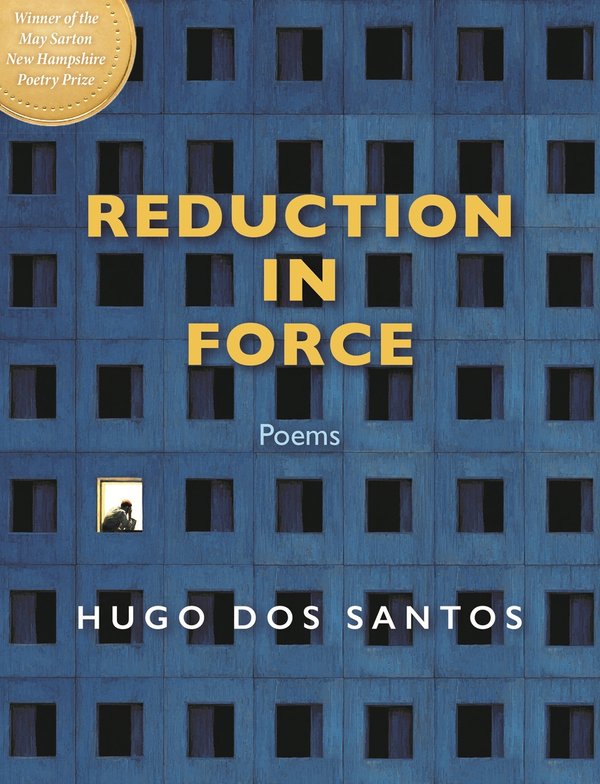
In Reduction in Force, Hugo Dos Santos writes from the fraught position of an immigrant father whose sense of arrival has been tethered—perhaps too tightly—to work. While the book takes its title from the colorless language of corporate layoffs, its emotional core lies elsewhere: in the speaker’s effort to reconcile the displacement, masculinity, and care engrained in him by his Portuguese-American culture, and in his fear of failing to pass stability on to his children.
The poems repeatedly return to the moment when professional erasure reactivates older immigrant vulnerabilities. Employment, once imagined as proof of belonging, especially for Luso-American people, is revealed as conditional and revocable. In one understated line in “Day 76,” Dos Santos captures this double exposure—economic and cultural—when the speaker admits that “Change is the longest word I know.” The loss of work becomes inseparable from the loss of fluency, authority, and social footing—in two cultures.
Fatherhood anchors the book’s moral gravity. The speaker measures the consequences of insecurity not in abstract terms, but through the daily labor of care: explanation, reassurance, protection. The poem “Day 31” registers an acute awareness when he remembers how his own father struck him once after he touched a hot plate:
I understand now, writing this
his fear: a son who won’t listen,
wandering toward danger despite warnings,
signs.
These lines crystallize one of the collection’s central tensions—how a parent absorbs humiliation privately while trying to model resilience publicly, how despite him trying to keep his son from experiencing pain, he knows the impossibility—and necessity—of it.
Dos Santos’ immigrant perspective sharpens his critique of the American dream. The speaker is not naïve; he understands the promise of work as a form of conditional hospitality. When that promise collapses, it exposes how deeply productivity has been mistaken for worth, and how fatherhood itself has been entangled with the ability to provide. This is especially evident in “Disillusioning,” which despite the title, clearly illustrates said critique:
I celebrate knowing that I have
done these and also all other
things, because I have been
one who does the believing
with a conviction that feels
just like the doing.
This poem resists melodrama, while the rest of the collection does much the same in allowing bureaucratic diction and domestic imagery to collide, revealing how institutional language infiltrates the most intimate spaces of daily life.
Formally, Reduction in Force mirrors this instability. Fragmented lines, abrupt tonal shifts, and the cold vocabulary of management coexist with scenes of home and memory. The effect is cumulative and unsettling: we feel how easily the logic of disposability bleeds into the self, and how much effort it takes for the speaker to keep that logic from reaching his child.
Yet the book ultimately refuses despair. What emerges is a recalibration of value. As faith in institutions erodes, the poems locate dignity in presence, memory, and ethical attention. Fatherhood becomes a quiet form of resistance—a refusal to let corporate narratives of usefulness define the measure of a life.
Through the voice of an immigrant Luso-American father, Reduction in Force expands the scope of contemporary American poetry in such a timely way, insisting that labor is never only about economics. It is about lineage, belonging, and the fragile hope that one might still give one’s children something sturdier than what the world is willing to guarantee, which is the real American dream.
Reduction in Force, by Hugo Dos Santos. Peterborough, New Hampshire: Bauhan Publishing, April 2026. 104 pages. $18.00, paper.
Marina Carreira (she/they) is a queer Luso-American poet and artist from Newark, New Jersey. A Pushcart Prize nominee and 2024 Luso-American fellow in the DISQUIET Literary Program, she is the author of Dead Things and Where to Put Them (Cavankerry 2025), Tanto Tanto (Cavankerry Press, 2022), Save the Bathwater (Get Fresh Books, 2018), and I Sing to That Bird Knowing It Won’t Sing Back (Finishing Line Press, 2017). She has exhibited her art at the Newark Museum, Morris Museum, ArtFront Galleries, Monmouth University Center for the Arts, among others. She works in higher education and teaches Women and Gender Studies at Kean University. Find her on Instagram at @savethebathwater.
Check out HFR’s book catalog, publicity list, submission manager, and buy merch from our Spring store. Follow us on Instagram, Bluesky, and YouTube. Disclosure: HFR is an affiliate of Bookshop.org and we will earn a commission if you click through and make a purchase. Sales from Bookshop.org help support independent bookstores and small presses.

