
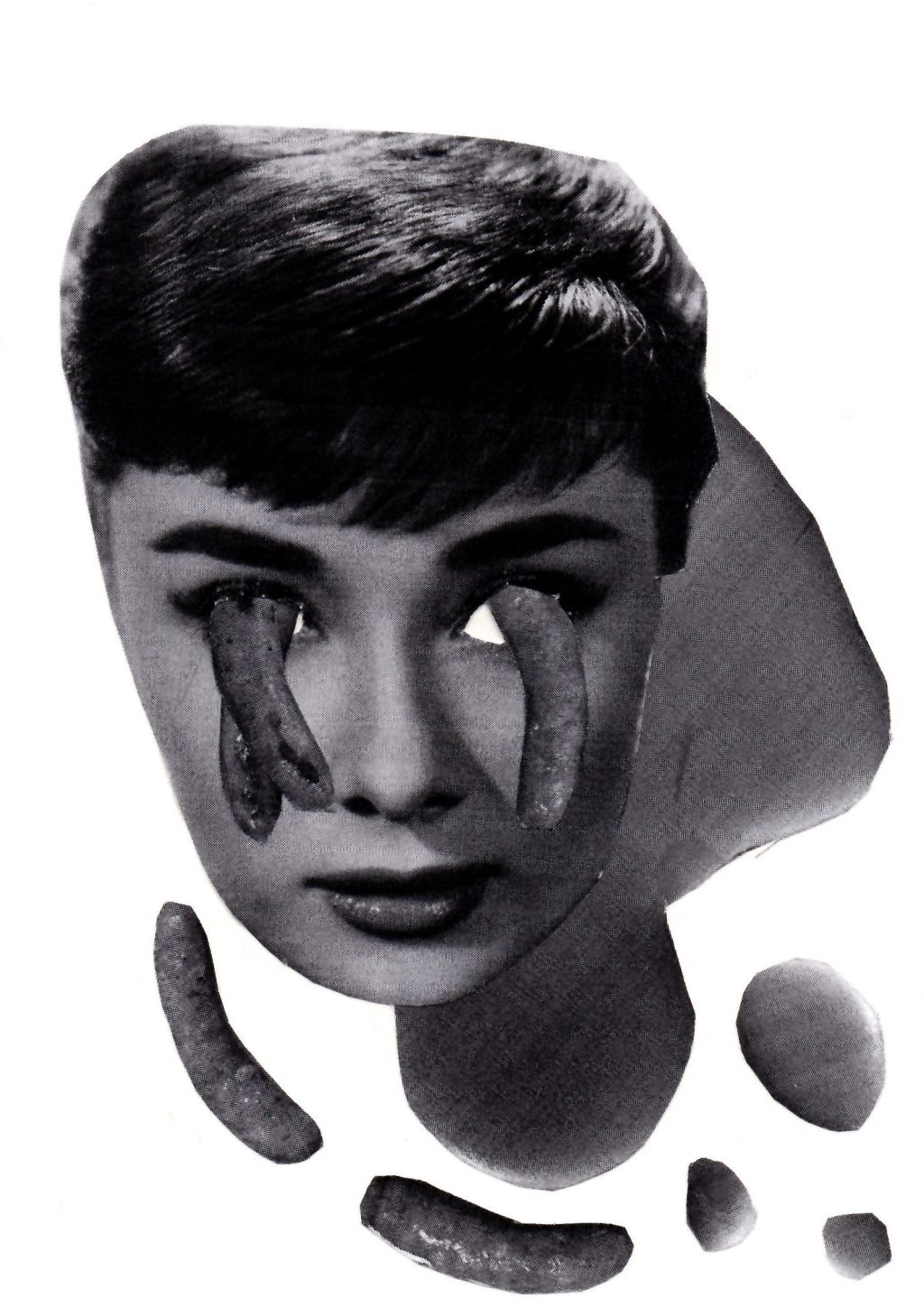
(A dreamoir inspired by Wendy C. Ortiz)
I wake with a sharp pain behind my eyes, the kind that makes it difficult to open them. I rise in a fog of headache and blurred vision, taking careful, tender steps around the apartment. The apartment is a strange amalgam of familiar spaces, other spaces I’ve lived in throughout my life. The shapes of the rooms all belong to my current apartment, but individual fixtures—a window, here, a chair in the corner, there—will flicker, changing shape. The chair becomes a different chair, an object from an old, different apartment. A device, glitching out. A sputtering memory.
Aside from this memory-glitching, the apartment is strangely disheveled. In the living room, a pile of empty wine and whiskey bottles. A dozen black brocade throw pillows, scattered in a circle. Red satin ribbons, scraps of torn skirts, strewn among the pillows.
In the center of the room is an enormous, chest-high shell of melted candle wax, shaped like a hornet’s nest.
I stare at it.
I walk around it, touching different spots.
In some spots, it is cold.
In some spots, it is still soft, and still warm.
What’s the last thing I remember? My forehead throbs with effort. It was drinking whiskey, straight, right from the bottle. The bottle had a weird old photo printed on the label. I remember pointing at it, joking, making someone laugh.
I remember stumbling to bed, feeling disgusted—by someone, or something—and collapsing in the dark.
On the edge of the room, I find a still-lit candelabra, tilted at an angle, propped up by a mound of empty bottles. There is a pillow sitting next to it. A burning smell. A singe mark. Bits of cotton stuffing, brown-tinged, crisped with black.
I blow the candles out, aghast.
They could’ve burned the whole place down! I cry, not knowing who is still there, who they are, or who they were.
My husband yawns behind the bathroom door. Emerges in a black brocade button-down shirt that matches the pillows. He has no pants or underwear. I watch his bare ass ambling into the kitchen (which—thankfully—is our current, real kitchen).
Hey! You could’ve burned the whole place down! I chuck the singed throw pillow at his butt. I miss. He chucks it back at me, and hits.
The pillow scrapes my leg. I look down at my leg and notice it is bare. So is my arm, my stomach. For some reason, I am naked.
You got a little blotto, passed out. Missed the best parts of the night, he chides. A great book launch. Horatio’s best work, so far.
Who is Horatio? And why was he having a book launch at our place? And why did this book launch involve a pile of melted candles?
I watch my husband picking at a white mushroom. I notice there’s a pile of little mushrooms on the counter.
I am confused, hurt by his glibness, but I am also too embarrassed by my nakedness, my lack of memory, to ask what happened.
And I’m embarrassed that I don’t know who Horatio is.
Clearly, I should know him.
Clearly, he is an important man.
I’m driving to a wedding (whose wedding, I don’t know) and I’m with a friend from college, whom I haven’t seen since college. He’s whining about being hungry. I’m whining about how I have only one day left to get my wedding dress.
I placed an order on some sketchy-looking website that came up in my Instagram algorithm, several weeks ago. The dress has shipped, but it’s been traveling across the globe. One day, it’s in progress. The next day, it’s in Customs in the UK. And two weeks later, it’s in Customs in Taiwan. A week later, it’s in my state, a distribution center 20 miles from me. And three days later, it moves to a distribution center in Alaska. Currently, the status of my package is unknown.
Oh, pull off here! My hungry friend gesticulates toward a nearby lot, some kind of splitstyle fast food restaurant, two things in one. One side is Bookman’s Bagels. One side is Le Chat Cafe. I really want a fig and butter danish-bagel, says my friend.
That sounds a little esoteric for a place like this, I shrug.
No, he insists. They have amazing bagels at Le Chat. The Bookman’s Bagels are all ass. Le Chat gets bagels from New York, and they are ass, but in the good way. Good ass bagels.
I am a little skeptical. Why would the cafe order bagels from New York when there’s a bagel place attached to them? But there is WiFi in the cafe, and I need to have a chat with customer service to find out where my dress is.
Meow-meow, good morning. Welcome to Le Chat. A woman wearing an Amelie-style black-bobbed wig and cat ears greets us. She has long, claw-like, silver press-on nails. I wonder if they’re just a style choice, or if they’re part of her required uniform.
I’d like a half and half, a full cap, a half-baby pamplemousse, a fig and butter danish-bagel, says my friend.
The fig and butter danish-bagel has been discontinued, says the cat-eared woman. We get bagels from Bookman’s.
My friend gets wide-eyed. But your bagels were so good! Why would you do this? He pouts, like this is a personal affront to him.
Meow-meow. I’m sorry, sir. It’s a supply chain issue. Would you like to try the Shakespeare Special, or the William Faulkner Wildbread?
The wildbread? His face contorts. The wildbread? What does that even mean, the wildbread? What makes a bread go wild?
The cat-eared woman gets a far-off, contemplative look. Raises a silver nail to her lip. Meow-meow. What makes a bread go wild?
I leave the two of them to probe this philosophical question, and find a quiet corner in the back of the cafe. I log into my email and retrieve the confirmation message. Track my package. Its status is still unknown.
I click the customer service chat. Please describe your issue, prompts the chat. I type in, package delayed. When will it arrive?
Good morning, the chat answers. I am Ashley. I am sorry your package has been delayed. How can I help?
I ordered this dress for a wedding, I type back, and it has not arrived in time. I need an update, or a refund.
The … flickers in Ashley’s chat. It pauses for a moment, then starts flickering again. Pauses. Then flickers.
Why would you wear a fully sheer dress to a wedding? Ashley’s message reads.
I squint. A fully sheer dress? Did they send me the wrong dress?
I check the email confirmation, and—sure enough—I have ordered a fully sheer dress, see-through from neck to hem.
I am bewildered that I somehow failed to notice this mistake, with all the times I’ve checked this email to pull up the tracking form. I type back, I don’t want a sheer dress. Can I get my money back?
The … flickers. And pauses. Flickers. Pauses.
The message reads, You need to take responsibility. Whether or not you made the mistake—from the outset—you were wrong. If you did not want a sheer dress, you would have noticed the mistake. You did not notice it because—subconsciously—it’s what you wanted.
I hear the chair scrape, hear the soft click of ceramic on ceramic. My friend sits down across from me. He looks triumphant.
They had a small batch of the fig and butter danish-bagel in a secret freezer. I just had to ask the right questions.
The … is flickering, again. I stare at it. What’s wrong with me, that I don’t ever know the right questions to ask?
My friend bites down into his fig and butter danish-bagel. Mmmph.
The bread-skin crunches, cracks delectably between his teeth.
I’m at a party of some kind, maybe a wedding (whose wedding, I don’t recall), wearing a reddish-brown tulle dress. The layered tulle is cheap, and scratchy. It’s so sharp, it scrapes my hands. My hands get covered in small cuts that ooze and bleed. I wipe the blood onto my dress. It doesn’t show, at first, because my dress is reddish-brown. Eventually, though, the layered tulle gets weakened by the blood, and starts to fall apart. I wander off, searching the hallways, cabinets, and drawers, for a needle and thread. I do not find a needle and thread, but I find a stapler. I staple my dress back together. Rustle, rustle, goes my skirt. The stapler goes, ka-chunk, ka-chunk. My hands, of course, keep scraping up against the staples, getting bloodier and bloodier.
I’m in a gray zone—a gray hour—between sleep and wakefulness. I feel the static of my dreams—or my potential dreams—in waves. A kind of dead channel, with bits of images and sound emitting through the static, getting swallowed up, and lost in sheets of gray.
The dreaded day has come. I have to take a test. I know I’m not prepared. I sit in terror, picking at the paint flecks on my desk. I’m in the back row, at the far end of the room. I have to watch the teacher pacing, sifting slowly through her paper stack. I try to focus on the desk, its peeling skin. I register her movement as a shadow, shifting, pausing, setting paper down. A little glimmer that moves closer and closer, but doesn’t seem quite real. Perhaps the bell will ring before she reaches me.
As she approaches me, I register her smell—stale coffee, Tic Tac mint-breath, tired skin—and realize, not only have I not prepared, but I don’t even know what class I’m in. I do not know what test I will be taking.
She sets a stack of printed pages on my desk, face-down. I glance up, hoping—maybe—I will catch some recognition in her look. But, no. Her hair is combed in such a way—her head is turned in such a way—I cannot see her features. Eyes. Mouth. Anything.
I turn the test over. It’s multiple choice. Fill the circle in. Shade in the circle with your fine gray pencil point. The first question is about fairytale history. The choice feels pretty obvious. I fill the circle—scrape, scrape, scrape—and move on to the next. It is a math question. My heart jolts at the sight of numbers, symbols. I scan through each little circle-answer, tap them with my pencil tip. None of the little circles beckons to me, so I skip on to the next, but it is also math. The next: more math.
I flip the page. The next question is on athletic safety, how to handle weight equipment without muscle damage. I’ve never heard of the machine the question is referring to, and I can’t locate this strange muscle in my body. I choose the circle with the word levator scapulae because I like the sound of it, because something about the sound of it feels far away, an escalator of alien syllables to carry me above the page, beyond the test, beyond the room.
I hear a snap. Stale coffee. She is standing over me, and snapping.
Did I nod off?
What did I do?
Something wrong?
I feel a cold, dry hand, behind my neck, and dipping down the collar of my shirt. She grabs the tag, and tugs it. Summons me to stand.
She motions for me to move to another classroom, with another group of students. I attempt to scan their faces, to see if I recognize them, but their heads are tilted toward their desks. They’re filling in their circles. Quiet scraping. Deep in thought.
I sit at my new desk. This one has an S carved into the wood, in strange block lettering. An S for what? For Sarah? Sam? Steven? Simian? Sanitation? Sacrilege? Supreme? She sets a new test down in front of me, covering up the S.
The test is not in English. Not in any language that I know.
Is that Cyrillic? Or Arabic?
I can’t even tell.
Block paragraphs of text and empty squares beneath them.
I do not know what I should do, what I should fill the squares with.

I wake with a jolt. A feeling like electric shock. The static of my dream is buzzing through me. Through my marrow. Through the gray. I’m trying to retrieve something—someone—who seems essential to retrieve. Some name I can’t remember. It’s some actress. Actress. Someone dead. Her name begins with A, I think. The static hums. Her name begins with A. With Aa. With Ah. With Ah. Ah, ah! The static sharpens. Ah! A white light flashes through the gray. Aha! The name is Au! The name is Audrey Hepburn! Audrey Hepburn! Audrey Hepburn!
I do not know why I am trying to remember Audrey Hepburn.
I cannot remember how—or if—she featured in my dream.
I lie there, in the half-light, trying to remember why it seemed essential to remember Audrey Hepburn’s name.
I’m at my ex-mother-in-law’s house. In this context, I believe my ex and I are still together, living at her place. I try to help out when I can—wherever I can—but my helpfulness is less a form of altruism than a way to be alone. I’m in the kitchen, scraping dishes to be washed, and I can hear the TV playing some obnoxious game show in the next room. A buzzer buzzes every 15 seconds. Then, recorded laughter. Real laughter from my ex-husband, ex-mother-in-law, on cue.
I guess—if I allow myself to think about it—I am following my cues as well. My lonely cues, here, in the kitchen.
The buzzer buzzes. Scrape, scrape, goes the knife.
Recorded laughter. Scrub, scrub, goes the sponge.
Real laughter. Rinse, rinse, goes the faucet.
I find myself scraping a dish I didn’t notice on the table. It’s some kind of pale cream, with sausages. The sausages look untouched. Crisply singed. Gleaming with oil. There’s a smell to them, like warm skin, begging to be kissed.
I pinch one of the sausages between my fingers, and it feels—immediately—like a part of me, a new part of my hand.
I tongue the tip of it. Both firm, and soft. Both sweet, and savory.
I tongue the full length of it. Tender. Somehow soothing.
I wrap my mouth around it, testing, like I’m asking for permission, and something within the warm-skin-taste says, yes.
The oil coats my tongue, and lubricates my throat, and something bright—something illuminating—fills my throat, my chest, my gut.
I suck a little harder. Light juice, drizzling between my teeth.
I feel lighter, somehow. Full, but strangely light.
I swallow down the juice, but feel more like something’s swallowing me. Swallowing my loneliness, my discontent.
I suck a little harder, but I do not dare to use my teeth. I must preserve this little part, protect this feeling.
I wrap the sausages in plastic. Tuck them in a clear bag. Tuck the bag inside a fabric napkin. Tuck the napkin in a pocket of my purse.
I take them everywhere with me.
I take them out—in secret—when I need them, when I need to feel lighter.
I see a couple arguing. I take a sausage out, and suck on it.
I see a homeless man almost get hit. I take a sausage out, and suck on it.
I see a dead bird, or a dead rat. I take a sausage out, and suck on it.
One day, my ex-husband (my current husband, in this context) notices me reaching in my bag. He makes a face.
What are you looking for? he asks.
I bite my lip. I don’t know what to say.
He grabs the bag away from me, and swipes his hand inside the bag.
He pulls the sausages out from the bag. Inside his hands, they are disgusting. Greenish gray and moldering.
He drops them with a shock—a sick sound, like he’s trying not to vomit—as the sausages burrow into the ground, like worms.
There is a space I keep returning to.
A parking lot at night.
An empty parking lot.
A black night, no stars visible.
The only stars are lamps.
The only movement is my movement.
Yellow, painted lines. Clear indications of where things will go.
It’s a potential space. A space that will be filled in.
But it only feels safe—to me—when it is dark and empty.
An unreal space. My shadow, looming so much larger than myself.
A dozen shadows—one for each new me—under each light.
I have become a soft, warm substance. Silken tofu in some kind of broth. I feel my body bubbling, and crumbling. Dissolving into liquid. The sensation of this crumbling commingling— this dissolution—isn’t as alarming as it sounds. It’s oddly pleasant, actually. Being viscous. Being warm, and getting warmer. Feeling myself, thinning out, and spreading out. I never knew that I could cover so much space. I never knew that I could lose my form—become another form—so easily.
But I still can’t help thinking (I don’t know how I am thinking, as a tofu soup), I need to tell my friends, my family, the people that I love, that I’m dissolving into soup, but they should not worry about me. I am happy. I am fine.
I am not only fine, but better off, this way, being a soup. I do not care who eats me. I do not care if they eat me. In fact, I realize (somehow, I don’t know how) that I need to be eaten, can’t grow cold and thick, here, in this bowl.
Cold, disembodied hands are running through my hair.
That feels nice.
Cold, disembodied hands then click a switch. A razor blade begins to hum, and shred.
That’s not so nice.
I have been growing my hair out for many months, and I don’t want to lose the product of my patience.
Hey, stop! Please, stop, I call out to the disembodied hands. (They cannot hear my words, of course, because they don’t have ears.)
My ears are ringing with the razor sound. My ears are now exposed. My scalp is wide awake, alert, and prickling with energy.
Each root of hair feels like a severed nerve. The sharp sound feels like screaming, like it’s coming from me, coming from inside the hair itself.
Please, stop, please, stop. I try to call out, but I realize my voice is coming out as buzzing, shredding razor hums.
My hair has grown out quite luxuriantly (some would say a little too luxuriantly) in a sort of feathered, winged uppercut. The feathery effect is so luxuriant and birdlike that I enter the infamous Tropical Bird Contest.
The Tropical Bird Contest (for those of you who don’t know) is a professional hairstyling competition. A person pairs up with a stylist and a look-alike tropical bird, and the stylist sculpts their hair after their feathered doppelgänger. My feathered doppelgänger is a cockatoo named Charli XCX, and sadly, I suspect he doesn’t like me. He makes cat calls that seem sarcastic, and he does a kind of mocking little dance, gyrating his head back and forth.
The stylist dips her hands into a bowl of neon purple goop, and plops a fistful in the middle of my head.
I am concerned. Won’t it be difficult to get the volume that we need, with that much product before adding heat?
The stylist rolls her eyes, but Charli makes a cackling sound, like a wicked witch. Heehee-hee. Too much goop, he cackles. Too much goop.
This is a thermosensitive elixir used by NASA scientists, the stylist says. So, chill. I know what I am doing.
There is a magnifying makeup mirror next to me, the side opposite Charli, so I can see everything that’s happening: the evolution of my hair, and Charli’s commentary on it in the form of bird-dances and head movements.
The stylist points a weird hair dryer at my forehead, a peculiar structure with a sort of coiled muzzle, like a ray gun. The weird hair dryer emits waves of neon purple light. My head immediately aches. I feel like I’m being sunburned.
It’s absolutely necessary that we use that thing? I ask.
The stylist takes a comb out, teases at my bangs.
It really hurts, I protest.
She pretends she doesn’t hear me, and turns up the dryer level, drowning out my voice.
Inside the makeup mirror, I can see my hair looks stupid. Hugely puffed, no definition. Lopsided in all the worst ways. I can see Charli, quizzically cocking his head, back and forth. He skitters left-right, left-right, on his little branch.
My stylist turns the dryer off. Takes out a bright pink glowing wand: a giant neon dildo. Sprays something directly in my face, into my eyes. It burns. I cough violently, and Charli laughs.
Eck-eck, eck-eck, he calls. A mocking imitation of my cough.
The stylist rolls the glowing dildo underneath my bangs. It isn’t doing anything but making all the worst things worse. The shapeless flop on one side somehow has become even more shapeless, and the other side fluffs out with static flyaways.
I’m sorry. I don’t mean to question your expertise, I attempt to venture, timidly, but I don’t think it’s working. It’s creating some electric static, or something. I’m sorry, I deflect. It is my fault, of course. My hair’s fault.
The stylist huffs. You are impossible, you know?
I sigh. I know.
You are the worst hair model at the Tropical Bird Contest.
Charli is reveling in my humiliation, ruffling his feathers like a Mae West boa, chortling in a robotic monotone, oh-no, oh-no, oh-no, oh-no, she’s gone and lost her feathers, oh-no, oh-no, oh-no, gone and lost her feathers.
We come in dead last. Afterwards, there is a sad buffet. The line is long. The only thing that I can eat is fruit. I fill a paper bowl with mushy melon balls, pathetic grape vines of deflated skin, and mostly empty stem.
My hair smells like a car crash, and my melon balls taste like exhaust.
My bangs keep falling in my eyes and sticking to my nose.
I can hear Charli in the background, chanting like a school yard bully, melon ball, oh melon ball, oh melon ball.

I’m in a parking lot, at night.
An empty parking lot.
A black night, no stars visible.
The only stars are lamps.
Until I notice a small movement, glimmering beneath one lamp.
A snowflake, falling.
And another, and another.
Now, the sky is fluttering with snow.
It’s beautiful, but strange.
Oddly disturbing.
It’s a violation of the emptiness I know.
But still, it’s beautiful.
I try to quell my sense of dread.
I stick my tongue out, like a child, to catch the falling flakes.
A snowflake lands on the tip of my tongue.
It tastes like acid, makes a sizzle sound.
A bright red droplet drips down to the ground, staining the white.
Another droplet.
And another.
And another.
As the dread pools in my stomach.
That cold sense of: I was right.
It’s gone all wrong.
I turn this way, and that, searching for shelter.
But there is no shelter.
There’s just open space, and emptiness, and snow.
I stare down at the ground.
The white ground, getting specked with drops of red.
I hear my skin sizzling.
Steaming.
Vapor rising.
I’m leaning over the sink, looking at the figure in the mirror. Not so much looking as scanning it, assessing it. Scanning for spots that must be moisturized, or cleansed, or shaved, or plucked. Scanning for problems of the flesh that must be solved.
My scanning sense alerts me to a small, gray nub, beneath the tip-point of my chin, right in the middle of my jaw. And by right the middle, I mean, you could draw a perfectly straight line through it, dividing both sides of my face. But I don’t really think about this when I’m scanning. It’s a thing I register, subconsciously (or maybe, later, I will tell myself I registered), as I feel for the spot—and find it—with one hand, prepare the tweezers to clasp—grab, and pull it—with the other.
I clasp it.
Grab it.
Start to pull.
Expect a thin, minuscule bit to slip into my palm, which I’ve already readied.
I pull a half inch-long sliver of what is there, inside my chin.
But it’s still there. Somehow, there’s still more to extract.
I tug a little more forcefully. Another quarter inch emerges.
Tug a little more. Another quarter inch.
The thing is still there, deeply burrowed.
And the strand that I have pulled is steely, shining and metallic, like a wire.
I run a fingertip along it, cautiously. It feels like a wire. A surgical thread, meant to stitch a wound in place. I tug a little more—a little bit too hard, I quickly realize—eager to get this foreign object out of me.
I feel a sharp pain—like a tooth ache—shooting through my nerves.
I feel—and even hear—a sort of rusty shifting, in my jaw.
I feel bone loosed—something creaking to the point of cracking—and I know I shouldn’t pull it any further. But, I do.
I grip the thread, yank down. Another full inch, coiling into my palm. Shooting, searing pain. I watch the figure hissing in the mirror as its jaw goes slack, involuntarily. The face, now asymmetrical and wrong.
I’m being ushered through the hallway, at a party. I’m directed to put my coat on a bed, on top of other coats. There are over a dozen of them, winter shades of brown, and black, and gray. Thick, warm, and heavy. Filled with down, or wool with lining.
I feel strangely exposed, walking through the hall, without my coat. The apartment is cold. The kitchen—where everyone gathers—is the coldest room. The few people I know are already set in their little huddles, hovering over one another like a pair of clasped hands. Only one person makes eye contact, and—of course—it is a person that I do not want to talk to, who has recently offended me. She looks at me, searchingly, for a moment, then lowers her head. I feel half-relieved, half-sad. I’ve missed my chance.
The night unfurls like a slipped stitch in a satin pocket, like the kind that gets a little bit more torn, each time you touch it, until suddenly, you realize you’ve lost your glove. Your pocket is no longer seamed, contained. Your glove is stuck somewhere inside your coat.
I drink a glass of wine. Too sweet. I pour another glass, another wine, to try to cleanse my palate of the too-sweet-taste. This wine is too sweet, in a different way. Of course, I have to have another glass, another. All too sweet. The sugar-heaviness accumulates. My throat is sore. My head feels gritty, and I grind my teeth. The friend who has offended me is watching. She looks at me like maybe she is contemplating coming over. I can feel myself making a face.
At some point, glasses clink.
I hear somebody call, Horatio!
I hear hands clapping.
I smell candles being lit.
I grab a bottle of whiskey that has a label with an antique photo of an old dog, standing in a strange way. I think it is supposed to be a funny photo, but it frightens me. The dog looks like he’s balancing on broken legs.
I press the bottle to my lips, and tilt my head back. Swallow, swallow, swallow, swallow. When I tilt my head back up, and put the bottle down, I see the friend who has offended me, looking concerned. I feel my lips curling. My vision starts to blur.
I turn my back to her. I turn back down the hallway, to the coat room.
I can still hear people calling out, Horatio! Horatio!
I flop into the winter brown-gray pile of coats.
I pull one of them over me.
I pull another over that one.
I pull another coat around my head and shoulders.
A familiar smell. The coat belongs to her, the friend that has offended me.
I pull it close. I hold it tight. I breathe it in, burrowing deeper, deeper down into the pile of other, unfamiliar scents.
Meghan Lamb is the author of Mirror Translation (Blamage Books, 2025), COWARD (Spuyten Duyvil, 2022), Failure to Thrive (Apocalypse Party, 2021), All of Your Most Private Places (Spork Press, 2020), and Silk Flowers (Birds of Lace, 2017). Her work has also appeared in Quarterly West, DIAGRAM, Redivider, and Passages North, among other publications. She currently teaches creative writing through the University of Chicago, Story Studio, and GrubStreet. She is an editor for the magazine Always Crashing and curator of the Always Crashing Reading and Performance Series.
Check out HFR’s book catalog, publicity list, submission manager, and buy merch from our Spring store. Follow us on Instagram, Bluesky, and YouTube. Disclosure: HFR is an affiliate of Bookshop.org and we will earn a commission if you click through and make a purchase. Sales from Bookshop.org help support independent bookstores and small presses.

