
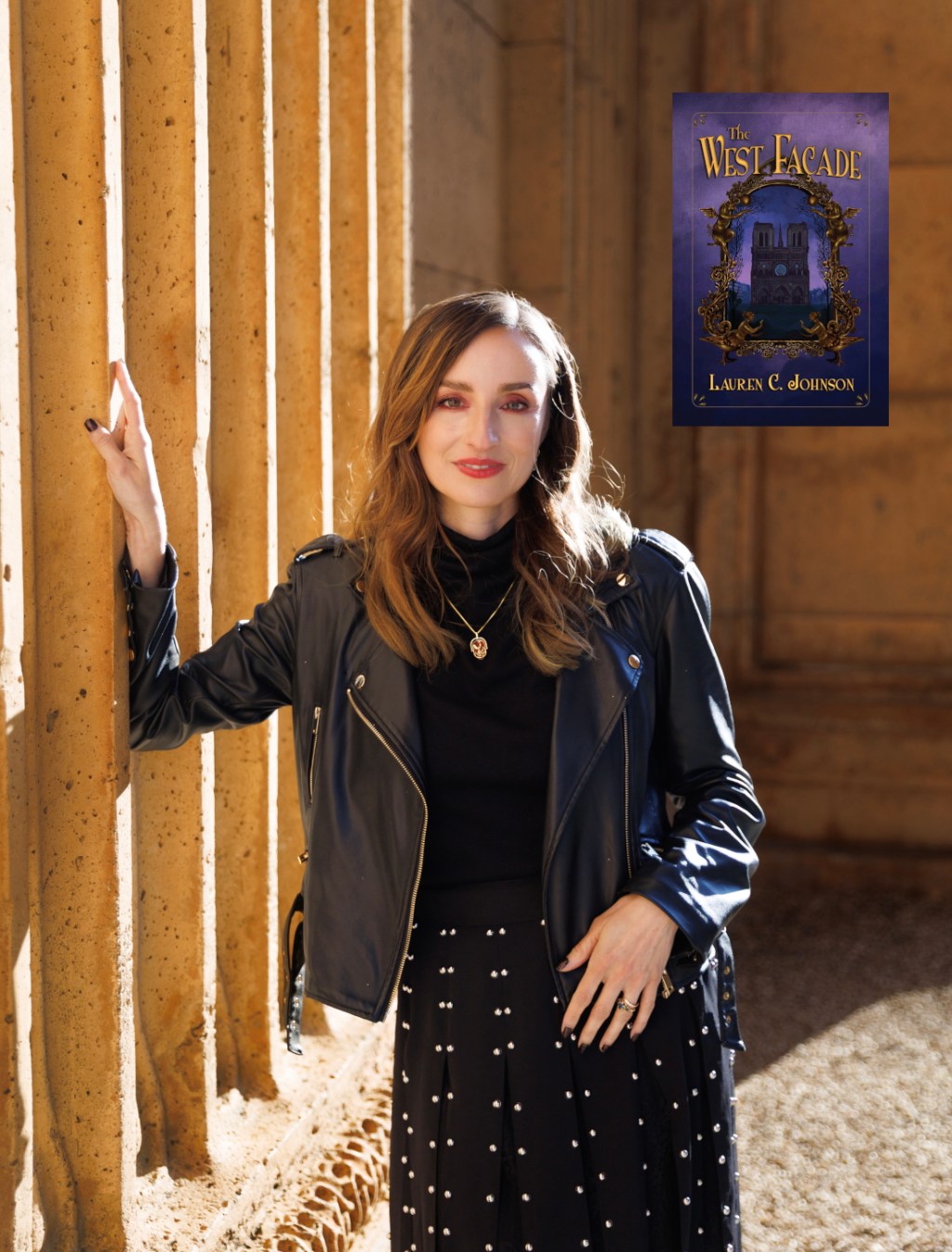
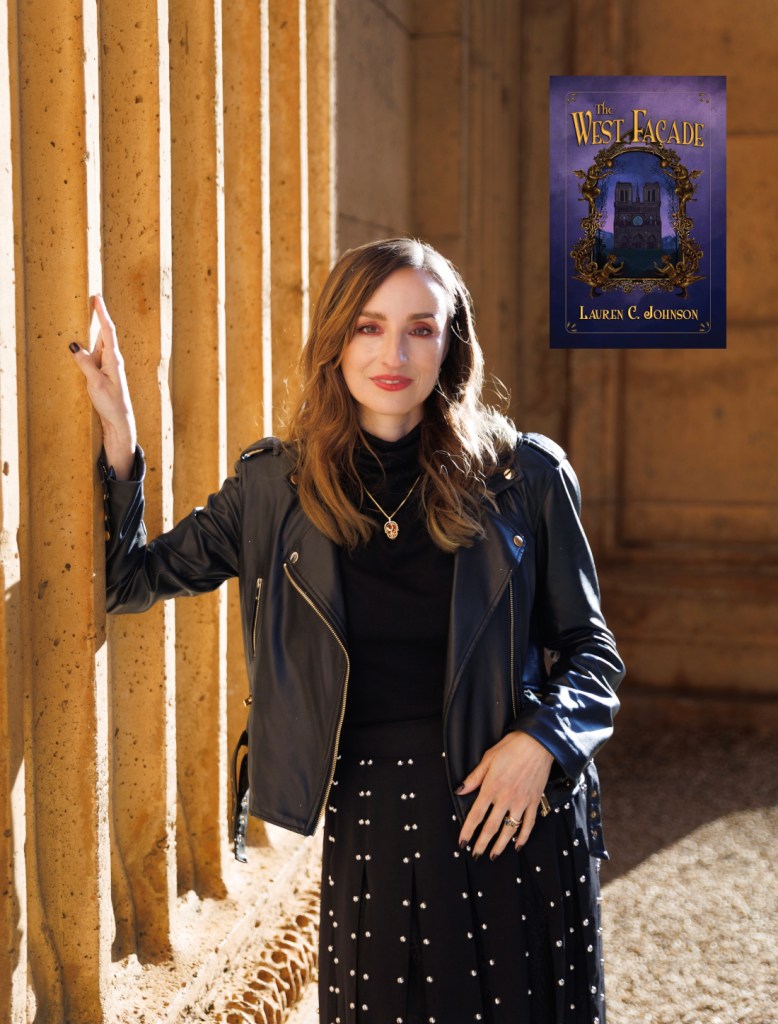
Lauren C. Johnson’s rescue dove Schooner is perched on her knuckles, eyeing me through the Zoom interview screen. “He’s bonded into a really hands-on bird. See? I can just scratch his little neck now, and I never used to be able to do that.” Johnson continues, “I think he sees us as part of his flock, and he’s just happier when we’re around.”
Touch, sense, and loving, curious attention to the non-human all play major roles in Johnson’s yearning historical fantasy novel, The West Facade (Santa Fe Writers Project). This debut operates with the magic of a fairy tale: once a month, in the darkness of each new moon, the statuary of the Notre Dame Cathedral comes to life. But what if, after a century of the same wakings among the same neighbors on the same building, the statue of St. Geneviève longs for more?
Under Schooner’s steady, companionable observation, I spoke to Johnson about the consciousness of limestone, the inevitability of decay, and the messiness of longing.
Kathleen J. Woods: The first half of The West Facade takes place in and on the Notre Dame—especially tucked in alcoves and scaling balconies of the exterior—while the other half enters the streets and hotels turned hospitals of 14th century Paris. You’ve described yourself as a place-based writer, saying “when a story idea comes to me, the setting emerges first, and the characters and plot grow from it.” What was your approach to writing these small and sweeping settings, and how do they inform your characters and plot?
Lauren C. Johnson: When this story first came to me, I was enamored with the idea of the statues on the iconic Notre Dame cathedral expressing their rich inner lives. At the time, I thought I was writing a short story, considered Paris as a city secondary, and worried that this fantastical work would be “invalid’ in the more serious literary landscape. How could I write about the Notre Dame in anything less than huge Game of Thrones style?
Luckily, my MFA thesis advisor at American University, Stephanie Grant, encouraged me to think about what called “the divine details,” including the potential symbolism of specific objects and what they can and do say about character. And when I visited Paris intent on learning as much as possible, Grant encouraged me to shift my focus from huge spans of French history to details as small as a particular candle in the cathedral.
This was a critical lesson for me as an author. When I gave myself permission to be small, I also felt empowered to let my story take place at the Notre Dame and think past its iconic status to stop and luxuriate in the small details of its architecture. This meant I could also give myself permission to linger on the experiences of my narrator, St. Geneviève, and allow her journey toward transformation to start out small.
The book doesn’t open with her leaving the cathedral. It’s small steps first, climbing up the walls, seeing Paris from new perspectives. All huge gothic cathedrals have something scary and imposing about them, and as Geneviève climbs up and down the Notre Dame’s shadowy nooks and ledges, I got to explore and play with the cathedral as this mysterious, imposing structure. I took great pleasure in immersing in the intensity of the architecture. Take the threatening expressions on the gargoyles—what would it be like for that to be your whole world? Religion aside, the Notre Dame is widely beloved, a global touchstone, and I enjoyed taking such an iconic monument and trying to subvert it.
When I was writing a short story, I limited my scope to the cathedral’s rooftops and west facade. Then, as the characters grew and the work expanded, the budding novel circled more of the entire cathedral, and I continued learning more about the Notre Dame and French history and gothic architecture. When I learned that workers journeyed from Germany, Italy, Egypt, Ethiopia, and more to build the cathedral, I became interested in the economies of the middle ages. Medieval cities were much more cosmopolitan and advanced than many assume, and my take on the sweeping Paris setting grew from that new understanding.
KJW: The West Facade features a healthy dose of organic grossness. Geneviève, while still an enchanted statue, sneakily eats an orange offering, and you describe the smell of it rotting in her stone body. Your medieval Paris smells of “violets and lilies, warm bread and roasted meat … mead decayed into the peculiar, sweet stench of putrid fruit, bile, and shit.” Why was it important to include decay and nastiness in this novel about a statue coming to life?
LCJ: If you’re trying to write about life and you’re trying to write about beauty, it’s also accurate to capture that decay is absolutely a part of the cycle. Writing rot felt honest—and also, I really enjoy it.
I also enjoy reading books that explore what’s disgusting. For example, and I can’t say this influenced The West Facade because I read it after writing, take Lapvona by Ottessa Moshfegh. That book is disgusting, and I loved it. Its horrific descriptions are playful with both language and the darkness of decay.
Every day, we’re vulnerable to illnesses, as we saw during COVID-19. Nothing about our health or physical being is assured or can be taken for granted. We’re falling apart as we’re alive every day.
KJW: Speaking of illness, readers meet Geneviève as she observes the devastation of the Bubonic Plague. She receives prayers and offerings from a drunk, crying teenage girl desperate to protect the health of her family. She watches carts of bodies rolled through the streets. She wonders “How [do humans] wake each day with the knowledge that their time with their bodies was so limited?” You had many centuries and decades to choose from while writing your Notre Dame novel. Why choose this plague period?
LCJ: When I still thought of the novel as a short story, I tried to set it right around the beginning of the Renaissance, letting my statues reflect on that period’s new modern and worldly ideas. What would religious iconography think as it watched people becoming less dependent on religion? Of course, people today are still reliant on religious iconography. And as I was writing into these questions and this era, I ultimately realized the story was too slow, and that there were not enough external stakes putting pressure on the characters to make decisions.
As I learned more about the history of Paris, I started thinking logistically. I knew the statues would have the power to come to life on the night of the new moon, when Paris would be dark, and the statues could conceivably move about unseen one night a month. Eliminating as much lighting as possible also meant eliminating the contemporary period.
Notre Dame took one hundred years to build fully, so it really only made sense to have the novel take place in the 1300s, when it was basically complete.
Then I learned the Bubonic Plague came to Paris toward the end of the 1340s. If one of my themes is decay as part of life—the awareness of our temporary mortal condition—I knew I had to lean into the devastation of the plague.
KJW: When enchanted-statue-but-not-yet-mortal-human Geneviève first climbs the cathedral and sees the Seine, she narrates, “It was overwhelming in its enormity, wide and writhing, as every bit alive as me. I felt alive. I was living things that had died and turned into fine grained stone. I was the next life. Calcaire.”
How did you approach the concept of “alive-ness,” including questions of materiality, memory, and consciousness?
LCJ: First, as an author, I reflected on the act of making. How much of ourselves do we put into what we make? And then, how much do we make something alive with our intentions? Both to create something that feels alive, that reflects the experience of living, and to achieve a sort of immortality in art?
My thinking here was influenced by my professor and reader, Despina Kakoudaki, who teaches how sentient robots in pop culture represent human projections of alive-ness and desires to defeat mortality. Right now, parts of the tech world are obsessed with longevity, and so many private health clinics and services and tech bros are wondering and promising how we can live forever, measuring every single blood cell. But I wonder, if we try all these interventions to stay perfectly safe and keep our bodies perfectly intact, are we fully going to live? And if someday we are able to upload our consciousnesses into machines and “see” through eyes of a robot but not feel anything tactile, be unable to interact with the world on a physical sensory level, is that really a way to be alive?
I personally don’t believe in an afterlife. I often think about how we all spend our lives collecting belongings and and achievements and community, and then it’s just over. And that sucks. In the absence of a religion or a spirituality, much of the process of writing this book was also a process of coming to peace with mortality.
I find great comfort in the fact that organic processes are cyclical. The statues on the Notre Dame are made of limestone—fossilized remains of once organic living things. If there is a spirituality I would connect with it, it’s in knowing that matter is recomposed and turned into something else. I imagine these marine creatures that lived and died and, over the span of millions and millions of years, were compressed into something else, another material that was again reshaped into another life, in the form of a statue. But nothing lasts forever, so that statue too will eventually erode and the material will become something else. I wanted to play with that biological reincarnation.
I also find studies into deep time fascinating and reassuring. Whatever goes on in our individual lifespans—our losses, our griefs—I can remember the billions of years it took for us to even get here. I read the non-fiction book Underland by Robert MacFarlane at the outset of the COVID-19 pandemic. At that uncertain time when we were afraid to touch anything or lean on our neighbors, it was deeply reassuring to read the scale of human existence as revealed through MacFarlane’s journey underground, through layers of ancient art, cities, and burial sites. We’ve been doing this for so long!
In one section of Underland, MacFarlane writes about the construction and uses of Paris’s catacombs throughout history, including the mining of Parisian limestone. There ware layers of architecture, of history, of art beneath the whole city and all ancient cities. What has existed long before exists still, and in exploring the layers of Notre Dame, I aimed to also explore what its stone remembers.
KJW: Geneviève is very curious about her sculptor or “maker.” What is the significance of makers and “being made”?
LCJ: The statues on the Notre Dame are objects made in service of the Catholic Church, largely to represent figures and stories from the bible. However, an institution didn’t carve them. I am interested in the thoughts and feelings of the individuals that did.
I wanted to play with the idea that statue Geneviève is not just an object but an expression of the person who carved her. For example, how did that individual interpret the story of St. Genevieve? Who or what inspired their shaping of her facial features? How did the maker’s conceptions about Genevieve influence their act of carving? Made sentient, can the statue make her own claim to who she is?
The poet David Keplinger taught me how to look at ancient art as an imprint of the past. An impression of a person long dead remains in art that has endured. And so, Geneviève will wonder and discover how she is an imprint of the person who made her too.
KJW: As mentioned above, this is a richly sensory book, and we follow Genevieve’s point of view through both statue and mortal versions of her body. How did you approach imagining or writing sensing through stone vs. skin?
LCJ: I owe 100% of the novel’s stone sense to Lidia Yuknavitch’s Body of the Book workshop, offered through Corporeal Writing. Reading early drafts of The West Facade, Yuknavitch asked, “What are the poetics of stone?” She encouraged me to understand that, if we’re going to be limestone as a narrator, we need to really inhabit limestone as a writer, then reader. What language would limestone use? What is my sense of being in a body that is not human?
Seeing this opportunity has opened up so much for me as a writer and influences how I read stories told from the perspective of non-human characters, which I love. For The Rumpus, I recently interviewed Thomas Morton about his novel Wolf, Moon, Dog, which is about the first dog who became domesticated by humans. So much of it is told in the dog’s perspective, and those sections really get into the “dog-ness” of the character.
I don’t think our human consciousnesses are superior. People want to step outside their own experiences, so why not imagine how a non-human character sees the world?And to do that successfully, you have to lean into language and imagine, based on that body, what is would be like to see the world.
KJW: Asked “Are you male or female?” the gargoyle Corvus responds, “You use mortal language! … Do you talk about sin and atonement too? … I suppose you can’t help it–absorbing this language. I understand you because I can’t help it either. After all, we are human creations. I call myself ‘he.’ But when we accept their language, you and I should remember we are made of things that are so much older than that.” As a human who has also absorbed human language, I wonder what interests you about its possibilities and limitations, both for your characters and for yourself as a writer?
LCJ: My primary art form is working with words and language, and I’m very aware of those limitations, the lack of words to capture some particular ideas and feelings. Adding to those limitations, how do culture, social structure, and ideas of right and wrong narrow the language we use to tell stories about something like gender? Who gets to repeat the stories that start to seem absolute or inevitable?
So if you have a character who is made of limestone—which is older than humanity and older than words—you open up an awareness that those stories you take to be absolute is actually based on this small little fragment of human history. The world is so much more expansive than these stories handed down that might not serve us.
KJW: What about the role of shame and guilt (“sin and atonement”) in the novel?
LCJ: After reading the novel, some people have presumed I was brought up Catholic, which I wasn’t. But most of my extended family are Southern Baptist, and there’s a lot of overlap there around shame for your body and desires. Religion aside, just to exist as a person or femme in the world, there are so many ways society will tell you you can just fuck it up.
Geneviève is a statue in the figure of a woman—not just a woman, but a saint. People are going to project every hope and dream on her, begging her to help them and solve their problems. And what the statue feels like, “I can’t. I’m going to fall short.” And that sense of falling short can be a great source of shame. I think that’s something we’ve all experienced in daily life. What do people want and need from me, but what are my limitations? How do I hold that?
KJW: Geneviève narrates, “I hated how I always wanted something and how quickly the thing I wanted at a given moment always seemed to change. Why wasn’t I content…?” What can a statue—made of stone made from dust made from bones—reveal about the nature of longing? And, “[Is] it perverse to want?”
LCJ: No it’s not perverse to want at all. I don’t think so. Bu then again, I guess it depends on some context. But for the average person we’re human. Wanting is part of the human condition
A very smart friend and beta reader of mine told me that she sometimes wants to shake Geneviève because she changes her mind so often. But I decided I like that about Geneviève. I wanted to show a woman character is who changing her mind often, because we get to change our minds often. We get to have our wants change—including wanting different people—and I don’t think there should be shame about this. Who is this perfect consistent person?
Regarding the nature of longing, that’s the book! We are going to long for things. If we were able to achieve immortality and our lives were as slow as stone, would longing and desire even be fun anymore, without that sense of urgency? Would life be fun?
Luckily, we can enjoy our longings while anticipating our decay.
Kathleen J. Woods is the author of the novel White Wedding, published by University of Alabama Press and FC2. She earned an MFA in Creative Writing from the University of Colorado at Boulder, where she served as Managing Editor for TIMBER Journal. Her work has been featured in Electric Literature, Literary Hub, Pacifica Literary Review, Humanities Review, The Racket, and others.
Check out HFR’s book catalog, publicity list, submission manager, and buy merch from our Spring store. Follow us on Instagram, Bluesky, and YouTube. Disclosure: HFR is an affiliate of Bookshop.org and we will earn a commission if you click through and make a purchase. Sales from Bookshop.org help support independent bookstores and small presses.

