
Science fiction and Mormonism were born together. Scholar Gillen D’arcy Wood explains how the same volcanic eruption that sent Mary Shelley indoors to write Frankenstein, thus inventing science fiction, also displaced Joseph Smith from Vermont to New York where he received his First Vision, thus inaugurating a new religion.
Like the Mormon pioneers who fled religious persecution to the Salt Lake Valley, Frankenstein’s monster is a refugee, a wanderer, an explorer of realms. Ryan Habermeyer’s novel Necronauts has another name for such a rover: Wiedergänger:
[German immigrants to Utah] said it in the old world but didn’t understand it until they converted to Mormonism…Traveler. Ghost. Pioneer. Zombie. One who walks again and again … A necronaut, slipping between this world and the next …
Necronauts’ raison d’être is death. The prologue, written by “Ryan Habermeyer, editor,” establishes the novel’s fictional backstory: Ryan’s estranged father, Mark, has just died in the small Mormon town of Calypsee, Utah, a bleak desert settlement full of “immigrants running away from famine and poverty ” where “nobodies” can become “pioneers and saints.” Mark was a writer for the Calypsee newspaper who converted to Mormonism in his twenties, an act that failed to endear Mark to his fellow townspeople—Ryan explains that being a “true-believing Mormon of pioneer stock” is “something you’re born with, something in the blood.” Mark’s conversion to Mormonism also caused Mark’s father to disown him. Ryan speculates, “It was alienation, not an aneurysm, that killed him in the end.”
After Mark’s funeral, Ryan is packing up his father’s house when he discovers in the bathroom a pile of obituaries written by his father, along with assorted photographs, all from around 1985, the year Mark disappeared from his son’s life. Of the thousand-plus obituaries, Ryan has “curated” ninety-five of them, “lightly revising a few details.” The result is Necronauts: a final collaboration between father and son, an act of grief, rage, and perhaps, ultimately, acceptance.
After the novel’s prologue, the fictional Ryan Habermeyer character vanishes from the text, but his curatorial presence remains. Few if any Calypsee residents in the selected obituaries die of old age or natural causes, and I’m not remembering any who die peacefully, either—people are bludgeoned to death, electrocuted, mauled by bears, fried in tanning beds, poisoned by black mold, hit by ambulances, hit by trucks. There are many suicides, a couple heart attacks. Most die in pain, alone, echoing Mark’s solitary death by aneurysm.
As the obituaries unfold into marvelous, self-contained fables (with miracles and executions alike), the novel’s central storyline, the emotional core, blooms. A relationship emerges between a lonely dentist and the novel’s protagonist, an orphaned “cosmonaut boy” without a home who never takes the heavy space helmet from his head for fear of turning invisible. The cosmonaut boy has “watched so many old sci-fi movies he [believes] he’s an alien.” He retreats to womblike spaces—refrigerators, iron lungs, abandoned hangers, dumpsters. He builds a trebuchet to launch himself to “Planet X,” where he thinks he belongs. The Calypsee townspeople—who side-eye the cosmonaut boy, abuse him, or try to baptize him—call him “Nobody.”
Winks to Pinocchio abound. The cosmonaut boy has scales on his skin “like tree bark, like he was some weird Pinocchio.” There’s a Fairy with Turquoise Hair analogue—Calypsee’s psychic’s daughter, a kindly woman who offers the cosmonaut boy love and pills. The novel’s first obituary is for “the woodcutter,” perhaps signaling upfront Necronauts will be a Pinocchio without a proper Geppetto to welcome home its misguided boy after a bad trip.
The dentist looks out for the boy, but the dentist has some issues. Though the dentist shows flashes of Geppetto, he’s more Candlewick, the friend who lures Pinocchio to the Land of Toys, where boys indulge their ids until they turn to animals—the dentist and the cosmonaut boy spend most of their time plying their bodies with drugs.
The dentist never breaks his addiction. Right after he asks the cosmonaut boy if he wants to get clean, he doubles back and says they should do just one more bump. Then, at last, he will be a true father figure: he will finally show the cosmonaut boy “how to throw a ball, how to swing a bat, how to grab his dick and spit.” Another time, the dentist declares, “Let’s go to church,” and they even get dressed up, but instead sneak into the dentist’s old middle school, where they find a suicide holding a note that says, Grief is a drug. “We’ll tell someone,” the dentist says, but they don’t tell anyone. They stand together in silence. They watch the snow fall. It’s more of a hopeless moment than a touching one.
But the dentist refuses to abandon the boy the way his own father did, and the drugs the dentist gives the boy feel like an attempt to ease pain in any way possible. There seems to be no real social safety net. These are the Reagan years. The dentist confesses to the cosmonaut boy the anger he holds toward his own deceased father, whom he says was a “nobody and wanted his son to be just like him.” And in lucid moments, the dentist cares for other suffering Calypsee residents, providing teeth cleanings to the poor, bringing bread to the lonely.
It’s never clear whether the cosmonaut boy can hear anyone through his helmet, and the dentist does not seem to be able to understand the cosmonaut boy’s invented sign language. Their conversations are more like concurrent soliloquies—the dentist warns the cosmonaut boy not to fall for the Mormons’ tireless love-bombing while the cosmonaut boy philosophizes about the best closer in baseball. Later in the novel, the dentist realizes he doesn’t even know the boy’s name.
Necronauts dredges up the Frankenstein latent in Pinocchio. After all, Pinocchio is, like Frankenstein’s creature (and like Adam of the Bible), a wiedergänger—lifeless matter somehow given breath, yearning to love, exiled to wilderness. Necronauts crawls with lurid creations, parts sewed into awkward wholes—an unmarried grandmother in all-black clothes with “zippers on her forehead” who hands out radioactive toys to children; a Christian sex shop that boasts the slogan: “Have a Second Coming at the Kinkalypse”; and the cosmonaut boy himself, both everyone’s child and nobody’s child, the ultimate latchkey kid of the 1980s. At one point, the narrator (Mark Habermeyer? Ryan Habermeyer? Is there a difference?) muses, “The American West is a Frankenstein and Calypsee is just one limb hanging by a thread.” Necronauts itself is a Frankenstein’s monster: a text stitched together of texts nested inside of texts alluding to texts, endlessly self-referential, endlessly interpretable and uninterpretable.
Ultimately, the tender, difficult relationship between the cosmonaut boy and the dentist is a salve for the pain radiating through Calypsee. The relief isn’t pure, but at least the pair spend most of the book in each other’s company. That’s more than you can say for Geppetto and Pinocchio, or Victor Frankenstein and his estranged son.
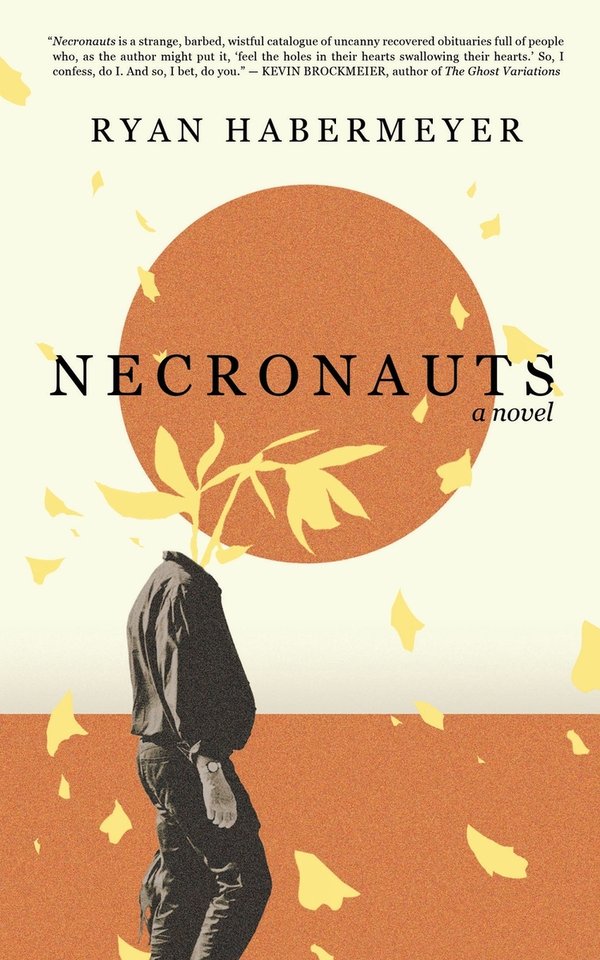
Necronauts, by Ryan Habermeyer. Fairfax, Virginia: Stillhouse Press, 2026. 322 pages. $20.00, paper.
Joe Aguilar is a co-editor for hex. He lives in Worcester, Massachusetts.
Check out HFR’s book catalog, publicity list, submission manager, and buy merch from our Spring store. Follow us on Instagram, Bluesky, and YouTube. Disclosure: HFR is an affiliate of Bookshop.org and we will earn a commission if you click through and make a purchase. Sales from Bookshop.org help support independent bookstores and small presses.

