
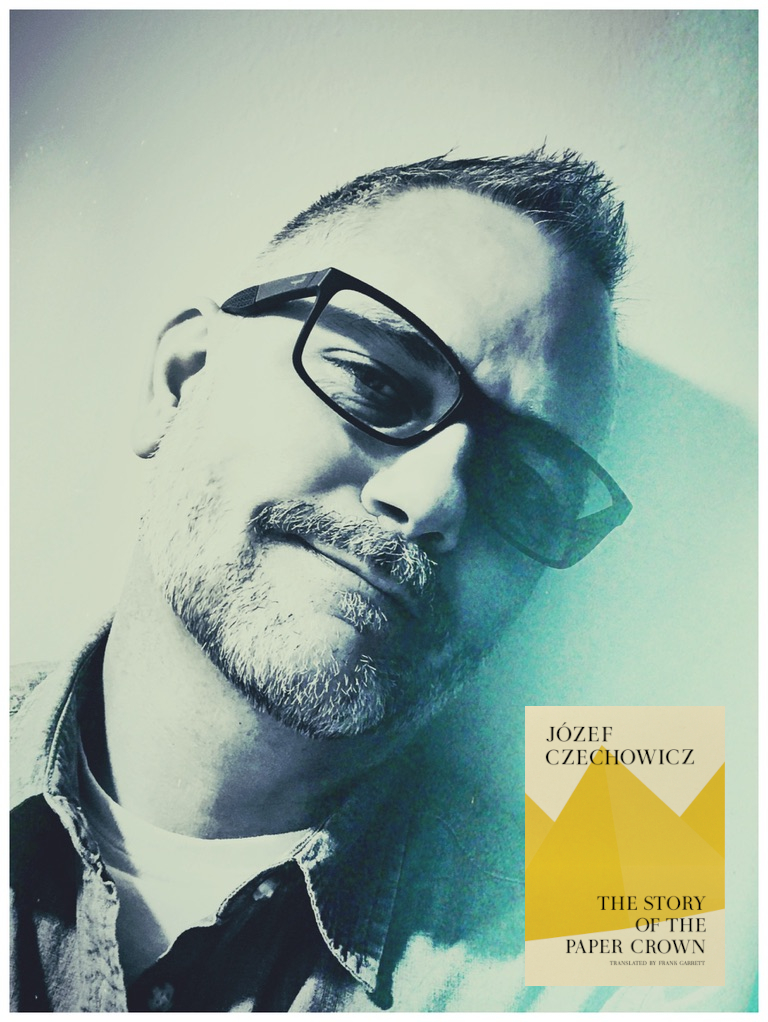
Frank Garrett is an independent scholar, writer, and literary translator based in Dallas, Texas. We spoke over Zoom about his projects in translation, philosophy, and specifically his ongoing work around queer Polish poet Józef Czechowicz (1903 – 1939), whose novel The Story of the Paper Crown he translated for Sublunary Editions in 2023. He is currently translating Czechowicz’s poetry into English. After our Zoom conversation, we conducted the interview via email.
Matthew Kinlin: Jacques Derrida once wrote, “A text is not a text unless it hides from the first comer, from the first glance, the law of its composition and the rules of its game.” Do you approach translation as a puzzle and how does language hide?
Frank Garrett: A puzzle, yes. But not only translation. Maybe all of language. And not a puzzle that has a solution. More in line with the secondary definition: an enigma. Only certain facets of language can be deciphered, solved. Never the whole of it. And never the whole of even the smallest of texts.
Almost daily I think about Václav Havel’s poem, whose title is usually translated “Estrangement,” the problems and dangers in its meanings and possible translations. It’s a visible poem: two letters (J and A) separated by dots that you can follow along any number of paths in order to conceptually join them to form JA. It just so happens that já is the first-person singular pronoun in Czech, so: I. But how can you translate this into English. I’d ask my students, and the standard response was “me.” Or rather: M and E.
But what if Havel wrote this around the time of the Prague Spring? (Which he did.) What if the agency of a subject is important or even the most important aspect here? After all, Havel did not write “mě,” Czech for “me.” But “I” only has one letter. How to separate and disarticulate this I from itself? Furthermore, there is no indication that we must start with the J. What if the tentative solution is AJ? In Czech, aj as an interjection could express wonder or surprise. Or it could be a synonym for also. And if we keep going: aj. is an abbreviation for a jiné, or and others.
It’s no longer a solitary I estranged from itself but maybe the wonder of also finding oneself among all others. And no, Havel’s intentions, if they existed at all, do not matter here, because Havel could never be the conclusive source of this poem any more than he could have the final say on any language occurrence. Nor am I delusional enough to believe that I and only I—as interpreter, as translator—have found the one right solution. I’m comfortable enough knowing that indeterminacy, what we might call irresolution, might be our only befitting fate as beings of language. Hiding right there on the surface of the poem is the very concrete, literal effacement of surface meaning, but that surface meaning is the only thing that is there.
Or there’s something else I think about almost as often: a scene from Wim Wender’s Until the End of the World when Claire is given a truth serum by a detective. She is compelled to speak the truth, but she switches to her native French, which the detective does not speak, in order not to betray her lover. And so, truth is being spoken but only so as not to be understood or deciphered. It is hidden away, even if its concealment is very much in the form of a standard, comprehensible language. In these ways, language, in refusing transparency, only ever shows itself as the possibility, and not the guarantee, of communication and of truth.
So, Heraclitus probably should have written that it’s also language, not merely nature, that loves to hide, that loves to hide even its own hiding, its own concealment, even from itself, from the first comer’s first glance to the parting glance of the most recent. Then we could have altogether skipped over Martin Heidegger. Or wouldn’t it have been wonderful if some Heraclitean disciple had written the Gospel of John: “In the beginning was the concealment of the Word, so as to render each subsequent disclosure of the Word derivative…” Then maybe we could have altogether skipped over Jacques Derrida, but one would have to be completely deranged to want to do that.
MK: Your lifelong project of translation is rooted in the philosophical and ethical questions of translation, taking from the works of Heidegger, Levinas, Derrida, and Blanchot. Can you speak a little about the impact of their work and the distinction between their philosophical basis for translation and an approach more based in literary theory or thinkers such as Walter Benjamin?
FG: I’m not sure about “lifelong.” I’m relatively new to translation, new to the profession of translation. It’s something I resisted for the longest time, primarily because I find belletrism in literary and translation studies so tediously uninteresting. I came to translation by way of philosophical hermeneutics after years of language studies in a failed attempt to become a diplomat. And inexplicably bridging all of that somehow is Maurice Blanchot, who I first read while doing my master’s research over the Holocaust in Poland. There is a bumpy road in rural southern Poland on which I began reading The Writing of the Disaster in early 1996, already thirty years ago. It wouldn’t be entirely wrong to say that I would have never studied any of those other guys except to better understand that one book.
And to bring Blanchot’s philosophy, his anti-theory of literature, his anti-literary, anti-belletristic non-theory, back to translation, I can only understand my role as a translator along the same lines that Blanchot understands his role as a writer who writes so as to render writing impossible. And let’s be clear: translation’s impossibilities have nothing to do with the nonsense of “untranslatable” words or authors. Every text I’ve ever translated has at some time been called “untranslatable.”
And my reading of the sorely misread Walter Benjamin places him much more firmly in Blanchot’s camp, so I don’t want to give the impression that I’m somehow against Benjamin. The hallmark of bad translation (and I might add of bad reading), as far as Benjamin is concerned, is that it does indeed communicate, but only that which is inessential; that is, the communicable itself. That is distinctly articulated in the opening paragraphs of his “Die Aufgabe des Übersetzers,” which isn’t even the most useful, if we are to, god forbid, hypothetically commit to the criterion of usefulness, of his writings on translation.
So more bluntly: I am against people ill-equipped to read and understand Benjamin reading him and coming up with garbage theories that simply rehash belletrist claims about literature and translation. It’s bad enough when historians read Benjamin! As a general rule, translators should stick to George Steiner and John Felstiner. I spent years biting my tongue in a PhD program that was adamantly hostile toward anything more rigorous than the aesthetics of a text, so we should, while on this topic, expect a few dramatic eruptions from me from time to time.
But again: I don’t want to give the impression that this is some kind of disciplinary turf war. It’s not. And besides, I’m very much an interdisciplinarian. It’s a categorical error on their part.
MK: Lublin, a city based in the south-east of Poland, feels like a spiritual epicenter for your work, specifically your relationship with its local hero, queer poet Józef Czechowicz. For a largely homophobic country, Lublin has plaques of Czechowicz around its streets. Can you describe your relationship with Lublin and encountering this confrontational gay artist?
FG: Lublin is one of the very few places I consider home, even more so than the rural community in Texas where I grew up. It was there that I was first on my own as an adult, and I was doing important work and research. I was back there recently after an absence of 23 years, and, despite so much change, it felt exactly the same and provided the perfect respite and refuge I needed. But I don’t romanticize it: Lublin still has its problems, which include rampant racism and xenophobia, as well as a stifling conservatism.
When I was first living there in the mid-1990s, a handful of the guys in the dorm where I lived assumed because of my accent that I was Ukrainian. As an undergraduate, my Russian professors were all Ukrainians, so a certain accent must’ve bled over into my Polish. And perhaps because no American in his right mind would be there. They were openly hostile to me. This past October when I visited, I was walking around Kalinowszczyzna, a former Jewish area of town, and some asshole skinhead drove by screaming profanity at me, assuming, I assume, that I was a Jewish tourist.
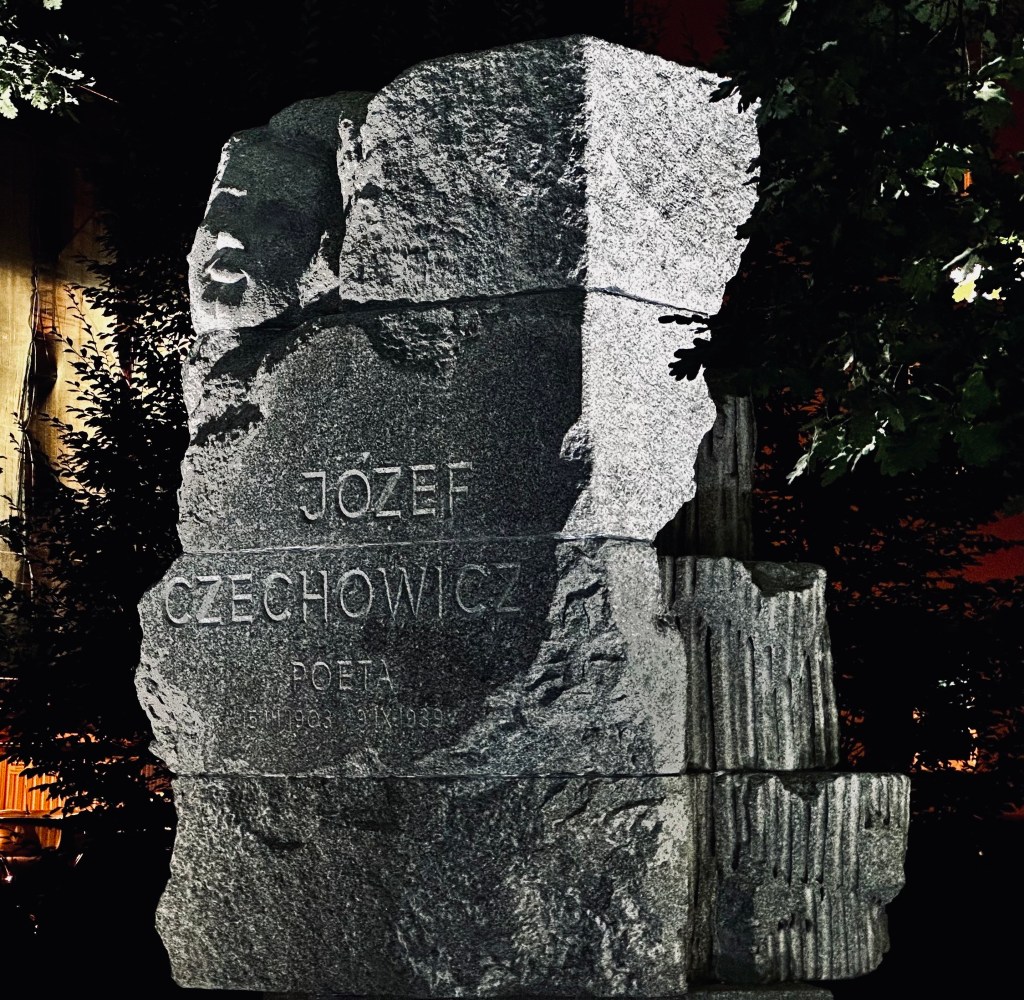
Back then, though, I walked past a huge monument to Józef Czechowicz almost daily for about six months, never suspecting that he would become such an important figure in my life and work, and never suspecting that he would become such a divinely Queer role model. It’s only fitting too that this monument is very near what once was one of the main cruising spots for the entire region.
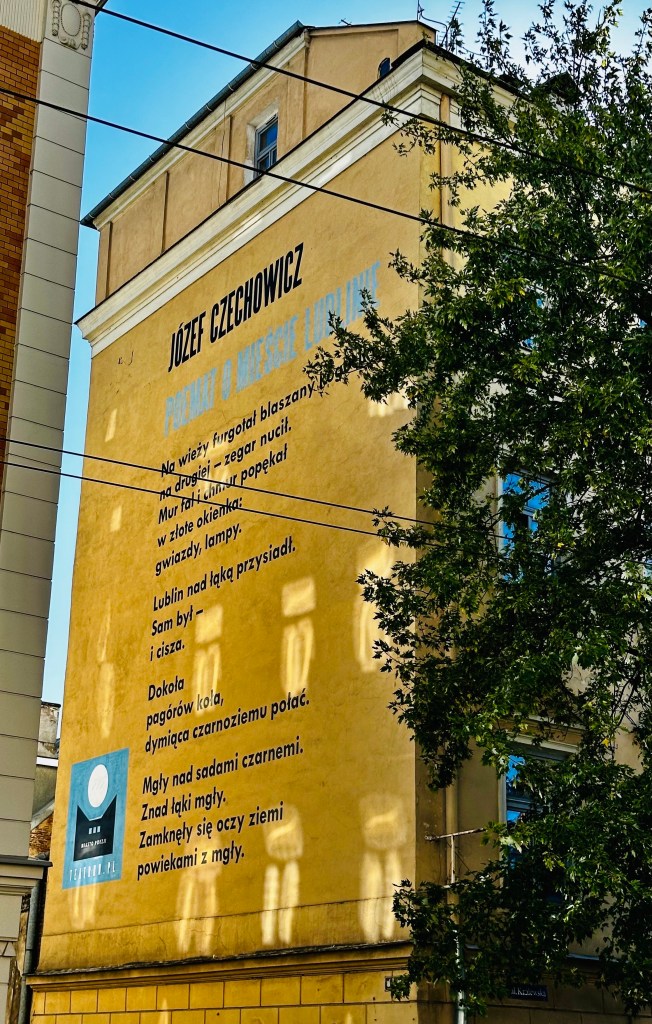
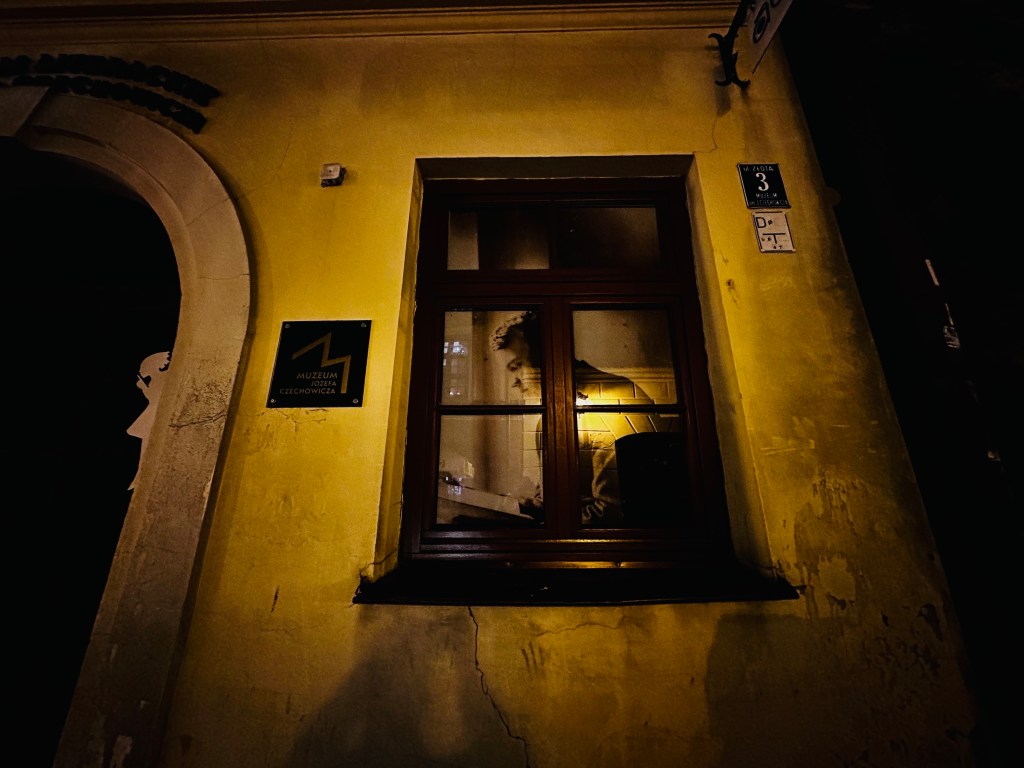
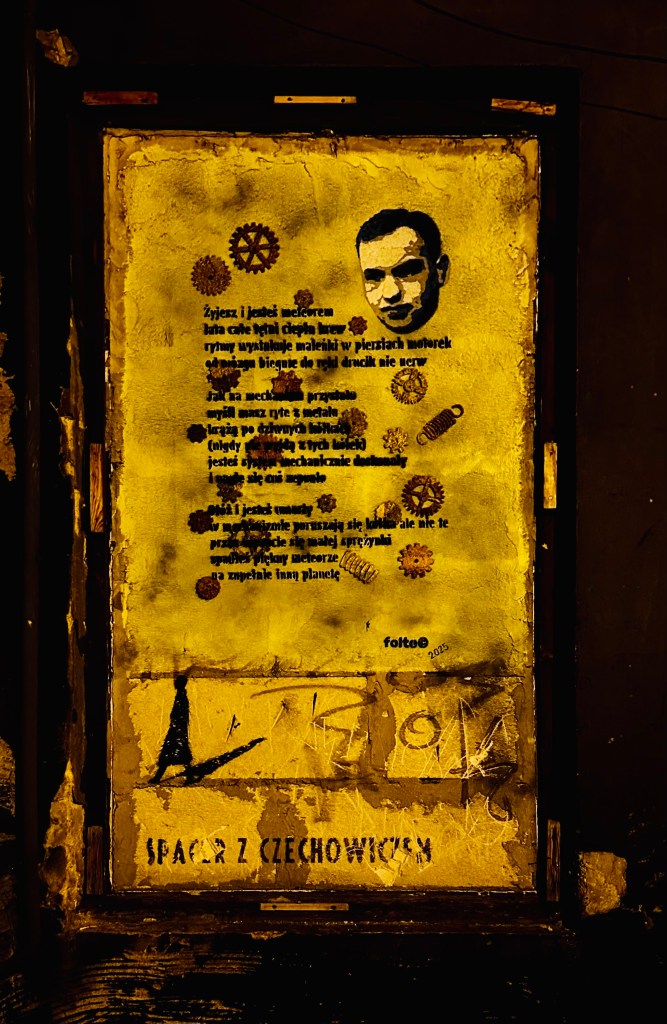
And now there’s even more monuments, plaques, and memorializations to Czechowicz. It’s difficult to walk around downtown or in the Old Town without coming across a mural with either his portrait or the words from his poetry. In 2029 Lublin will be the European Capital of Culture, so I hope that even more people will discover this gem of the provinces and likewise discover my Czechowicz translations.
MK: You translated Czechowicz’s novella The Story of the Paper Crown, which follows a young man facing his homosexuality. He slips in and out of feverish dreams where “Henryk is the king. He’s just now stood in Wawel Cathedral on the day of his coronation. His eyes are lowered. At his feet, so many carpets upon which the feet of bishops and princes in elegant, tight-fitting shoes stand.” How did you feel when you first read this hallucinatory prose?
FG: Since I knew him primarily as a poet, I had started translating Czechowicz’s poetry first, chronologically. But every time I would do the slightest bit of research, everything would point toward this strange, Queer story. After a handful of poems, I finally took a look at it. I instantly recognized the register, that quasi-formal archaic Polish from a hundred years ago. Not unlike the Polish of Bruno Schulz. (The two writers were familiar with each other’s work and had corresponded.) I also noticed the use of dialect, specifically that of Podhale, where I had spent several days, maybe altogether about two weeks, during previous trips to Poland. And I convinced myself that if I were going to chronologically tackle Czechowicz, then I might as well start from the very beginning by turning my attention toward this story with its baroque syntax, religious imagery, and mythological allusions. The protagonist Henryk hallucinates this story, but it was very much an hallucination grounded in Czechowicz’s world (the threat of war, etc) and in his mind (the burden of guilt, etc). And even though it is clearly a work of fiction, my work on it was very much akin to biographical and psychological excavation. Not only what Henryk’s motivation was, but what was Czechowicz’s motivation for writing this? Compared to the story, his poetry now, by no means reserved or restrained, comes across as downright monastic.
MK: As you discuss in the translator notes, Czechowicz is doing a lot with language in the novella. He’s writing in a southern dialect but also remaking: twisting standard Polish, mashing phrases and words together, sometimes inventing entirely new words. Can you describe the process of deciphering this bizarre act of linguistic collage and its possible motivations at that time in history?
FG: It doesn’t take too much in-depth research into Polish history to come to the conclusion that the Polish language is itself an art form and tool of resistance. Czechowicz wrote The Story of the Paper Crown in 1923, only five years after the establishment of the Second Polish Republic. Before then, since 1795, there was no independent Polish state, so the language itself became the means by which Polish identity, culture, and heritage were preserved. It seems that certain dialects of Polish were all the more charged by this task: a minority dialect of a language under occupation. Once it becomes a national language again, it collides headlong with modernism, with technological alienation, psychological expressionism, etc. In Poland you have all of the same conditions and characteristics of other European modernisms coupled with a completely new national identity that somehow accelerates and heightens the linguistic experimentation. I’m not sure I’d understand what all is going on in poetry and culture as well as I do without a background in philosophy, in the kind of philosophy of language or philosophy of poetry I got from the likes of Blanchot, Heidegger, and Derrida. I mean, Bruno Schulz was deconstructing the text while Derrida was still in diapers.
MK: As an act of collage, Czechowicz is doing something similar on a thematic level: blending gay sex with ecclesiastical language, and religious doctrine with Slavic and pagan imagery, all alongside references to Jewish mysticism and Buddhism. At one point, Henryk describes “Instead of the sun a Kabbalistic sign shines in the sky.” What is this magic(k)al land that our delusional Cervantes-esque king floats through and how do you understand Czechowicz’s iconoclastic, at times blasphemous, juggling performance where all worlds co-exist?
FG: The short answer is: I think it’s quite literally the same Poland, or pre-Poland landscape, he grew up in. People forget, or never learn, that Poland was for much of its history a multiethnic state: Jews, Ukrainians, Ruthenians, Lemkos, Slovaks, Hungarians, Austrians, the Romani, Turks, Lithuanians, Belarusians, etc. all lived together, influencing each other. From the 16th century until WWII, Lublin, with its many yeshivas, was one of the main centers of Jewish life. In 1933, Poland had the largest population of European Jews, slightly less than the Jewish populations of the Soviet Union and Germany combined. I wouldn’t trust someone in 1930s Poland who didn’t have some firsthand knowledge of Jewish life. And even despite the pervasive, and oppressive, dominance of the Catholic church, every schoolkid knows the local folk/pagan beliefs and practices, which continue to this day. This “magic(k)al land” we find in Czechowicz is very much still a quite ordinary place for a lot of people. Even when we factor in the destruction of the Jewish people, the defilement of their cemeteries, etc., that culture still permeates; we hear it in the names of streets, see it in the architectural ruins, and taste it in the flavors of the cafes. We should appreciate the fact that so many writers and artists managed to document that world.
MK: I admired Czechowicz’s frank descriptions of queer fantasy and desire, where “with his mouth he feasts on the pale, parted lips of Diadumenos.” At one point, Henryk muses, “how very strange is this love: meeting, parting ways, crossing paths, anger and bliss—April weather,” which took me to a line from the film Portrait of a Lady on Fire about two women in love, where one whispers to the other, “Do all lovers feel they’re inventing something?” How was it translating these strange passages of queer love as mutable as April weather?
FG: It was quite an experience blushing while translating. The language still is so erotically charged. And just imagining my grandparents reading something similar at the time. I’ve since translated a later poem that’s even sexier. Hornier. The title is “love,” and Czechowicz writes about plowing a firm sofa hard like a field, about eager knees turning into plowshares in order to plow on, and you know exactly what he’s talking about. And then a few pages later he prayerfully converses with Thérèse of Lisieux. It’s always instructional to find out that our generation wasn’t the one to invent sex or desire, to first have to negotiate between the body and the soul.
MK: The novella is filled with startling religious imagery, especially around the figure of Saint Francis whose “pale palms glow—palms on which ruby stigmata ooze blood.” It reminded me of something like Yukio Mishima’s Confessions of a Mask, his erotic fixation on Saint Sebastian. However, unlike Mishima’s repressed protagonist, Henryk seems to work through his guilt. Whilst contemplating the sun, he reasons, “Is it for tracking down our sin? Surely—it shines for love … The world!” Does the book operate as a liberating psychosexual fable?
FG: I’m wary of calling it liberating, at least if we mean by that term some kind of resolution or psychic release. The Story of the Paper Crown doesn’t free Henryk from guilt so much as it refuses to let guilt have the final say. So even though Czechowicz stages desire and shame in the same symbolic field along the axes of royal coronation and ecclesiastical ritual, neither desire nor shame is purged by way of the other. Instead, Czechowicz forces their coexistence. And even more importantly: shows how desire and guilt both impels and impedes along both the royal and the religious axes.
The comparison to Mishima is useful precisely because it helps clarify the difference. In Confessions of a Mask, Saint Sebastian becomes a fixed erotic image, a fetish, onto which desire is projected and immobilized. Czechowicz’s Francis remains unstable, wounded, and porous. The image-symbol bleeds, leaks, and does not crystallize. Henryk’s insight that the sun shines “for love … the world” isn’t an absolution so much as a reorientation: sin is no longer the primary lens through which existence is read. Any freedom he wins merely displaces repression’s, religion’s authority by allowing his desire to be seen, felt, lived.
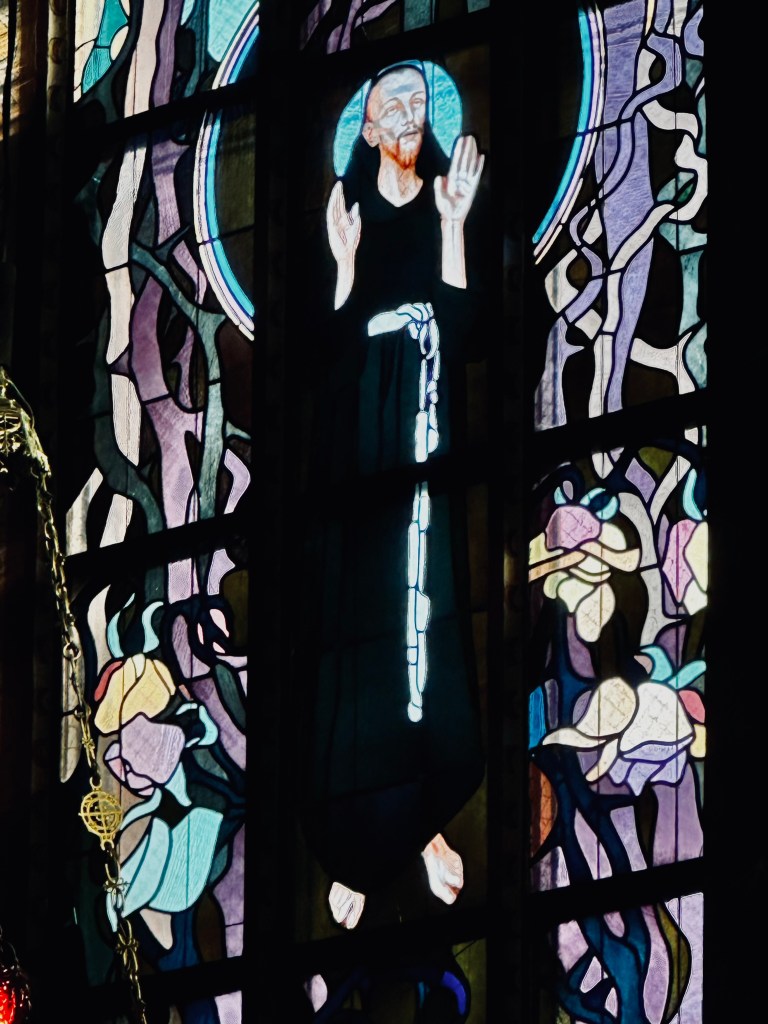
I probably need to think through this more, but Francis’ porosity, too, is ekphrastic: Francis moves in and out of the stained-glass of Krakow’s Basilica of St. Francis of Assisi, designed by Stanisław Wyspiański, whose polychromatic work is sumptuous to say the least. It’s almost as if Czechowicz is articulating the iconography itself as a kind of iconoclasm: the image both is and is not of this world, both is and is not transcendent, yet the image exists and confronts us in the only world to which we have access. It’s the opposite of fetish.
Another quasi-ekphrastic flurry is when Diadumenos enters Henryk’s room to make love. The scene is both sexy and thoroughly drenched in religious imagery: “Thin silk fabric covers his torso. His legs are bare except for a thick purple cashmere belt that girded his hips. On the belt, embroidery: the Three Marys at the Tomb.” I don’t mind confessing that I seriously laughed out loud when I read that. Czechowicz’s formula for writing sex scenes, then, seems to be sexy + sumptuous sexiness + religious imagery. And even better if there’s also an allusion to death.
MK: Czechowicz is writing in this high poetic register, akin to something like Rimbaud, and similarly writing at a young age. He’s also from a working-class home and using everyday street language. How did you attempt to capture some of Czechowicz’s inexperience and keep it grounded in his lived experience?
FG: I adore how Czechowicz overwrites; he writes too much—too ornately, too fervently, too earnestly. That excess is like confection. A high poetic register, with religious overdetermination, and sudden erotic surges all give evidence to Czechowicz trying to think and feel his way into form, into a poetics of language as well as of living. Yet at the same time he’s a working-class provincial, a poor boy from the sticks, steeped in street language, dialect, and lived precarity. Sex and religion both appeared wrapped in opulent embroidery, accompanied by saints and death. There’s something quite literal as well as pedestrian about it all. But it’s also true. True for Czechowicz in a deadly serious way. But sometimes, too, the language is a bit unsteady and clumsy, as if the language itself is learning how to bear this weight. Czechowicz learned to embrace that discomfort, making language’s instabilities one of his strengths. I just follow Czechowicz’s language.
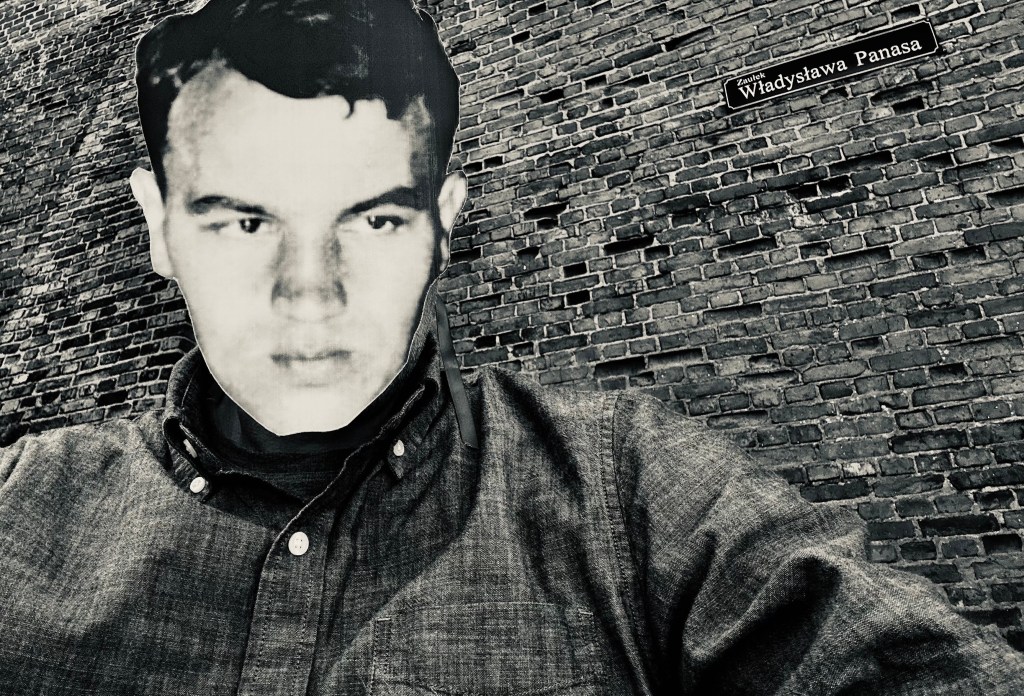
MK: As part of your studies for The Story of the Paper Crown, you visited locations around Lublin mentioned in the story, with a mask of Czechowicz’s face. Can you speak about this fun engagement with the text and its many references?
FG: Since the early 1990s David Wojnarowicz has been one of my favorite artists. His Arthur Rimbaud in New York (1978-79) series of photographs captivates me still: the easily recognized Rimbaud on the seedy streets of 1970s New York, riding the subway, masturbating on the piers. So my walk around Lublin while wearing a mask of Czechowicz is very much an homage to Wojnarowicz, but it was also a research project and a translation project in and of itself.
The Story of the Paper Crown is saturated with specific streets, churches, and atmospheres in and around Lublin (as well as Krakow and other places). I wanted to see what would happen when those references were re-entered not as scholarship but as a kind of misrecognition or performance. Putting on a Czechowicz mask was a way of refusing historical distance without pretending to collapse it. It was a way to think how and to what extent Czechowicz was his environment while also exceeding that environment. And then also there’s me, to some extent very much a product of my time and experience in Lublin, a product of my time spent researching and translating Czechowicz.
I wanted to see how this temporal disruption played out when Czechowicz was allowed to wander a contemporary Lublin that both remembers and forgets him, that commemorates him with plaques while remaining structurally hostile to queerness and to otherness. The mask made the gesture visibly artificial, but it was never really about some sort of authenticity or reenactment. It was about inhabiting reference as performance, about testing how texts continue to look back at us from the spaces that produced them. Walking those paths while wearing a mask of a dead poet’s face quite literally between me and the world underscored what translation itself does: it stages and performs, never seamlessly but always only ever provisionally, a brief but at times illuminating encounter across time.
MK: You recently returned to Lublin to translate the second of Czechowicz’s seven volumes of poetry, following on from first volume Stone. How did you approach these poems that don’t use punctation and other idiosyncrasies?
FG: Czechowicz’s refusal of punctuation isn’t a gimmick; it’s structural. The poems move by breath, accumulation, and tonal drift rather than by syntactic closure, so my first task was to resist the very strong temptation to clarify, to stabilize, to decide where one thought ends and another begins. Doing so would have imposed an authority the original texts avoid.
To some extent, I treated the poems as acoustic scores. Line breaks, enjambment, and spacing had to carry the work that punctuation usually does, allowing meaning to emerge through rhythm, alliteration, imagery, sematic tension and pressure rather than pure grammar. Czechowicz’s language slides between lyric, prayer, quasi-reportage, and hallucination, and punctuation would have prematurely sorted those registers.
At the same time, these poems are grounded in weather, labor, liturgy, war, anxiety, street noise, advertising, technology, and rural speech. So while I preserved the syntactic openness, I kept the diction concrete and physical, resisting elevated or abstract English. The goal was to let the poems remain unsettled but not vague.
MK: Georg Trakl writes, “The ominous anger of masses of men / Is like the wild organ of the winter storm / The purple surge of battle / Leafless stars.” In his poetry, Czechowicz shows a similar talent for color and visual imagery. How did you conjure these violent yet dreamlike scenes into English?
FG: By treating color and image as forces rather than descriptions. Czechowicz, like Trakl, doesn’t paint scenes so much as unleash them: color arrives charged with violence, weather, and historical dread. I tried to avoid prettifying that intensity in English. Instead of searching for lyrical equivalents, I followed the pressure of the image—how quickly it strikes, how abruptly it shifts, how little it explains itself. The dreamlike quality comes from that refusal of narrative coherence. So the task wasn’t to translate pictures, but to preserve the shock, velocity, and chromatic weight with which the images enter, and fling off, the language of the poem.
MK: Czechowicz, killed in bizarrely random circumstances in the first days of World War II, is often known in Poland as a writer of the catastrophic. Can you speak a little about this?
FG: Czechowicz is often grouped with the so-called Polish “catastrophists,” writers who sensed the moral and political collapse gathering over Europe in the 1930s. (Other catastrophists include Bruno Schulz, Jerzy Andrzejewski, Stanisław Ignacy Witkiewicz, and Czesław Miłosz, among many others). Czechowicz’s poems are filled with aerial perspectives, burning cities, and a strange, anticipatory mourning, as if disaster were already underway on the level of atmosphere and color. After the German invasion on September 1, 1939, Czechowicz fled Warsaw and returned to his native Lublin, hoping the smaller provincial city might be safer. On September 9, during a German air raid, he was killed in a barber shop very near the building where he had been born 36 years prior.
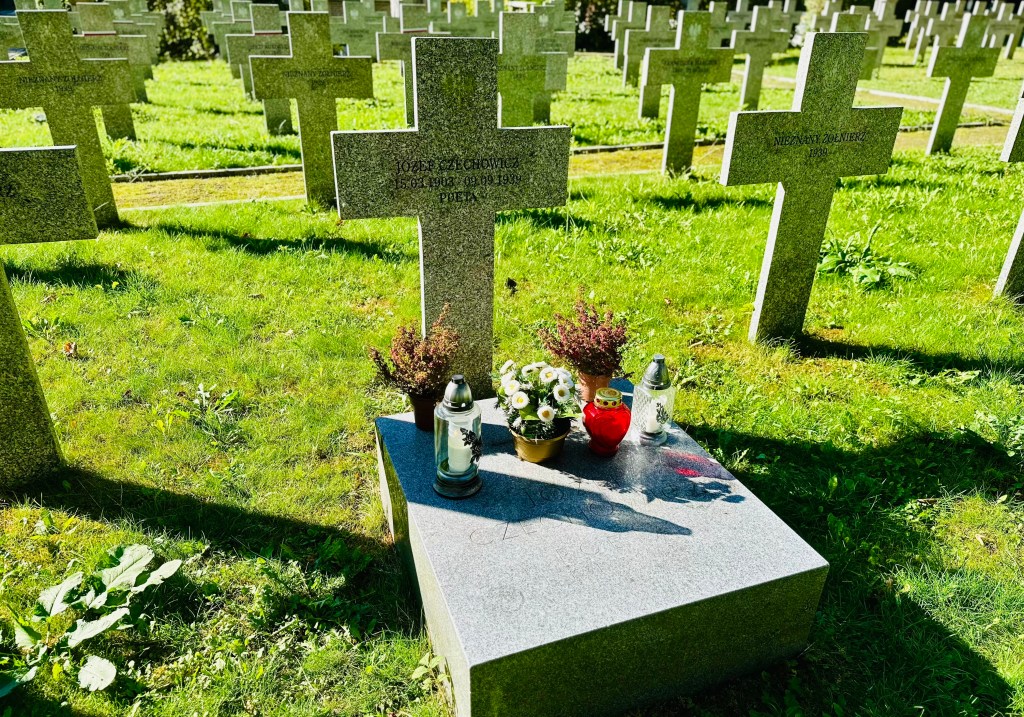
There is something painfully fitting about Czechowicz after Czechowicz, about the legacy of the dead poet. In the cemetery there are two memorial sites dedicated to him, yet both are empty; his remains were never definitively identified. The poet is physically absent in death in a way that inversely mirrors his cultural presence in life. But his face, words, and memory saturate contemporary Lublin—on plaques, murals, and monuments—while the body itself remains unlocatable, as if catastrophe had dislocated and dispersed him into the very landscape his poetry tried to chronicle.
Matthew Kinlin lives and writes in northwest England. His published works include Teenage Hallucination (Orbis Tertius Press, 2021); Curse Red, Curse Blue, Curse Green (Sweat Drenched Press, 2021); The Glass Abattoir (D.F.L. Lit, 2023); Songs of Xanthina (Broken Sleep Books, 2023); So Tender a Killer (Filthy Loot, 2025); and Beyond Grandeur & Other Stories (Anxiety Press, forthcoming 2026). His collaborative works include: Psycho Viridian (Broken Sleep Books, 2024) with Callum Leckie; The Getaway Spar (Anxiety Press, 2026) with Tom Over; Oberon’s Zoetrope (Submersible Press, 2026) with Kenneth M. Cale; Spirit in the House (Modern Alchemy Press, forthcoming 2026) with David Kuhnlein; and Box Office Poison (Future Tense Books, forthcoming 2027) with Nate Lippens. Instagram: @obscene_mirror.
Check out HFR’s book catalog, publicity list, submission manager, and buy merch from our Spring store. Follow us on Instagram, Bluesky, and YouTube. Disclosure: HFR is an affiliate of Bookshop.org and we will earn a commission if you click through and make a purchase. Sales from Bookshop.org help support independent bookstores and small presses.

