
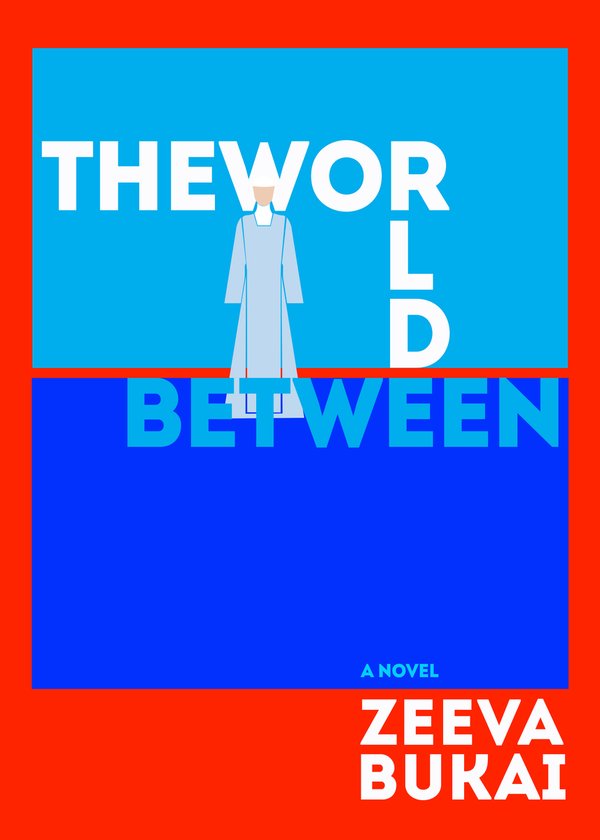
Zeeva Bukai’s The World Between is a collection of short letters from a woman in an Israeli sanatorium to her husband back in New York. She reflects on the breakdown of their marriage and her early life during the Holocaust. The nameless narrator grew up in Poland until the start of the Second World War, when her family fled east and landed in a Soviet labor camp in Siberia. After the war, she moved to Israel before building a life with her husband in the New York City theatre. When we meet her back in Israel, she is approaching seventy and reflecting on the traumas of her youth that have come to determine the love she has required throughout her life. This beautiful epistolary text confronts the lasting implications of childhood suffering on the adult psyche, demonstrating that such trauma reshapes intimacy and creates a lifelong search for home in place and in people.
Throughout the novel, Bukai paints the narrator’s two loves—Rothman and Max. The narrator and Rothman grew up together, went to the labor camp together, and moved to Israel together after the camps. He even introduced her to her eventual husband, Max. She seeks comfort in Rothman because he has, throughout her life, provided it for her. In Max, she appears to look for partnership. It is difficult to imagine that she doesn’t love Max; she continues to yearn for his approval, and most of her recollections center on him and their marriage. Still, it is evident that their love does not include the kind of all-encompassing safety that Rothman provides her. In almost every recollection of Rothman, he is taking care of her. In the few in which that isn’t the case, she looks after him. The pair provides for one another the home that has been repeatedly robbed from them.
In the first letters to Max, the narrator recounts early difficulties in their marriage that she appears to accept as natural strains in a marriage. Max’s last play, Di Bloy Dame, in which the narrator plays the lead role, however, seemingly drove the couple into irreconcilable tension. When she first writes to Max about the play, she claims to have simply found the play artistically flawed, writing that she “just couldn’t find anything redeeming in it, not the characters, not the plot, definitely not the indigo set, or the blue costumes and elaborate wigs [she] was forced to wear.” In time, however, she reveals her true qualms with the play—that the distasteful titular character is a reflection of her, one that Max created as a “weapon to use against [her].” Max’s position, as the creator and director of the narrator’s plays, has placed him in a unique position of power. With half the globe between them, she becomes the author of their relationship, a marked change from when Max wrote the roles for her to inhabit and saw himself as her “ventriloquist.”
As a wife and actress, she seems to have not only accepted this dynamic, but indulged in it. Until Di Bloy Dame, she apparently believed Max’s work to be singularly important. In one letter, she tells him:
I don’t think you understand what you accomplished with your plays. You married innocence with the demonic, the lovelorn with the cynical. You made the old world live inside the new. You made it live inside us and helped recover what was lost.
Many of her recollections return her to childhood, and from the text’s early pages we are aware that the narrator is so haunted by it that children preoccupy her thoughts. Describing a mundane exchange at the playground across the street from her sanatorium, she reports to Max that her “heart swells to see such kindness in children.”
One of the most poignant letters details her return to Poland after the war. When she arrives, she finds that strangers have taken over her home, leading her and Rothman to leave for Israel. That sense of having nowhere to go informs much of the narrator’s adulthood suffering. At every juncture, she is abandoned, left without a place to stay. As a result, she longs, perhaps above all, for a home. Despite the affairs, resentment, and anger that constitute her marriage, the betrayal she references most is Max’s decision to sell their Tel Aviv apartment. Time and again, we wonder where she is meant to go.
Onstage, in the gulag, in the sanatorium, she yearns for a place to belong and a person to comfort her. She herself recognizes that her love of theatre comes from the “sense of belonging [that] envelopes [her] every time an audience applauds.”
The narrator is at times chaotic, unreliable, dishonest, and immature. Still, she is deeply understandable and wholly likeable—a mark of Bukai’s talent. Her pain and inner life are so well-rendered that we feel as though she knows her not only in her old age at the institution, but also at the labor camp and during her years in New York.
As the text progresses and her mental state erodes, the narrator grows increasingly forthcoming. The information that has been slowly dripping out suddenly floods onto the page, and questions about the source of her pain and the true conflict of her marriage are answered, though it is evident that she has become even more unreliable. In this way, Bukai reminds us of the fragility and complexity of truth.
A small, mighty novel, this story feels as though it was written in a single breath and must be consumed as such. Its imprint is deep and longstanding, with even minor characters’ sorrow demanding our lasting attention. The book is underpinned by recurrent stories of childhood pain and different types of love. At all stages in life, and particularly in old age and in painful moments, we require the needs of our youngest, weakest selves. Such profound suffering in youth slows the aging process. Survivors of war trauma remain tethered to the moment in which their innocence was stolen, even as they move thousands of miles away and build new lives. As the narrator so hauntingly puts it, “time heals, or maybe it only obscures.”
The World Between, by Zeeva Bukai. Harrison, New York: Delphinium Books, February 2026. 150 pages. $22.00, hardcover.
Mia Carroll is a writer and engineer. She lives in Manhattan with her husband.
Check out HFR’s book catalog, publicity list, submission manager, and buy merch from our Spring store. Follow us on Instagram, Bluesky, and YouTube. Disclosure: HFR is an affiliate of Bookshop.org and we will earn a commission if you click through and make a purchase. Sales from Bookshop.org help support independent bookstores and small presses.

