

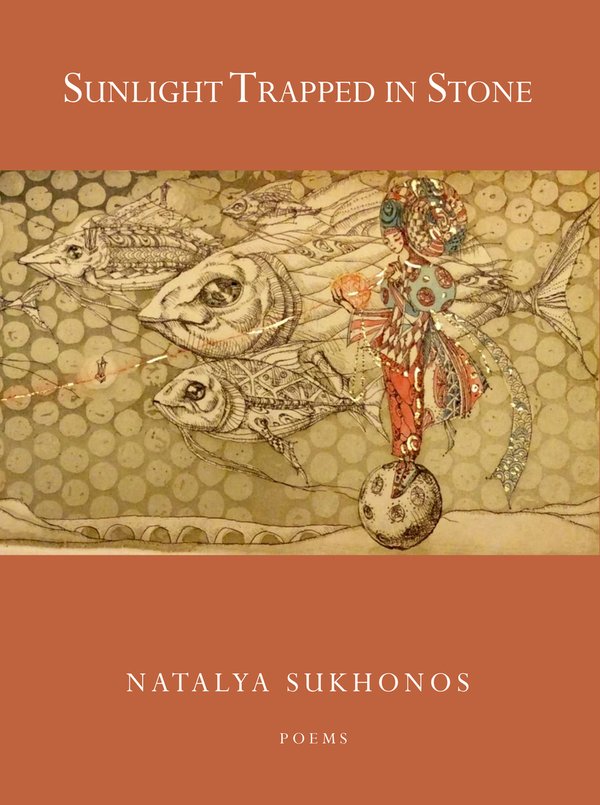
“Mount St. Helens in ashes,” writes Natalya Sukhonos in her newest poetry collection Sunlight Trapped in Stone, setting the scene for a dazzling ars poetica: “Enter the ballooning spider / who sends a long silken thread / into the molten core / only to let go.” Here, Sukhonos nods to the iconic American poets of the nineteenth century, Walt Whitman and Emily Dickinson, while also staking claim to her own poetic philosophy in her frontispiece poem “Ars Poetica with Spider and Peaches,” which explores the role of the artist as spider in times of catastrophe. The vertiginous imagery seems particularly timely at this moment as we reckon with earth-shaking scales of catastrophe and risk while at the same time testing our agency as poets who seek to make something reparative and beautiful out of destruction, even at our own peril.
Sukhonos asks, is art like the spider’s net, a form that flirts with the abyss? Or is it the “wind playing with thread? / Or is it a letting go // as when a poem conjures a bowl of peaches— / the way the summer light becomes / still around their contours, / then gleams over our faces / with a painterly halo?” With turns delightful and kaleidoscopic, the poet asks probing questions about art’s negotiation with the particular, such as the spider web, the gleam of the sun glinting on the peaches, and their reflected light that halos the onlookers. It is also an affirmation of the relational and transformative potentialities of art against the abuses of nations, the perils of ecocide, and the injustices of history. It is this liminal, relational space that poetry affords. However, Sukhonos is wary about where the poem takes us: “the poem / ends / before we achieve grace, / before the spider, weaver of tales, / makes contact with fire.” While the poem may not end with transcendence or an experience of the sublime, it does interrupt the artist’s descent into the fatal fire. Offering no false promises or easy answers, Sukhonos suggests that while poetry may not promise a salvific myth or experience of sublimation, the act of making is nevertheless what keeps the poet from the void.
Sukhonos, born in Odesa, Ukraine, and a current resident of the United States, inhabits the role of spider-figure, “a weaver of tales” whose multilingual and sonically rich poems provide an ethos of care and intimacy during this fraught political moment. Sukhonos is a dreamy but still open-eyed poet who locates succor in the natural world and family relationships, while also offering a robust critique of empire and its environmental and humanitarian abuses in the twentieth and twenty-first century. Author of two previous collections, A Stranger Home and Parachute, Sukhonos is a diaspora poet whose sensibilities are hybrid and multicultural. In the collection’s hauntings and temporal flexibility, she can be read in the vein of Jorge Louis Borges, with his vast intelligence and ability to realize the subversive powers of magical realism. She can also be read as an heir of Elizabeth Bishop, with her ability to negotiate personal and geographical dislocation with equal parts vulnerability and aplomb.
Also akin to Bishop’s poetics, Sukhonos’ gaze never overlooks granular details while she also keeps in sight historical traumas and ecological destruction. Never does she reduce poetic insights to universal generalizations. For example, in her poem “After Bishop,” she pays homage to “One Art” in its rhythms and themes, and does not draw away from grief’s patterns of reoccurrence: “I hold [loss] close, peer into its gray / and curtained chambers,” but suggests that even grief’s interior wound, while painful, is still worthy of attention. Both biographical and other-oriented, Sunlight Trapped in Stone engages with other texts, archives, voices, and personal histories while reckoning with the war in Ukraine, the fallacies of the American Dream, grief for the dead and the historical and ongoing traumas of war.
A lyrical exploration of immigration’s arrivals and departures, its hauntings and yearnings, the collection explores both colonist and colonized territories with exacting attention to all they withhold and deliver. In New York City, “Street signs scream neon blue, lemon yellow, poison green. / I can’t measure up to the colors of the New World. / Our huge family is a broken kaleidoscope, its pieces off-kilter.” While in Guadalajara, the speaker explores how minute organic territories and colonized landscapes each offer a way into contemplation and critique, even while their differing scales of life are layered and nuanced: “a lavender axolotl / gingerly stretches its webbed feet. Yellow seahorses / pass each other, bob their heads in recognition. / In a seventeenth-century convent, your graven archways surround me / in a warm hearth. A fool with a turquoise halo / beckons me into one of your paintings.” With an eye for the aesthetic, the absurd, and the natural curios of the Earth, Sukhonos enters the liminal role of the traveler and tourist with curiosity and ambivalence in a vein reminiscent of Bishop.
In her war poem “Parachute,” she offers a counterpoint to the masculinist baggage and patriotism of many of her literary predecessors. While grappling with the legacies of war, the speaker paints a portrait of a grandfather whose love for his granddaughter is a buoy in a scene of destruction and death and who must later reckon with his own vulnerabilities as an immigrant to the United States. The speaker takes in atrocity at a human scale while also never losing sight of war’s devastation to the Earth. “Ukraine’s black earth, good for harvest” is “broken,” and yet Sukhonos’ gaze recognizes life’s reparative and reciprocal cycles between life and death: “Tiny beetles scurry in its cracks, / crawling all over his toes, grasping little grains / of the world he carries, sending them back to earth. / The earth receives his warmth, releasing it so he may propel himself / into a world to come.” There is no false vision of patriotic or even human redemption, but the poem finds purchase in the insects that scurry through and turn the soil and the grandfather’s love for his family that reverberates across generations even after his death.
Equally compelling are the poet’s love poems for her daughters and beloved; intimate and yet mythopoetic, the poem “I Heard the Sea’s Voice in Your Voice” stuns in its musical slippages: “I look at [the beloved’s body] from all angles / like a child who turns over a stone / to watch the sun glide onto its curves, / caress its crevices.” Calling to title of the collection, Sunlight Trapped in Stone, “I Heard the Sea’s Voice in Your Voice” is both a lullaby in its repetition of lulling “l” sounds and a sensuous fairy tale of a woman entranced by what she beholds in the beloved’s corporeal repertoire, which is evocative of the sea.
In its formal range, abundant empathy, and fearless reckoning with hegemonic abuses, Sunlight Trapped in Stone is a clarion call for our times. It is a collection that I will return to again and again as a kind of primer for art-making and loving in an age freighted by both personal and collective grief, and for believing still in “a world to come,” shaped by the spider-artist.
Sunlight Trapped in Stone, by Natayla Sukhonos. Brattleboro, Vermont: Green Writers Press, March 2026. 86 pages. $16.95, paper.
Sarah Giragosian is the author of Queer Fish, winner of the American Poetry Journal Book Prize, and The Death Spiral. In 2023, the University of Akron Press released the craft anthology, Marbles on the Floor: How to Assemble a Book of Poems, which she co-edited. She also wrote Mother Octopus, a co-winner of the Halcyon Prize. Her memoir What Kind of Hawk is forthcoming from Milkweed Editions. Her writing has appeared in such journals as Orion, Electric Literature, Pleiades, and Prairie Schooner, among others. She teaches at the University at Albany-SUNY.
Check out HFR’s book catalog, publicity list, submission manager, and buy merch from our Spring store. Follow us on Instagram, Bluesky, and YouTube. Disclosure: HFR is an affiliate of Bookshop.org and we will earn a commission if you click through and make a purchase. Sales from Bookshop.org help support independent bookstores and small presses.

