
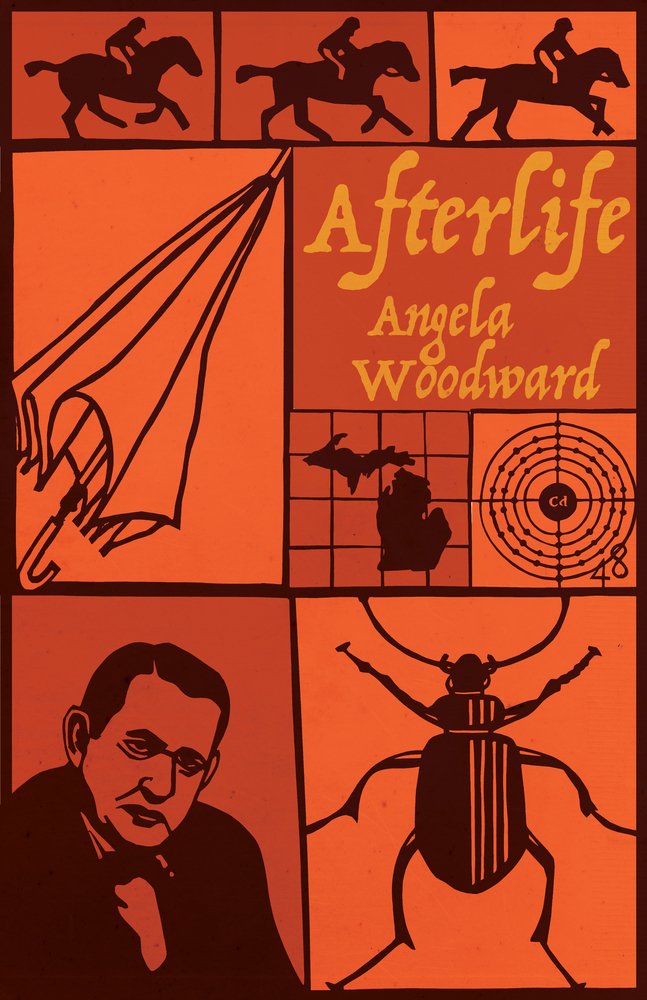
In this luminous novel, Angela Woodward chronicles the meaning of death, the illusions of truth, and the strange, shimmering persistence of the self beyond the ordinary boundaries of life. Through fictional encyclopedia entries, surreal vignettes, and personal narratives, Afterlife blurs fact and imagination, the material and the ghostly, with poetic precision and biting wit.
Woodward’s speaker journeys through museums of bird art, cults and conformity, environmental chemicals, and lost loves. What emerges is an elegiac, deeply intelligent inquiry into how we continue to haunt the world—and how the world haunts us back.
Struck
I knew this guy when I first lived in Chicago who visited the music store where I worked. The owner of the music store seemed to collect characters, including me. Not that I wasn’t a mild-mannered and serious musical instrument saleswoman, but the owner told me I reminded him of Tippi Hedren, while vehemently criticizing my choice of clothes. I only later learned she was Alfred Hitchcock’s favorite actress. If that tells you anything. The other clerk, Enrique, came to work after his days at one of the city’s most prestigious magnet high schools. He was virtually homeless, staying on the couches of various friends, and probably undocumented. He was also a prostitute, or lived off gifts from boyfriends, but I didn’t know any of that until he’d had to go to the emergency room after one of his dates turned violent. I knew this schoolboy Enrique only as a guitarist. Supposedly he was really good, but I never heard Enrique play more than a few phrases while he tuned up a guitar for a customer. I heard his friend Mark play once. Enrique invited him to the store. Mark had graduated from a private conservatory, but was now on the loose, with no prospects. Classical guitarists were not much in demand in the city or anywhere else, it seemed. An oboist or flutist could audition for an orchestra, and a pianist or harpist could get a gig on a cruise ship. But Mark’s only employment was delivering pizzas. He had met Enrique somewhere, and he came into the store because Enrique invited him. He sat down on a chair by the counter and played us a piece that had been composed for him.
For a writer to describe music is very difficult. I could compare the notes to colors, write that he wafted blue and lavender scarves of sound by us, or say that the music felt peripheral, as if we were taking in only a side glance of it, while its whole momentous bulk hovered just beyond reach. I could describe Mark’s bland, doughy face, his unmemorable features, and how while he was playing his instrument, his unremarkableness seemed designed not to distract from the historic agility of his hands. I could say the piece Mark played was like some other piece of music you might have heard, but I can’t think what a good correlate would be. I can’t even give it a genre, except contemporary classical guitar. This piece Mark’s friend or teacher or unknown stranger had composed expressly for him called out of the instrument things I didn’t know a guitar could do. This music had a silver mistiness, as there’s nothing more beautiful than when the guitarist hits a harmonic—that is, rests his finger very lightly on the top of the string instead of pressing it down against the neck so the note plucked vibrates an octave above where it would otherwise be found. The composer, through this gifted guitarist Mark, conveyed a heavenly glistening, but he also dragged it down with some mysterious meanderings, the notes heading off into fetid alleys of an unknown city while sunset snaked its last sparks off the spires of tremendously influential corporate bank towers.
I learned at a later point, through what a well-informed friend had read on a reputable website, that the listener never hears music so much as remembers it. That’s why when you buy a new CD or maybe stream for the first time an entire album by a jazz quintet you adore, at your first listen it’s just a scramble. You don’t even know if you like it. You’re just trying to fix it onto what you already know. And then at the second listen, each note seems to have found its place. By the third time through, you can already hear the first chords of the next track as the last one is fading. This phenomenon creates a challenge for symphony orchestras that want to debut new and musically daring pieces. Even the most loyal symphony subscribers find themselves wondering when it will be over instead of remarking on the novel experience. The orchestra set up four trumpeters in four corners of the auditorium so that the sharp anthem would descend on the audience from all directions. The people squirm in their seats and remind themselves of the floor number and section of the garage where they parked their vehicle. The symphony subscribers can barely tolerate the debut, much less appreciate it. The ears long for familiarity, and in fact spend all their time trying to fit new sounds into old patterns.
As it is also with many books I’ve read and revered, I can’t remember much about the piece Mark played, but I remember how it wrapped me up. I had no idea what I was hearing. The composition, and the way it took over this pudgy Mark and made a portal of him, opening us two music store clerks and our elderly boss into an alien cityscape where we were lost and terrified and tremendously grateful for the experience—all that lingers, but I couldn’t say that the piece was Brazilian or in a major key or was eleven minutes long. Forgive my imprecision. You’ll just have to take my word for it that listening to Mark play was a striking experience.
The music store owner made no attempt to hire Mark, though I imagine that’s what Mark was angling for. My boss was a shrewd judge of character. Even so, Mark often stopped by to chat with Enrique. Without his guitar in his lap, he was an annoyingly dull person. After two or three conversations with him confronted me with his bland stare or his slightly spitting laugh, I ignored him. The most he got out of me was a nod to mark his entrance. Enrique and I talked about a lot of things, including how he took part in a protest against bilingual education. He felt his Spanish-language classes in elementary school had trapped him on a rung of low achievement he had been lucky to bust out of. Besides music, he was interested in the history of geodesic domes, and also in robotics and utopianism.
One Saturday morning Mark came into the store early. Enrique hadn’t made it in yet, and the owner and I were inventorying an order of German metronomes. The store owner clearly didn’t like Mark, but he read his bleak expression and offered him the chair next to the counter. Mark told us he had almost been killed. He’d been robbed at gunpoint while delivering pizza the night before. He took an order to an address that didn’t look right to him, in an apartment block along the lake. As he stepped out of the car, two men jumped him, and one pressed a gun to the base of his skull. He felt the cold snout, in fact could feel it there still.
“I could have died,” he said. “They got all my money.”
While the owner considered that here was Mark, still alive, and that he had no one to tell his story to but Enrique’s boss and colleague, I burst into tears. I wasn’t thinking of Mark so much as the piece he had played us. No one else could play like that, and the piece itself was totally unique. It had been written just for him. If he had been shot in the head, that music would have vanished.
The store owner gestured toward the box of metronomes. There was nothing to cry about. Robberies like this happened all the time in the city. What did a pizza delivery guy expect? We had to finish our inventory in the next ten minutes.
Getting nothing from my boss, Mark gaped at my wet cheeks. His doggy eyes calculated that I might after all feel some compassion for him. No no, I stuttered, shaking my head and wiping my eyes. I read out the serial number of the next metronome. I said nothing about the remarkable composition he had played for us. I didn’t say I still thought, no matter what happened, that Mark was a boring piece of shit. But given my moment of weakness, my behavior in the ensuing weeks would have to make my coldness toward Mark crushingly clear.
Later that summer I went to a free street concert, where the organizers had blocked off the intersection and rigged lights above a temporary bandstand. Four women in tall black hats wailed against a backdrop of clarinet and mandolin. I didn’t go to the festival for the band in particular, but had showed up to meet some friends who lived nearby. We stood and talked, cupping each other’s ears to be heard over the noise. Gradually, the forest shrieking of the four women outweighed whatever trivial things my friends and I had to discuss. We stopped talking and drew ourselves into the throng in front of the stage. After a few more steps forward, we could barely move, penned in by boylike men in baseball caps and gloriously bare-armed young mothers. I looked up at the women on stage, giantesses in their fabulous headdresses.
I lowered my head, maybe checking on what sticky mess my sandal had dabbled into. At this slight motion, I entered a totally different soundscape. When I held my face towards my feet, the swirling sounds of the audience murmuring to each other and crackling their plastic beer cups filled my ears. With my head up, the four women unfurled their furious harmony. Angled down again, I made out a separate musical realm of infinite, undifferentiated hubbub. The crowd noises, vast and unorchestrated, hung underneath the composed music of the band. I only had to shift my chin to move from one level to the next. I hadn’t noticed this interference or been bothered by it at any previous musical event. My ears had been doing the work all along, of skeining out the unwanted din. Now I was struck by what a rough base the women’s music floated on.

Angela Woodward is author of the novels Afterlife, Ink, Natural Wonders, and End of the Fire Cult, as well as two collections of short fiction.
Reprinted with permission of FC2
Check out HFR’s book catalog, publicity list, submission manager, and buy merch from our Spring store. Follow us on Instagram, Bluesky, and YouTube. Disclosure: HFR is an affiliate of Bookshop.org and we will earn a commission if you click through and make a purchase. Sales from Bookshop.org help support independent bookstores and small presses.

