
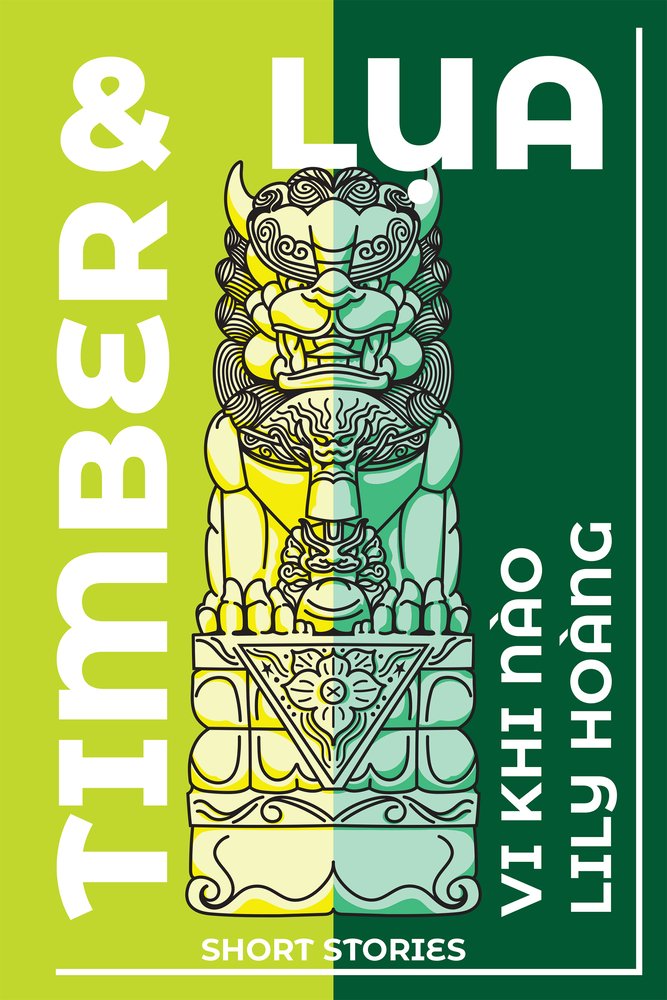
Timber & Lua is a book of ten short stories, stories whose plots follow the logic of dreams rather than the logic of waking life. For example, several of the stories chart the relationship between a woman and her boyfriend, who tries to please her by turning into a small dog.
The stories are formally experimental, often taking the form of dialogues between characters or within a character’s own mind. Often, the characters pose strange questions that elicit yet stranger responses. This makes us pay attention to how things are being said, in a way that kept me on the surface of the stories instead of allowing me to sink in. For example, in one story that takes the form of a dialogue between a sex bot and the new owner who is taking her out of her packaging, the robot asks:
“Is fucking like a lavish party? Or, except for me, is it a bathroom door everyone knows how to open?”
Here is the same question, posed another way:
“Is fucking like a một bứa tiệc xa hoa. Or, ngoại trừ me, is it a bathroom door everyone knows how to open?”
Because most of the stories in this book follow a pattern in which each story is told first in what the jacket copy calls “Vietlish”—a mixture of English and Vietnamese on one page, and, on the facing page, a glossary that translates the Vietnamese words and phrases into English in the order in which they arise. Then the story appears again, this time fully in English on one side, and fully in Vietnamese on the other.
For me, this was also part of what kept me on the surface of the language, because I don’t read Vietnamese and have had very little exposure to the language. But it also forced me to think much more than I usually do when I’m reading about where I’m reading from. Someone who read both languages would have a different experience.
I did a lot of work, glancing back and forth between the Vietlish and the glossary. I could have chosen to read the stories in English only. But then I would have been aware that the Vietnamese was there to be attempted and I was slacking. And I would have felt I was missing the point of the book by not trying. So, the mixture of English and Vietnamese felt like an invitation, while for the same reason, the book felt uncompromising. All of these are emotional reactions I had to material that simply existed. The authors created these reactions and dilemmas for me merely by this formal choice.
And the book was interesting and memorable because it was such a rare experience in my reading life. But I don’t know that these difficult stories will, themselves, stick with me. My favorite story in the book was also the longest and the most plot-heavy. Among other adventures, the time-traveling main character has to rescue Ursula the Sea Witch, who has become beached. But the dream logic of this story, too, made it hard for me to connect. There were moments when it felt genuinely emotional, and then the story would seem to back away from and abandon that emotion. These didn’t feel like failings on the part of the authors, Vi Khi Nào & Lily Hoàng, who wrote the book collaboratively. I had the sense that they were always in exquisite control of what they were doing.
That is to be expected from these authors, who have been publishing books for a combined 33 years or so and who have between them garnered the Ronald Sukenik Innovative Fiction Prize; the Nightboat Books Prize for Poetry; the Jim Duggins, PhD Outstanding Mid-Career Novelist Prize; the Red Hen Press Fiction Award; and the PEN/Open Books Award. Both of them also have a history of collaborative work. Hoàng released a collection of short stories left unfinished by other writers, which she completed herself (and has spoken in interviews about other collaborative projects that may not have been published). Nào has collaborated on several books of poetry and prose before this one.
I would have thought this was relatively rare, but actually both authors are members of She Who Has No Master(s), a collective of womxn and nonbinary writers of the Vietnamese diaspora who engage in collaborative, polyvocal, and hybrid-poetic works to enact a politics of connection across diasporic boundaries. When I counted the collective’s “fluid and evolving members” as it appears on their website at the time of writing, I count 19 current members and eight past participants. Once again I’m struck by just how many people are out there making art, even within what seems like a very specific niche.
And I wondered whether my struggle to connect to these stories was another way in which who I am as a reader affected my experience. The stories are queer, and techno-futuristic. The boyfriend who changes into a small dog changes into a female dog. The sex bot and her new owner are both female. There are readers who may find more emotional connection to them despite the difficulties of sinking in. In fact, a queer woman who reads English and Vietnamese might feel fully invited in instead of being held at a distance, and the book may be intended to operate in exactly that way.
I appreciate it when a book in some way replicates something I’ve experienced in real life in a way that no other book has, and this one replicates my experiences of being the one person at the table who doesn’t speak the language that everyone else speaks and only being occasionally brought in when others lapse deliberately or casually into English. The English translations in the glossary often don’t quite work with the grammar of the sentence as it appears in the story, so it even gave me that sense of getting the gist rather than understanding with perfect clarity. When I find myself at tables like that one, I spend a lot of time either trying to fill in the gaps in my own understanding or being at peace with not understanding. It’s nice to still be welcome to sit there with everybody.
Timber & Lua, by Vi Khi Nào & Lily Hoàng. Pasadena, California: Red Hen Press, 280 pages. $19.95, paper.
Ashley Honeysett’s debut book, Fictions, won the Miami University Press Novella Award and the Chicago Writers Association Book of the Year Award. If you want to be a more adventurous reader you can subscribe to her newsletter at ashleyhoney.substack.com.
Check out HFR’s book catalog, publicity list, submission manager, and buy merch from our Spring store. Follow us on Instagram, Bluesky, and YouTube. Disclosure: HFR is an affiliate of Bookshop.org and we will earn a commission if you click through and make a purchase. Sales from Bookshop.org help support independent bookstores and small presses.

