
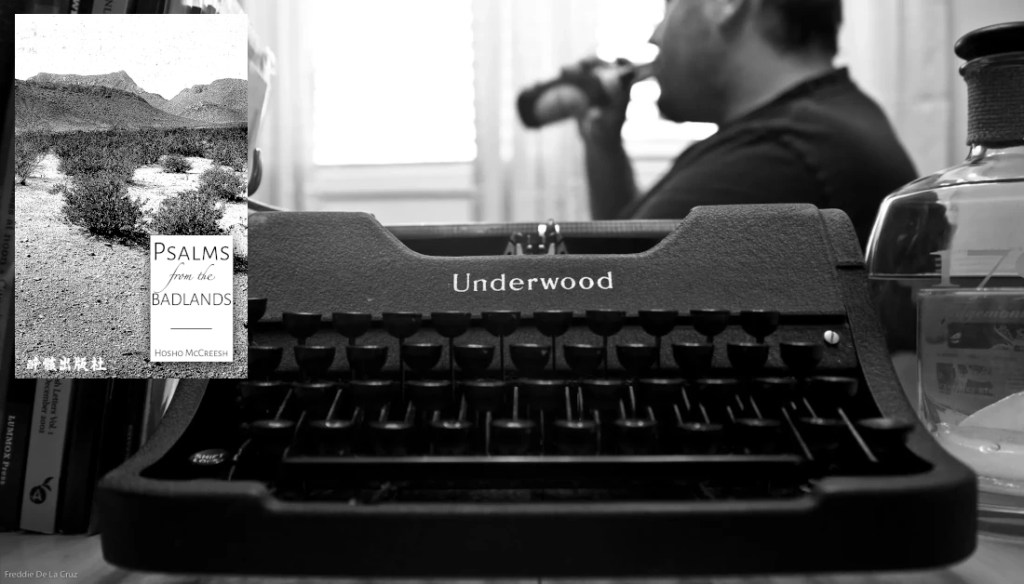
The Hebrew psalms were songs of lament, a crying out for help, or hymns praising God. Hosho McCreesh, in his new book Psalms from the Badlands (DrunkSkull Books), loosely follows the tradition of the latter and fills his pages with hymns that praise not necessarily God but life and the land on which life flourishes, specifically “the gypsum and caliche badlands of the American Southwest.” Like the Biblical psalms, McCreesh’s own offer hope and resistance in times and places that seem hopeless. Instead of beseeching God to save us from such times, these psalms push us to search inside our own selves for strength:
BLOWN SAND
TOSSED BY AN
ANGRY SPRING WIND—
& ONCE AGAIN,
NO CHOICE
BUT TO
FACE
IT
He masters what Kerouac attempted to do with his American free-syllabled haikus, which is to photograph an image and follow it with an encapsulated, greater meaning. The importance of the small things, the beauty in the mundane, and the simple wonder of being alive are all explored throughout his psalms. Whether it is a zipper spider, a circling buzzard, a September breeze, a stiff-leafed oleander, or when we encounter our humanity and our spirit, or at least our desire, to go on. In sparsity, McCreesh digs deep. In small things, he creates grand significance. And in the millennia old tradition of the psalms, he invites us to be present, to notice what is around and within us.
Fortunately, McCreesh and I have had a small bit of correspondence over the years, and I was able to send him some questions over emails to dig deeper into his style and the source of Psalms from the Badlands.
Peter J. Kahn: Are you consciously sitting down to write a poem in a certain style, like one of your Psalms from the Badlands, or a narrative/drunk poem like in A Deep and Gorgeous Thirst, or any particular form at all? Or, are you writing whatever works at that time and placing it where it belongs, with like-minded poems, afterward?
Hosho McCreesh: I think it depends on where I am with a project. If I am not working on anything in particular, then I tend to noodle sorta aimlessly, letting things just be what they are, with no plans or designs. If, after doing that, some sort of shape starts to emerge—I trust it, and just go with it, arriving at whatever rules or structure starts to feel consistent for an emerging collection or project.
For example: with A Deep and Gorgeous Thirst, all I had to do was nail down my first line—and that was it. From there, I could just launch into that particular drunken yarn and see where it went. Over and over—all it took was the right first line. It was like wrestling lightning—I almost couldn’t keep up. I finished my rough drafts of all of them in about three weeks.
With Psalms from the Badlands—which took me 17 years to finish—the process was very different. By a couple of years in (and building on the original 37 I wrote for Kendra Steiner Editions), the shape of the poems felt pretty consistent and so then I just waited. When something beautiful grabbed hold of me—a visual, a feeling, a memory—I chewed on it a bit, then, with a consistent structure in mind, I got it down, pared it, cutting and cutting, rarely adding, just trying to get the image and what it meant to me to align. Then every time I had 150 done, I read them all, brutally cut or edited the ones that no longer worked … then just waited for more. I did that over and over until I finally had the book I wanted.
Not every book needs that kind of approach (or any kind of approach)—but I firmly believe that every book needs to be its own thing—somehow, some way. And I always want to challenge myself in new and interesting ways. So those dynamics end up being mutually beneficial.
PJK: Having appeared in small press publications all over the U.S. and in Europe, and having a dozen or so collections published, are you still sending work out to the presses? Do you send to university journals? Are you interested more in collecting your published poems into books or writing directly for a book?
HM: I keep harping on this idea that, “once I get retired, if I get retired” then I’ll get back to a more regimented practice of both writing and submitting. Nowadays, with my attentions pulling me in twelve different directions all the time, I try to write enough to have work I’m proud of ready to send out to magazines and journals I know I’d like to crack. Work takes at least 40 hours a week, so I am desperate to someday have that time to use artistically instead. The same is true for presses. There are a handful that I adore—and ones I want to put out stuff with. If they ask for stuff, I try to deliver. I’d love to return to my original practice of writing from about 10:00 p.m. until 1:00 or 2:00 or 3:00 a.m. almost every night; and sending stuff out constantly. But there’s only one of me … and the alarm clock for work goes off too early these days to stay up all night.
As for manuscripts—I always prefer to mix in some published stuff and some new stuff, and I try to keep from having the same pieces in multiple books. As far as I know, that’s only happened a handful of times. Like I said, I want each book to offer the reader something new. There are plenty of places I’ve never submitted yet that I’d really love to crack. I just need more time to sort it all!
PJK: Do you play with multiple forms at once, like writing poems and stories around the same time, or do you tend to have stretches where you do one or the other. Besides writing, since you create animations, videos, your DrunkSkull Sidewalk Cinema events, do you tend to focus on one at a time or are you multitasking?
HM: I am typically working on everything, all at once—just mentally mulling things when I’ve got some quiet time and space within. I only truly stop when a project is done and dusted. I have a fairly slapdash way of keeping everything separate—but it’s still a work in progress. By way of explanation, I work on whatever is front-of-mind at the time. I jot notes, lines, phrases on Post-its, email myself, or even write on my arm until I can get a bit where it belongs. I stop when I’m stuck and do something else until an idea or solution arrives. When it does, I get it down. The only time I start focusing exclusively on something is when it is close enough to being done that the more professional, almost clerical work of refining and editing becomes the need. As a manuscript is finalized, I hyperfocus on it—to the annoying exclusion of most other things. So it’s important to not do that until I know I’m really close! And this says nothing of the other types of practice I really want to develop more deeply—my painting, collage, photography, screenwriting, someday even film. I’d love to learn to sculpt and to do more printing and linocuts. I want to do everything, or try to. I just gotta get there.
PJK: Besides writing Psalms from the Badlands, which contains poems directly connected with New Mexico and the southwest and the desert, has living in that area had much effect on your work? Is it the landscape, the people? I’m a Midwesterner and I think the cold and the snow have a drastic effect on people and how we talk to and treat each other, cause it is hard to be dishonest or indirect when it’s -10 degrees out and you are digging someone’s car out of a snowbank, and it is hard to dislike someone who would help with such a thing. Is there something in the Southwest that is similar?
HM: Absolutely. I can’t actually even know how much. New Mexico is such an amazing place—culturally and geographically, geologically—that there’s no way for anyone with an eye toward natural beauty, to not be bowled over by it. It’s a place of extremes—always has been. And I think that’s reflected in the grit and honesty of most folks. The extremes create a mindset that’s pretty level, one that sands the edges off the too-highs and the too-lows both socially and existentially. I find most folks to be pretty reasonable, to quietly appreciate beauty—be it high art or even just an excellent sopapilla or tortilla. Economically, there remains too much desperation—and that fuels some of the ugliest stuff, same as it does everywhere. I feel myself constantly searching for that bright line and shifting between being open and guarded. But, like the desert itself, the beauty of it—when it breaks through—is undeniable. A lot of people will look at a mesa and not see anything there. But for those of us that see it differently, hell, we’re glad people don’t sense the magic.
PJK: Who have been some of your favorite artists and writers you’ve worked with? Presses? Bottle of Smoke Press has always been one of the great ones to me and is where I first found a lot of great writers, including yourself. Did Bill Roberts play a part in your success?
HM: Bill Roberts was foundational in my getting anywhere as a writer. He believed in my work early on, made it look beautiful every time he was involved with it. Sean Lynch too—of Ten Point Design (and Press, when he was printing stuff!). Both were involved with the GPP, and we ended up working together over and over through the years. Sean would design things. Bill would print things—even for other presses. They made my stuff look so great year after year. Both have helped me tons as I’ve moved into more of my own publishing. Then there are other presses and artisans that I deeply admire: Johnny and Giselle at X-Ray Book Co./Bagazine/The Kutups; Michael Curran at Tangerine Press who often does things with Billy Childish and Hangman Books and Vipers Tongue. Hell, there are just a lot of folks who blend writing and art and bookmaking and I love that supposedly small presses can do really unique and beautiful things. As for writers—I will miss someone if I start naming names—so hopefully they all know that I love them and that my heart is pure! I can only say I’m honored to have worked with everyone I have, and look forward to most anything else that comes my way. I am floored every time anyone wants to work on something—be it a broadside or a collection or whatever. I think that if I just get to make cool shit until I die, artistically, that’s about as good as it can ever get.
PJK: You like to say keep books dangerous, support the small press. What does the small press do that the mainstream presses can’t?
HM: Big publishing is, first and foremost, a business. But the small press, to my mind anyways, is an art first—meaning the two things are only similar in some very basic ways. Otherwise, the rules are drastically different. Big publishers make products that must be aimed at big audiences. They need to sell tons to break even, and so they have to make things that might sell a lot. So—macrobrews then, Budweiser and Coors—giant, predictable, no surprises—so folks always know what they’re getting. The small press—these are your local breweries and distilleries, making badass stuff, in smaller batches, with big flavors that are never going to work for everyone. And they don’t have to! It’s the little guy, the underdog, the rebels—this is the small press—being exactly the thing that they are, and finding people that love them for it. In a more practical sense, one thing the small press can do that big publishing can’t is making gorgeous and collectable special editions. I often do 26 snazzy special editions—or 50, or 100—and at that scale, each can be individualized and made beautiful. I can make 32 original, collage-cover hardback editions of my novel Chinese Gucci. Big publishing’s superstars simply cannot make 100,000 handmade special editions. To me, that’s a feature of the small press—not a bug.
PJK: Is there a role for the writer/artist in America today, where the problems both political and humanitarian are so direct, and people’s responses on social media so immediate? When everyone has a voice, does the artist get drowned out?
HM: Even when things aren’t pure dogshit out there, this is the age-old question, isn’t it? Does art matter? Does anything matter? On a long enough timeline, very little actually does. But, on our own personal timeline, and when it comes to whatever the hell we want to do with our one little life, we’ve gotta find our own meaning in the frozen wilderness of existence. And, for anyone brave or foolish enough to call themselves an artist or a writer, especially in a world that often feels like it couldn’t care less, I think that whatever meaning we can carve out for ourselves puts a little something good into the slipstream, something that otherwise wouldn’t be there. And if it’s not there, then that’s it. That’s where it ends.
But if it is there—well—who knows what it might do?
I’ve written a bit about my most well-known poem, “Cicada,” and all the amazing ways it has moved—all the ways it still surprises me. One little poem—and yet, it has reached and resonated with so many people. To me, it’s the artist’s dilemma in microcosm: we just can’t ever know what can happen or how. And if, in the end, nearly all human endeavor will be devoured by the sun anyway—then why the hell shouldn’t we just enjoy ourselves, do the things we’re inspired to do, and share it with whoever cares? That’s my plan at least. And I encourage anyone else out there who feels inspired to do something artistic—to do it—do it as well as you can—and ask nothing more of it than that.
Because, who knows … who knows … who ever knows …
Peter J. Kahn is from Wisconsin but spends as much time as he can every year in the medieval city of Toruń, Poland. He has worked in warehouses, in retail, on production lines, as a copy editor, and worse. He runs Dead Prince Books, handmaking books of poetry and art.
Check out HFR’s book catalog, publicity list, submission manager, and buy merch from our Spring store. Follow us on Instagram, Bluesky, and YouTube. Disclosure: HFR is an affiliate of Bookshop.org and we will earn a commission if you click through and make a purchase. Sales from Bookshop.org help support independent bookstores and small presses.

