
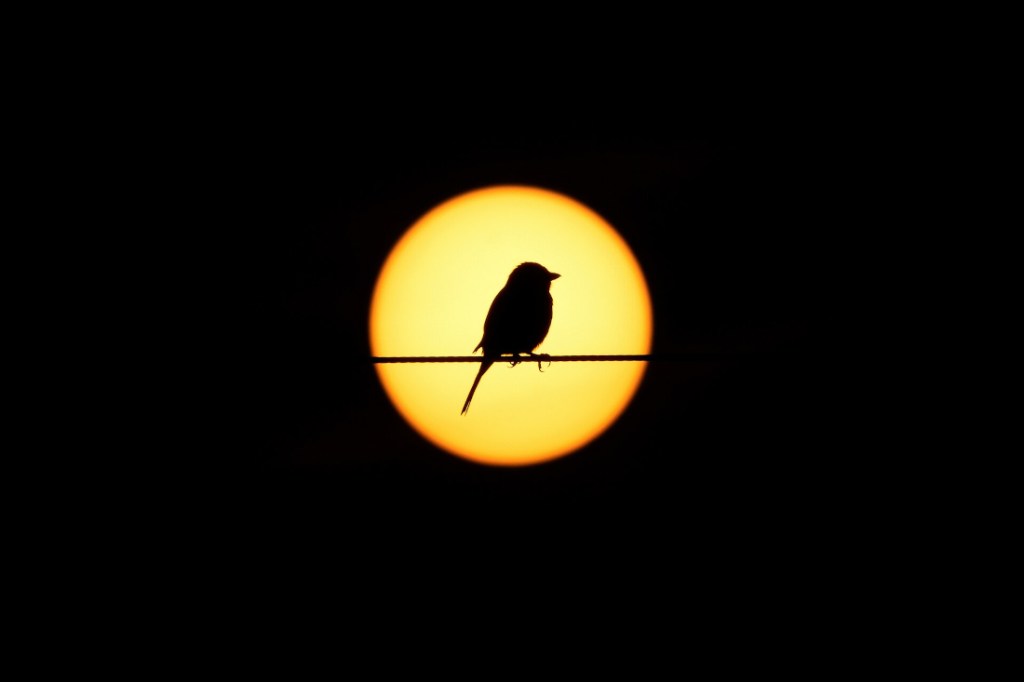
I imagine my husband as a shrike. This bird eats what he impales, wood splintering, his tree decorated with flesh. They immortalize death when they hang their prey on spines or barbed wire, feverishly pecking at their bodies for days, but their meat is never enough. At night, my husband wakes me by resting his hand on my waist, mouth brushing my ear, and his voice filters through a haze before his words are against my throat like a branch sharpened into a knife; complaints of how he’s starving pulses against me how I’ve starved him. I tell him fine, our silhouettes meld into one shadow, I focus on the perspiration slicked along his shoulders and the way moonlight freezes in each droplet, and afterward, I say I love you to make sense of its shape, but it never feels right when it’s released into the open, vulnerable sky.
He is gone by the time I wake up. His Lexapro has spilled on the nightstand, crumpled 7-Eleven receipts obscuring sticky-notes of half-baked pitches, headlines, and news. Like all writers, he is a good liar; he reconstructs experiences that don’t belong to him, and my father was the same. As a romance author, he’d create grand gestures or swoon-worthy monologues, but our house was bleak and muted, as my mother was cooped in her own separate bedroom. I hated the silence. I still hate it.
The living room TV crackles against the autumn air before it softens into birdsongs, Julie Andrews’ voice filtering in, smooth as water. She’s singing The Sound of Music. I like to imagine she’s singing to me, standing in that deep, green grass, mountain caps cutting, reaching for clouds. I grab her hand, our palms knitting together. Let’s go away, she tells me, and I say yes, I’d like that, and we are off toward nowhere so we can be alone.
The song’s interrupted when the coffee finishes draining from the Keurig. I don’t know what I’m thinking. The coffee is too bitter, so I pour it into the sink and watch the murky brown swirl into the dark.
I want to submerge my hand in the drain, turn on the garbage disposal, shred into ruby flakes. My finger circles around the cold metal. My wedding ring refracts morning light, though it’s barely noticeable; the strings of light are small, white scars in a quiet house, and they vanish as I sink my fingers into the drain.
A delicate hand wraps around my wrist. My mouth purses, skin chilled by a stray breeze filtering through the windows. Slowly, I trail my eyes from the arm to a face I once knew. Her eyes are a striking shade of caramel against brown skin; she is deathly, frail, yet alive. She leans over the counter and presses my hand against the black marble, though it feels like she’s holding my breath in her grip.
The white, lace curtains flutter in the wind. A part of me has leapt out the window, run down the barren streets, chased after the line of cars so one might take me away. I stare back at my old friend—an echo of a person. That’s all I can think of when she peers at me, silent in her solemnity, hair matted against her head like an old, worn nest.
“What happened?”
Myna’s brows furrow, bottom lip quivering. Her fingers are rose petals, trailing my arm until she cups my elbow, providing balance when I find myself swaying, dizzy from confusion. Her gaze drinks me in. With more force than I intend, I swat her hand away, but it takes one second for her to disappear. I expect her cinnamon scent to linger where she once stood, but there’s nothing but thin, cold air. My back hits the kitchen counter. I sink onto the floor. “Myna?” I don’t know why I expect an answer, but I repeat her name anyway. She’s a prayer etched onto my tongue, but no matter how many times I say it, she never listens.
In the living room, Julie Andrews’ voice fades and the music softens. It’s quiet again.
“My high school classmate went missing yesterday.” Our bedroom is dark, the glow of my computer screen a veil over my face. My husband continues writing in his small notebook as black ink smears along the side of his hand. He nods, glances at me before returning to his writing.
“Her name was Myna,” I add, taking a sip of peach tea. I flinch when I find that it lost all of its heat. “There’s only one article about her. I can’t find anything else, not even if she was married or had any kids.”
My husband nods, saying that’s too bad. I murmur, “It says she went walking before she disappeared.” I set my cup down and focus on the wet rings stained along the wood. Shifting in bed, I pull the sheets higher over my shoulders. He’s not looking at me.
“She was in the house this morning.” His pen halts against the page. His eyes find mine. “I was making coffee when she appeared, but then she was gone. Maybe I imagined it. Or maybe I saw her ghost. But the article said she was missing, not dead, so she’s probably alive. She has to be. I guess I imagined her, but it’s not like I think about her often. It’s just that she was my only friend in high school.”
I drink more cold tea, the cup twitching in my hand. My husband opens his mouth to speak, but I cut him off. “You know, she used to have a fear of heights. So every time we crossed the bridge that overlooked the freeway to leave school, she would always hold my arm. She was always scared to look at all the cars racing beneath us, and I remember a strong gust of wind made me stumble once and she screamed but it wasn’t enough for anyone to hear.” I sigh. The cup is empty. “I can’t remember our last conversation.”
My husband sets his notebook on the duvet, a pinch in his jaw. He asks me why I’ve never brought her up before. My finger circles the rim of the cup, and my mind submerges into a deep fog, Myna’s silhouette fading, like a worm slipping down a bird’s throat, swift and easy. I set my cup down on the nightstand and lie on my side, away from him. “There was no need to,” I murmur. “We stopped talking after high school.”
She sounds special, he says, methodical—bitter, even. His body curls mine, breath misting my skin. I await the moment where he bites into my neck to induce paralysis, as a shrike would. My heart wants to slip through its ribcage, burst from my chest.
“She was just an old friend. Never kept in touch after that.” A certain possessiveness filters through me. I want to keep her to myself, so I don’t tell him about the way she’d sometimes bury her face in the crook of my neck as we walked the bridge, her breath a spiced perfume that warmed me.
“I just …” I strangle the sheets in my fist, flitting the memory away as if it was an intrusive thought. “I just hope she’s okay.”
My head feels light. He raises his hand—shadow hanging like a dark cloud on the wall, nails crescent, primed to shred—and when it comes down, I imagine being pulverized. Instead, he brushes stray hairs from my face, tells me he’s sure Myna’s fine. When she’s found, he jokes, he’ll write about it for his next article in time for Halloween.
I exhale, body limp as he brings the blankets higher to swallow us. The lights go out, and I fall asleep thinking of Myna’s hand on my arm, lips quivering, eyes pleading for me to hold her back.
My husband complains that his wedding ring is missing, but he doesn’t make a great fuss over it for long. He searches the nightstand, pulls apart drawers, before his shoulders slump. Well, he sighs, it was getting too tight anyway. I don’t have the courage to question his insinuation, because Myna’s watching from the doorway, pitying me, like she’s been for the past week. I can’t meet her eyes.
After watching him drive away for work, I return inside the house, as usual. As I lock the door, I observe the way my ring hugs my finger. The diamond is small and beautiful, just like our wedding despite its unorthodoxy. My dress was made of lace, and instead of white, the entire bodice was pink blush. My mother felt it was distasteful; my father had no opinion, partly because he didn’t care for fashion, but mostly because he wouldn’t have attended the ceremony anyway—not with my mother there. He made a passing comment about how she’d burn the minute she stepped into Saint Mary’s Church. God doesn’t welcome whores, he said.
I felt heavy before the first piano notes of the processional echoed behind the church’s doors, reverberating against the wood until it pulsed, like a heartbeat, thudding louder until my chest swelled with anxious blood. The organs breathed out low, deep hums—a melody more daunting than sweet—and the floor vibrated as if the pews would splinter. I stood, alone, staring ahead at the stained glass along the doors where Mary’s sad eyes met mine, her open hands tilted, reaching for the soaring white dove. My fingers played with the bouquet’s stray leaves until they crumbled, a flurry of green falling to the floor.
We stared long at each other before the doors opened, Mary splitting in two. Like a turbulent wave, the crowd stood from their seats, heads turning. A shriek of violins pierced stale air, and beneath the notes, the rain outside fell harder and pricked the stained glass windows. My legs were numb. Everyone’s eyes impaled me, burrowing, whispers curling over the back of my neck. The walk down the burgundy aisle felt endless: bright stars flashed from cameras, and Christ looked down from his cross behind the tabernacle, hands bloodied by worn nails and his eyes focused skyward. He was staring at the white dove, its silver silhouette engraved against the high, looming wall, frozen. I swallowed hard, but dryness kept accumulating. The white dove kept watching, so I dropped my gaze to my husband standing before me.
He was crying. Something twisted inside at the thought of him loving me so much as to weep in front of me—in front of a crowd. I offered a smile, brushed his cheek, picked lint from his shoulder. I refused to blink so tears could well in my eyes.
I didn’t think I’d ever get married, I said in my vow, voice trembling. But then you came around. It was meant to be, I suppose. Throughout the ceremony and reception, I would keep glancing at the ring on my finger, the silver band so tight that it would leave indented lines, blood begging to circulate, to leave.
After years of wearing the ring, a permanent blister sits, the lump growing bigger. Twisting the ring around my finger has always been a bad habit. I fidget with it until my skin burns.
A dead sparrow lies on my doorstep. Its wing is broken, a small wound tucked just above it. Tiny, gray feathers lay scattered across the dead lawn, and blood speckles grass blades and the uneven sidewalk below a red cedar tree.
I bend to the ground and envision hooking my fingers in the bird’s small wound, pushing deeper until I can hold its heart—imagine the way it moved in rhythms, pumping blood. My finger circles the gash, my nail budding red. It’s strangely fascinating, but when its blood dribbles onto my skin, it seems I’m being watched.
The crumbling of leaves split the neighborhood’s calm; crows watch from their power lines, bodies forming a cursive letter. Moving backwards, I shut the front door, the lock whispering with a soft click. I stay huddled in the living room observing the sky bleed orange until soft footsteps bring me to my feet.
My walk down the hall is long, and with every creak, an echo of fluttering footsteps move toward our bedroom. I have to stop several times, my palms slick with cold sweat, before entering.
Inside, the windows are open, my husband’s closet empty and his clothes piled underneath our bed. On his nightstand, notes with women’s names some of them marked with “M” for missing—lay scattered beneath his pill bottles. The letter stares back at me, daring. Knots twist in my stomach, as if my husband’s hands were tying my intestines wrong, reconfiguring me.
He’s chasing after stories of lost women. My eyes keep trailing down the list until I find Myna’s, and by then, my vision is clouded, my chest flushed with icy fire. What does my husband know of anything? He eats people for a living and regurgitates them into half-baked prose. Myna is the one thing that belongs to me, that he cannot touch. He would ruin her.
The windowpane shudders against shaking branches, and I reflect on the way the dead sparrow’s vacant eyes reflected my face, how its body will no longer possess the sky.
When I leave the bedroom, Myna’s spoiled breath hovers over the nape of my neck, her brittle hand touching my shoulder to steady herself. Tense, I stop walking. Look, she whispers with a new rasp to her voice. My husband’s wedding ring is bound around her finger. Do you like it? I imagine her at Saint Mary’s Church, blue light from the stained-glass windows streaming across her dress like a fan of feathers, the ring glowing like magic on her hand. The vision eases the tension in my stomach in a way that surprises me, and with a wary smile, I tell her, “I do.”
When the windows turn black, my husband returns from work. He says he got drinks with friends because it’s Friday. I’ve never been fond of alcohol, or being around drunk men, as I’ve often had to deal with when he invites his friends. It’s difficult to remember any of their names because they’re all copies of one another; they reek of alcohol, words heavy and tinged rotten. I don’t tell my husband what they say, because the last time I mentioned that something offensive had been said, he didn’t understand.
You know how guys can be when they’re drunk, my husband said as I was cleaning their plates off the coffee table and cleaning the alcohol stains on the rug. They’ll say things that don’t make any sense, so it’s best to move on.
I didn’t bother arguing. I cleaned the entire living room in silence, replaying the shrewd comment until I, too, finally believed in it: I am not enough for my husband.
I finished cleaning around two in the morning and found my husband with his arm hooked around the satin throw pillow. I watched him sleep for a few minutes as my shadow cut him. He reminded me of a little boy; the tender creases between his brows and the stiffness in jaw had vanished—his mind a realm I couldn’t touch—and in that soft light, he seemed innocent of every bad thing he ever committed. It embittered me how often I had to bend myself to please him, to ease the ailing of a child. Yet, in the heat of my frustration, I woke him with my hand on his stomach and kissed him until he wanted me; eventually, I thought I’d want him as fervently as he did me, but the feeling never came. He was all heat and aggression, and I followed his rhythms like a shadow, empty of physicality. When it was over, he wished I was like that all the time. Like what? I wanted to ask, but I already knew the answer.
The whiff of alcohol from my husband’s breath stuns me, and I realize that his slurred words aren’t about me, but about the dead bird at our doorstep. Why didn’t you get rid of it? He asks, dropping his keys onto the coffee table.
“I forgot.” He shakes his head and looms. I shrink on the couch; his lazy smile vanishes. Well, he says, someone has to clean it. His eyes pierce mine as the slow, offbeat ticking of the grandfather clock resonates. I count the seconds that pass between us. His hands close into fists.
“I’ll clean—”
No, he bites, I’ll do it. He leaves. When the clock’s ticking begins to sound like a beak pecking wood, I glance down at the glass coffee table and find Myna’s inverted reflection. I lift my head. Our gazes hold each other like two cupped hands; when I stare into them, her hurt seems to pass on to me. What can I do? I almost ask, but my lips can barely mold the words. She senses I want to speak and places her outstretched hand on the table. My eyes trace the outline of her hand—feeble and thin, shaking softly, moisture fogging the glass—and my hand mimics her movement.
Our fingers are close, but once the peck of the grandfather clock strikes and fades beneath the floorboards, Myna coalesces with the space between light and shadow, and disappears. When I blink, my eyes burn; I hadn’t realized I had been staring for that long, because when my husband returns, he says my eyes are red. He holds my face, examines me. When he finds nothing, he runs his fingers along my shoulder, concerned with the way I’m trembling. I tell him his hands still smell of blood and alcohol, and his hold on me slackens. He drops his arms to his sides.
You seem more distracted lately, he mutters as he sits across from me. He looks out of place sitting where Myna once was. I have to avert my gaze.
“Do I?” I quip. “What makes you say that?”
His head tilts from side to side, eyes hazy as he finds my face. He stretches his arms over the back of the sofa, his shirt lifting, revealing his wallet in the jean’s side pocket. I make a mental note to ask him how much he spent on drinks just as he releases a sharp sigh. You’re just … nowhere, he says. I ask him to clarify, and his sighs become exasperated, fingers playing with the silver belt buckle. I come home, he explains, and it feels like I’ve walked into an empty house.
“Empty,” I repeat. There’s a weight churning in my stomach. The image of his friend projects—the judgment in his eyes, yellowed teeth, the cross hanging over his alcohol-stained shirt—and the shame fills me the way red wine filled the chalice at our wedding. I remember how my reflection bled into the cup when I sipped upon its bitterness. The pungency sits with me.
Yes, my husband answers. You feel far away.
“I’ve always been right here. You’re just not looking at me.”
He scoffs. How can I when you’re avoiding me?
I say nothing, hoping he’d let it go and retreat into the bedroom, sleep off the drunken thoughts, and rise the next morning forgetting he had proposed the question. Instead, he stares hard at me. He wants to know why I’m avoiding him, even if I hadn’t realized until now. I want to tell him that the house is empty because he swallowed everything, but I resign, staying quiet. He shakes his head and stumbles into the hall, slamming the bedroom door shut so his anger resonates.
I sit for hours on the couch, blinking back the dim, yellow glow of the living room lamps. In his absence, the house is still, its edges softening. The drone of electricity filters the quiet, and I count the seconds it takes for the noise to fade into the background again.
The surreal nature of the night—its isolation and the inevitable silence—makes the room hazy and distant, like I’ve transcended into another space in time. The walls are too white; the windows too opaque; the furniture unaligned; the floor too narrow to hold the house upright; and my body, melded to the sofa, acutely wrong. It hollows me. I don’t realize I’m crying until a hand wipes my tears away.
Myna is moonkissed, eyes black enough to hold an entire night. Her body is a bruise, but she is stunning. With gentle hands, she holds my face. I grasp her wrists, as if I am blind and reaching for someone to level me. She takes me into her arms, and our faces touch. Her skin is the closest thing to comfort.
Myna’s ribs poke against thin, drooping skin, and if I press hard enough, my nails slice open crescents, her ivory bones peeking like stars. I close my eyes, focusing on the smallest sensations to ensure she’s real, and when I open them, her rib cage breaks to reveal an empty chest cavity. With a troubled hitch in her breath, her rib cage extends backwards, spine splitting, each rib a glowing, white feather. She doesn’t let me stare long at her metamorphosis, for she closes the space between us.
Myna caresses the remaining tears from my lashes before her mouth hovers over mine, and the intimacy of it, the newness, sets me back. The dread builds, and I’m a teenager again; I feel perverted, like a man, for wanting her.
I tilt my head away. Myna flinches. This isn’t the life I’ve been chasing—the one my father wrote stories about, the one my mother admitted she dreamed of. I remember her hunched at the foot of their bed, the lamp dim and coated with dust, as mascara dripped. They’re all rotten, she said. When she wiped at her eyes, mascara bled across her sharp cheekbones and onto her fingers, like tar, and the more she swept her trembling hand across her thin, aged skin, the more distorted she became. After her weeping subsided, she looked long and hard at me, as if teetering on the brink of clarity before the familiar condescending air about her returned. If you find a good one, she said, don’t let him go.
I drop Myna’s hand, and shift away until my shoulder blades dig into the couch. “I want to.” I look at the floor, tracing an outline of a bird over the matted carpet. “But I …”
Myna holds my cheek, caresses my tears, hums softly into my ear. She doesn’t say a word, only holds me. I close my eyes. I can feel the faint wind dragging across us, the whirring of cars below the bridge we’d cross. We are back again, clutching each other, finding balance on a bridge we believed was too fragile to hold us. Despite her degradation, she is warm, and I bask in her glow for as long as I can.
“I’ve missed you.” I burrow my head into her neck. She kisses my cheek. I don’t hear anything she says, as the lights sway and my body aches beneath the thick coat of exhaustion. When I fall asleep, I dream of crucifying hands to spines.
Yellow headlights peer through the window, blinking to warn me that my husband has arrived. He steps out of his car and stares at the remnants of orange-brown leaves scattered on the sidewalks, eased by the soft violet streaking the horizon. He stays entranced until a bird croaks from a powerline, wind streaking through its feathers. When my husband takes a step toward the bird, it leaps from the line and disappears into the evening. For a while, my husband stares at the quarter moon before he finds me at the window, his eyes darkening as if I stole the skylight he had longingly gazed at. I withdraw from the opening in the curtains, the sliver of light fading as I close them shut, and return to the kitchen where the chicken seethes on the stove and the mess reminds me of my place.
I retrieve two chipped plates, and I find my husband seated at the head of the table with his sleeves rolled to his elbows, fingers tapping against the table. We both glance at his barren ring finger, and when our gazes touch, we’re quick to look down at our plates. He’s been avoiding me—always leaving the room I’m in, sometimes sleeping on the couch or residing in the garage where he can polish the novel he’s been working on for years—but it’s his hunger that urges his return to me. He twirls the knife in his hand, watches as I pick apart my food. The minute my knife reveals a purple vein in the chicken, my appetite slips, and I aimlessly prod at it as if, by some miracle, it might come alive.
Knives and forks shriek against plates, and the sounds of his chewing and swallowing resonate. The noises are profoundly loud, and I hone in on every minute detail: his glass tilting, the blade’s rivets splitting chicken in half, revealing white, moist meat, the low breaths between each bite. After a moment, I realize that I’ve been cutting at my chicken, dozens of lines ravaged across. I keep cutting even when my husband breaks his vow of silence.
I need to talk to you about something, he says.
“What about?” Something cold and damp slides over my shoulder. Myna’s withered hand curves over my cutting hand. Her breath against my ear is faint and stale.
It hasn’t gone out publicly yet, he starts, but it’s about your missing friend.
“Oh.” My voice is frail. He hesitates, licks his lips. Myna leans over me, dark hair shadowing my vision, and her hand tightens over mine. Shhh, she murmurs. My husband’s voice fades, and despite catching fragments of his words, it’s not enough to piece what he’s saying. I retract my hand from Myna’s and lean over the table so the drapes of her hair fall like black water behind me. The air lightens, but I still feel her.
“What?”
My husband clenches his jaw—he hates repeating himself. I’m writing a piece on her, he says, his inflections fading then expanding, like a swollen breath. They found her wedding ring on a forest trail, but they haven’t located her yet.
Shhh. I cut my cold chicken, its purple veins throbbing. My head hurts. “Wedding ring?” My knife moves back and forth.
My husband rolls his eyes. That’s the first thing you say?
“Well, I just … I don’t know.” Myna’s hands are on my shoulders, nails marking moons in my skin. She is tender, yet her desperation drips from her fingers, and a part of me wants to turn around to ask her if it’s true—if she really has a life without me.
What’s really happening here? my husband says, and Myna’s grip on my shoulders loosen, as if she was shaken by the demand.
“Nothing. I swear—”
It’s obvious it’s not nothing.
“Why are you upset?” I shake my head, focusing on my plate. The knife swings back and forth, as if it has its own gravitational pull.
Don’t try to deflect, my husband says, his veins protruding. Myna’s hands slip over my ears, but I shrug her away. You’re so concerned with some woman you barely know more than your own husband. You’re clinging to a memory that she probably hasn’t even thought of once—and by now, my best bets are that she’s fucking dead.
My knife shrieks against the glass, and with it, blood blossoms over the curve of my palm like a pool of red wine. It’s warm, and as the blood trails down, Myna’s fingers slip over mine to wipe it away, my husband’s hand overlapping with hers at the same time. I flinch, and move away. Both of their arms stay outstretched, empty, and when my husband retracts his arm, only Myna remains.
Look what you’ve done, my husband sighs, shaking his head. I feel his disappointment sharply, and when I glance at Myna’s hand and the silver ring on her finger, I feel stupid. My face gets hot, and I hold my breath to force the tears from spilling over.
“You did this,” I spit. I don’t know who I’m talking to, but it’s enough for Myna to retract her hand. Her hair moves across my shoulders, rough and tangled. Her cheek presses mine, but with the quick tilt of my head, she recedes, like ocean water heaving itself toward the moon. Immediately, I want to apologize, explain myself, but she is gone, and I am reminded that she’s still out there somewhere, waiting for someone to hold her.
There’s a shift in the air: the house’s walls are skeletal, the flooring too weak to hold me, the lights so dim that any second they’ll flicker, go out. I wrap my arms around myself and dig crescents where Myna’s fingers once were, blood sprinkling down my back like holy water.
My husband stands from his seat, quiets his anger. He offers to help clean my wound, but I tell him no, I can do it myself. He doesn’t ask again, only sits and stares at his cold food while I stare at mine. After a few minutes, he picks up his fork, stabs at the chicken before taking a bite.
When my husband is starving, he’ll eat anything, even if it’s cold or tasteless or expired. He eats in silence while I watch him, and when he’s finished, he offers to help with my wound, but the blood has dried on my skin like a permanent scar, so he leaves and shuts himself in the garage while I take our plates to the kitchen and dump his leftovers into plastic containers, just as I do with his other half-eaten meals. I hesitate about throwing my food out the chicken a bright pink, the white plate dotted with blood droplets—and without thinking, I move toward the open window and sit the plate on its edge, looking to the sky and wondering if a bird will nestle its way into the house, just to have a bite.
Sofia Mosqueda holds a B.A. in Writing and Literature from UC Santa Barbara’s College of Creative Studies. She also has a minor in Professional Writing with an editing concentration from UCSB’s Writing Program. A recipient of the Brancart Fiction Prize, CCS Most Excellent Writing Award, and the HFA Creativity Contest Award, her poetry and short fiction can be found in The Catalyst, Zaum, Across the Margin, Laurel Moon, and elsewhere. When she isn’t writing, you can find her getting lost in video games or rewatching her favorite anime.
Image: Prasan Shrestha, commons.wikimedia.org
Check out HFR’s book catalog, publicity list, submission manager, and buy merch from our Spring store. Follow us on Instagram, Bluesky, and YouTube. Disclosure: HFR is an affiliate of Bookshop.org and we will earn a commission if you click through and make a purchase. Sales from Bookshop.org help support independent bookstores and small presses.

