Before looking into No More Animal Poems I happened to read Cynthia Griffin Wolff’s Emily Dickinson and Adam Nicolson’s Bird School. Wolff’s meticulous readings of Dickinson sharpened my alertness to Vincenz’s intricate system of wordplays and allusions. Nicolson’s masterly and conventional observations of the natural world gave me a foil to Vincenz’s equivalently masterly and pronouncedly unconventional approach: if Nicolson’s book is in the infrared range, Vincenz’s is in the ultraviolet. A systematic comparison would be beside the point. Vincenz filters the literary and scientific evidence in an entirely unique way.
No More Animal Poems has a complex structure. Mordantly, given its overriding theme of extinction caused by human appetites, the overt structure is that of a formal French menu, from an amuse-bouche and hors d’oeuvres through petit fours. Underneath is a counter-structure of vatic utterances, a “short documentary,” a parodic TED talk, a “Masterclass on Hydrocarbons,” a “Silent Movie Set on the Planet Urearthra,” a “Think-Tank on Permafrost,” a burlesque interview, a “Novelette in Reverse,” a “Social Media Event,” and a “Cosmic Riff” on quantum entanglement, appended by “Notes, Comments, and Signifiers” and a “harrowing” list of species extinctions. Woven into the fabric are prose sections, poems, and several strategic photo images. These components contain a cat’s-cradle network of names, themes, and allusions. In sum, we have a classic satire/satura, a mixture of elements that criticize our human foibles and cruelties from multiple, kaleidoscopically varying perspectives.
No More Animal Poems packs an uncanny power to stimulate our alertness to the valence of words and allusions. Vincenz lives in western Massachusetts, in sight of a mountain that inspired Melville. When his book says “whale,” we think of Moby-Dick. “Radio” prompts the Ishmael Reed of Yellow-Back Radio Broke-Down; “Daddy,” Sylvia Plath; “Balcony,” Jean Genet; “chandelier,” Alfred Jarry; “Madeline,” Marcel Proust; “trout,” Richard Brautigan; “dormouse,” Lewis Carroll; “sunflower,” Allen Ginsberg; “mother goose,” Charles Perrault; “cockroach,” Franz Kafka; “president,” Asturias; “fuzzy,” Adam Nicolson’s insistence that “Fuzziness is a necessary openness to the reality of other lives.” Vincenz makes explicit reference, in the main text and in the “Notes,” to a handful of such precedents, but most of us will find ourselves in a forest of associations drawn from canonical literature; various avant-garde movements, significantly dada and surrealism; and popular culture, notably Frank Zappa’s wiseacre approach to cultural missteps and Don Van Vliet’s (Captain Beefheart’s) championing of animal rights.
In reading No More Animal Poems I thought I saw Vincenz maneuvering, like an airboat pilot through the Everglades, among various movie directors’ styles, prominently Cocteau, Fellini, Ingmar Bergman, Stanley Kubrick, and Charley Chaplin (who are mentioned in the “Notes”) and also Buñuel and Dalí, Walt Disney, and David Lynch, and even Busby Berkeley, and Woody Van Dyke, who directed—long live Nick and Nora—the first four Thin Man films.
Vincenz deploys words like “apple,” “bioluminescence,” “umami,” and “myth” for maximum, might as well say maximalist, strategic effect, seemingly as effortlessly as Lautréamont dispensed juxtaposed words and images in Maldoror. He coins the term “Lyversol” for us to unpack in its multilingual puns. Even numbers count: the number 17 recurs, summoning up the André Breton of Arcane 17.
Vincenz changes tones and keys, and springs surprises, in ways that reminded me of Guillaume Apollinaire, Ambrose Bierce, William Burroughs—and those are just the A’s and B’s. There are manipulations of diction worthy of Jonathan Swift and Thomas Pynchon and the much underappreciated novel Transformations by John Mella. Yet I do not think of “influence” nor of “the anxiety of influence.” Vincenz has absorbed a host of “belles lettres,” lettres de cachet, and lettres scandaleuses, a wealth of imagistic modes, and troves of data. Working among these he has captured a meta-myth of our tangled (“We were all entangled in tangles”) times. All readers of No More Animal Poems will find their nerve endings stimulated. Some nerves will signal “Ovid,” some may signal “Max Ernst,” others “Samuel Beckett.”
What Vincenz appears to me to have achieved in this new book is a work of “experimental” literature in the true spirit and substance of literary performance in alliance with scientific discourse. Though the technique has already been dubbed “eco-poetics” and “cosmic cli-po,” my preference is to regard No More Animal Poems as sui generis. If that sounds paradoxical given the book’s Darwinian theme of connectedness through evolution, I offer no apology. The book’s title is itself a paradox, since the volume includes a menagerie of elegant poems about animals actual and imaginary. These poems express what will go missing from the world if we fail of imagination and generosity to all things living.
There is a companion MP3 album, titled No More Animal Songs, featuring Vincenz and the Supersonic Orchestra, accompanied by recorded macaques, chimpanzees, and blue whales. From the sample track I heard, this recording, like the book, tunes in to the natural and imaginative worlds and takes the tradition of Thoreau, Muir, Rachel Carson, et al. supersonic, sweeping its audience awake into acute sensitivity and on red alert.
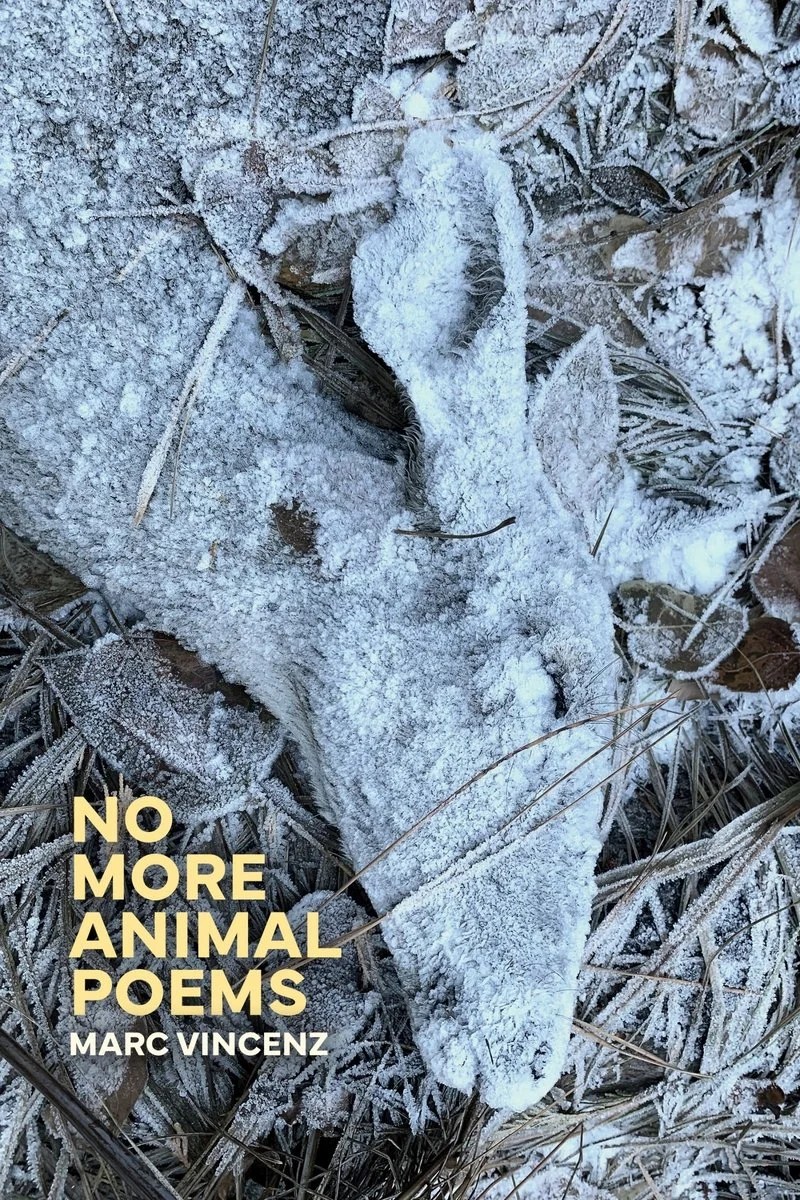
No More Animal Poems, by Marc Vincenz. Buffalo, New York: White Pine Press, April 2026. 160 pages. $20.00, paper.
Dan Campion is the author of the poetry books Calypso (Syncline Press), A Playbill for Sunset (Ice Cube Press), Star Anchors (Ice Cube Press), The Mirror Test (MadHat Press), the monograph Peter De Vries and Surrealism (Bucknell University Press), and is a co-editor of Walt Whitman: The Measure of His Song (Holy Cow! Press). His poetry has appeared in New American Writing, Poetry, Rolling Stone, and many other magazines.
Check out HFR’s book catalog, publicity list, submission manager, and buy merch from our Spring store. Follow us on Instagram, Bluesky, and YouTube. Disclosure: HFR is an affiliate of Bookshop.org and we will earn a commission if you click through and make a purchase. Sales from Bookshop.org help support independent bookstores and small presses.

