
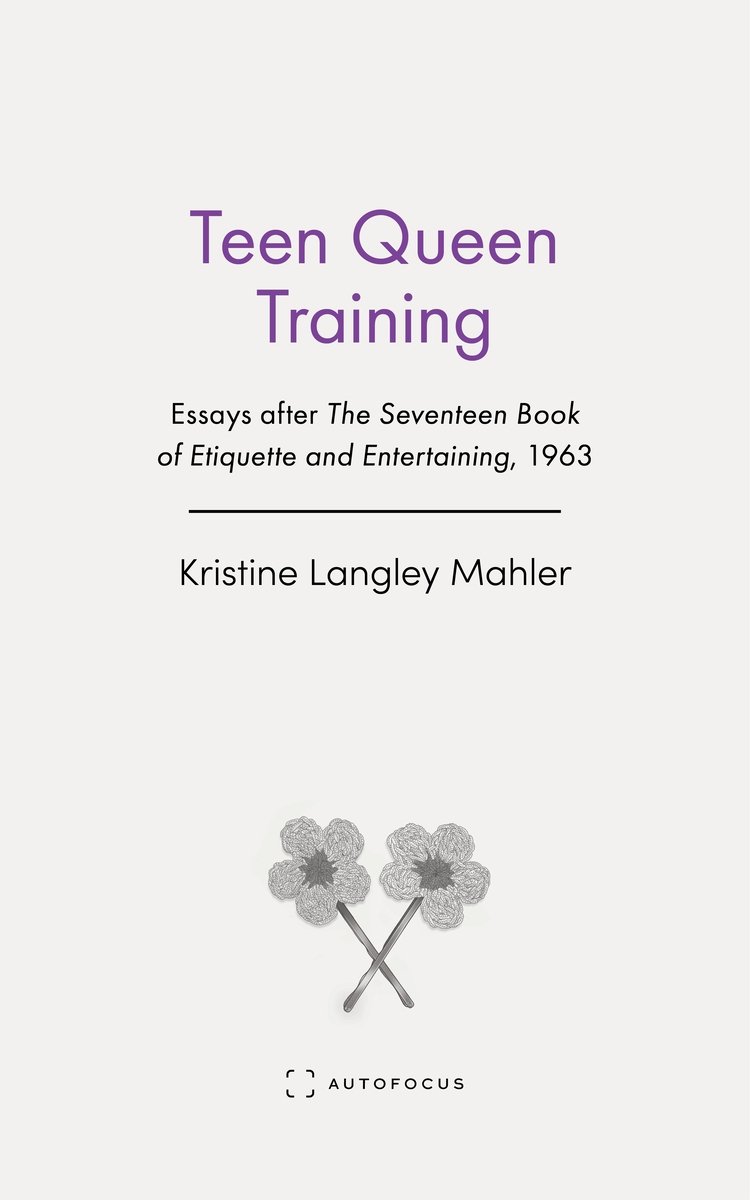
Readers of Mahler’s other excellent essay collections—Curing Season and A Calendar Is a Snakeskin—already know that form is clay in her hands, and she has a potter’s fine touch in shaping every word into a vessel brimming with beauty. In the case of Kristine Langley Mahler’s Teen Queen Training, equally inventive and lyrical, a master class in constraint essays and found forms, that’s quite literal. This collection’s twenty-six short essays, as Mahler notes in the short introduction, “are erasures created from The Seventeen Book of Etiquette and Entertaining by Enid A. Haupt.” Each chapter of Mahler’s book corresponds to one of the chapters in Haupt’s original handbook. Originally published in 1963 and reprinted frequently, Haupt’s book is a prim, ponderous manual of guidelines for young women. Table manners, travel etiquette, preparations for prom, impressing your beau and his pals, and mannerisms to adopt on the phone—for all these arenas and more, The Seventeen Book provides drills straight from the June Cleaver school of domesticity.
Before each chapter, Teen Queen Training includes a facsimile of the corresponding first page in Haupt’s Seventeen Book. The words and individual characters comprising Mahler’s chapters are circled, while the original, unredacted text remains legible. These interstitial pages stage the debate between Haupt’s didactic lectures and Mahler’s quick, ungovernable wit. This feature of the book is a gift to aspiring writers of constraint essays and found forms, a model for ripping the chaff from a source text and sifting it for narrative truth.
However, there’s a quiet lesson at work in these elisions. Through her cuts to The Seventeen Book, Mahler reminds us that we aren’t passive recipients of texts. Our minds aren’t vessels to be filled with information. Texts act on us—and we act on texts. That’s at odds with the didactic prose of Haupt’s book, with its exhortations intoned from the depths of a home economics room. Through the art of erasure, Mahler’s Teen Queen Training cuts through the edicts of “proper” girlhood and revives those scraps of language into a conspiratorial, playful, and wise voice in the ear. “It’s the classic description of someone who’s nice, good, noncomplaining: a bore,” she tells us, in the chapter “Good Sorts.” (Haupt’s original chapter title was “Good Sports Go Places.”) The good sorts and good sports alike are banal, boring, tediously unbothered, far too buttoned down. Maybe Billy Joel was completely off the mark, when he said that only the good die young; they’re too boring to get into any interesting scrapes.
Through her elisions, Mahler subverts the so-called rules and hints that all these strictures effectively contain their own escape hatches. The rules for proper behavior practically invite evasion and circumvention: “You are responsible, you go to your parents, ask what rules are frowned on, rules you’ll want to learn to keep interruptions at a minimum. You can be competent and content.” This sort of phrasing—snarky, clever—abounds in the pages of Teen Queen Training and exposes the subtexts buried under the layers of The Seventeen Book’s propriety. Mahler also crafts shimmers of the nineties and the aughts from this canon of mid-century etiquette. Here, there are references to Ginuwine, Cheetos, “Fiancée Mode” (which smacks of the various “modes” that have populated Instagram feeds in the post-COVID years)—all turns of phrase that render this project timeless, modern, and timely all at once.
In Teen Queen Training, the past represented by The Seventeen Book may be prologue—but we needn’t accept that fate. The erasure project of Teen Queen Training transforms the handbook’s idealized American girl from a pliant, obedient subject into an agent, fraught with interiority and conflicting wants. Specifically, Mahler’s cuts transform the stodgy direct address of Haupt’s handbook into a second-person narration crackling with lyricism and the live-wire emotions of teens. It’s worth comparing some selected prose from Mahler’s “A Spectator Event” to the source chapter in The Seventeen Book:
HAUPT: Performers need a good audience to inspire them to do their best. [. . .] The point of entertainment is to enjoy the performance. Manners like these will make you a good member of the audience . . . .
MAHLER: The true theater of a girl glitters with excitement, a shimmering display of technical skill: the point is the performance. You’ve been restless and bored. You want to be a success, so you don’t suggest the evening you’d like—that would cost more than the show you’d have to give.
Mahler’s prose prickles with an all too familiar pins-and-needles sensation: nerves, agitation, stress. Where The Seventeen Book imposes guidelines on how a girl should behave on a date, Teen Queen Training dramatizes raw and real emotions. Mahler has chiseled off the bark of the handbook’s language, here, and exposed the heartwood of narrative interiority.
Throughout, Mahler’s second-person narrator is dynamic and nimble, leveraging the second person’s capacity to step back from characters and offer clairvoyant, compassionate commentary. “The real problem for every unattached female,” Teen Queen Training cautions at one point, “is the expectation that a kiss has value.” At other turns, this play with the narration’s emotional distance undercuts the assumptions about girlhood in ways that offer avenues for liberation and self-discovery: “The art of appearance, the knack of knowing how to kill with a dress—it’s like a boy: predictable, changeable, indispensable. A lock. [. . .] You like a pattern; you don’t like every boy.”
Because of Mahler’s elisions, the guidebook is no longer a text that dispenses pre-packaged knowledge: Teen Queen Training is a narrative that taps into the anxieties of adolescence, the tension between what’s expected of teen girls in America and their efforts to cultivate their own identities.
Teen Queen Training: Essays After the Seventeen Book of Etiquette and Entertaining, 1963, by Kristine Langley Mahler. Easton, Pennsylvania: Autofocus Books, February 2026. 158 pages. $18.00, paper.
Patrick Thomas Henry is the author of Practice for Becoming a Ghost (Susquehanna University Press, 2024), which was long listed for the Story Prize. His work has appeared in the Denver Quarterly, West Branch, and elsewhere. He teaches creative writing at the University of North Dakota. You can find him online at patrickthomashenry.com or on Instagram @Patrick_T_Henry.
Check out HFR’s book catalog, publicity list, submission manager, and buy merch from our Spring store. Follow us on Instagram, Bluesky, and YouTube. Disclosure: HFR is an affiliate of Bookshop.org and we will earn a commission if you click through and make a purchase. Sales from Bookshop.org help support independent bookstores and small presses.

