
Orville, prostate on a Jeep’s hood under a blaze of stars, aimed his gun at imaginary targets. A print of his wife’s last email dropped from the hood onto the desert’s sand. Orville’s typical scowl became a mean grimace after reading: “Don’t be angry now, but I’m in love with Denzel and we’re going to have a baby.”
Denzel was Orville’s cousin.
“Jackson, get off that damn hood,” the CO finally said, after Orville had been out there for an hour. “I said get down. Goddamn it, Jackson, move!”
Our base sometimes got mortared.
When Orville didn’t respond, the CO hissed: “If you don’t get off that friggin’ Jeep, I’ll friggin’ blow you off it myself.”
Flares illuminated Orville’s grimace—dazzling descents in night’s blackness on the other side of the wire.
“Ohhhh, don’t worry, sir,” Orville said, “someone’s gettin’ their ass blown away for sure—and it sure ain’t gonna be me.”
Jackson became more washed by certainty’s froth than any atheist or believer I’d ever met. Something mystical, like the aurora borealis, surrounded him in the glow of those flares. Someone gripped by the fate of blowing away the Unfaithful Old Lady couldn’t get zapped in some stupid war. He became the Crazy, Blessed Dude who would get justice back home. No way he could get greased. Everyone wanted to be in his Humvee. His protecting magic got confirmed when a vehicle travelling behind his Humvee got wrecked by a roadside bomb.
“Lucky motherfucker,” we said, when someone got the seat beside the magic man.
The Great Mystery wasn’t going to let someone with Orville’s destiny get a scratch. We were convinced. Special perception radiates from death’s proximity, your strobe-light senses dormant under daily life’s sameness. We could detect what radar couldn’t. We could smell good and bad luck. Bad luck at home had smeared good luck all over Orville in war.
A cell-phone-detonated bomb exploded two yards from Orville just as he stepped behind a tree. The trunk split the blast’s wind. Orville remained unscathed in a half-yard-wide, ten-yard-high rectangle of still air. Killer wind had shot by him on both sides.
“See,” he said. “I’ve got a mission.”
His dry cackles swirled with the base’s brown dust.
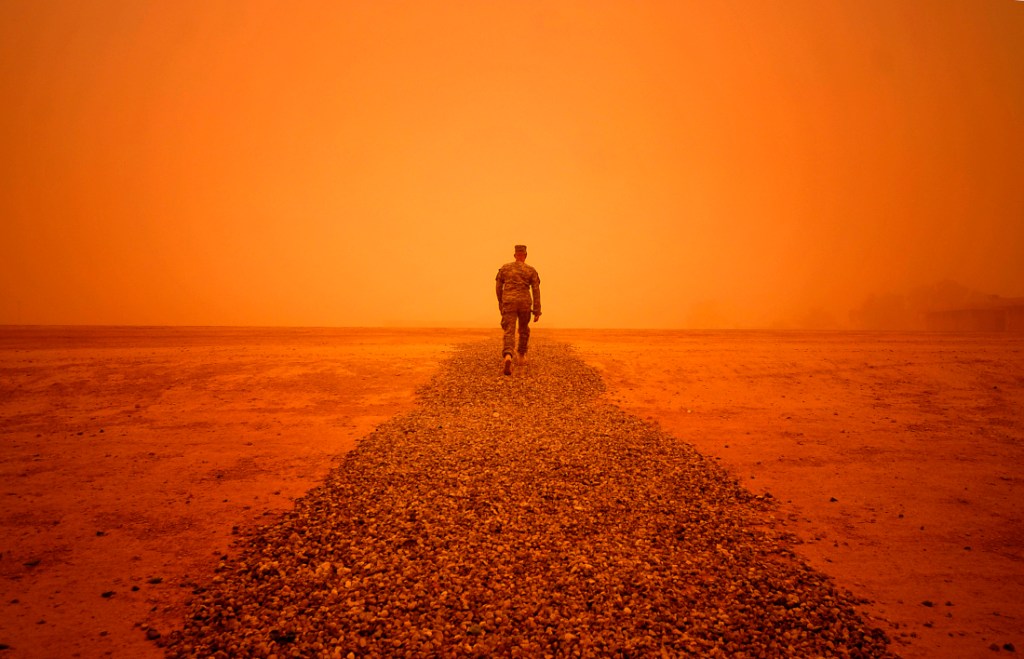
When I got transferred away from that magic, I again felt the shiver of the unknown. If you must know what’s coming next, war murders you. I was a short timer: even the desert’s sands could rise up and strangle me. The wind could become deadly gas. Birds could now drop bombs on me. Even the kids resembled killers hooked on retribution.
I released the mother of all exhalations on the plane as it took off to get me out. The pilot asked us if we wanted to do a quick detour over where we’d been based; everyone screamed: “No fucking way!”
Someone leapt out of his seat, screaming: “Get the fuck outta here!”
The sand I brought back from the war sits in an hourglass on a shelf in the living room. That sand makes me love home. I sometimes turn up that hourglass. The sand’s descent resembles death’s inevitable approach. I watch that sand while imagining someone, with a scowling grin, pumping cartridges into a shotgun on a dark, dog-howling, Tennessee-backwater night. I can hear the gun being snapped shut. I can see the shooter’s bitter eyes.
Then imagination stops as the sand whispers into alleviating silence, and I stop seeing things I now don’t need to see.
Kim Farleigh has worked for NGOs in Greece, Kosovo, Iraq, Palestine, and Macedonia. He likes painting, art, bullfighting, photography, and architecture, which might explain why this Australian lives in Madrid. He has received 243 acceptances from over 100 different magazines.
Image: DVIDSHUB. commons.wikimedia.org
Check out HFR’s book catalog, publicity list, submission manager, and buy merch from our Spring store. Follow us on Instagram, Bluesky, and YouTube. Disclosure: HFR is an affiliate of Bookshop.org and we will earn a commission if you click through and make a purchase. Sales from Bookshop.org help support independent bookstores and small presses.

