
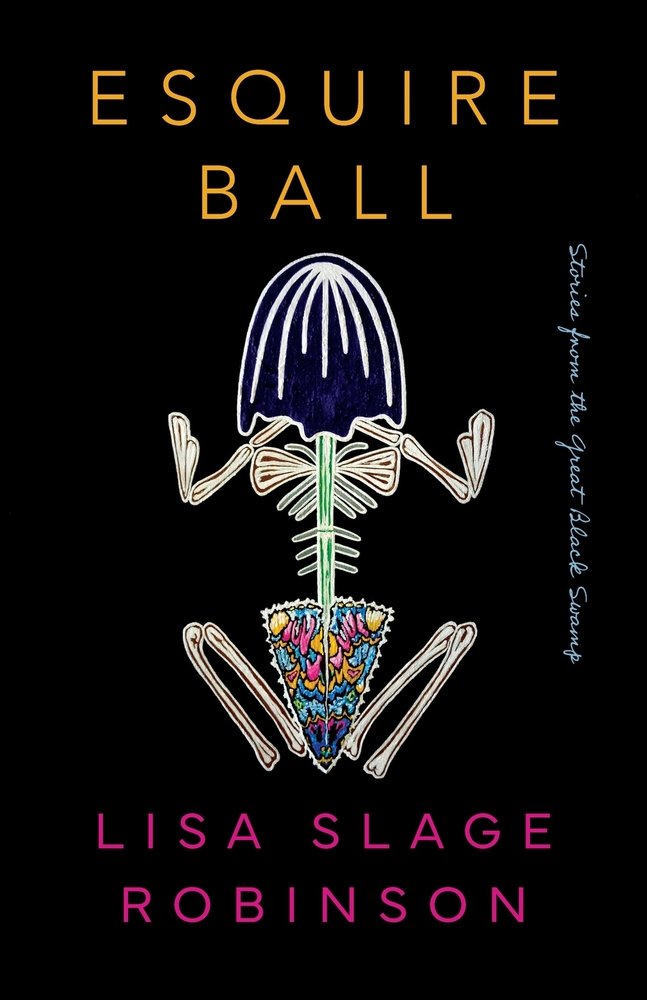
To dive into Lisa Slage Robinson’s 13 electric short stories in Esquire Ball is to enter a world where the women must use wit, vim, and chess-like precision to survive a legal landscape fraught with land mines of male ego, greed, and desire. While the stories shift in point of view and plot, a recurring protagonist—a sharp, clever woman named Cissy—flits in and out of the collection, darting from one opportunity to the next, always trying to stay three moves ahead of her male counterparts. She doesn’t just change tactics, she also seems to alter her appearance, depending on the situation: “Her short hair slicked back like wet feathers. Her nose beakish. One side of her face appeared flat, almost smooshed, a sliver of a scar underlined her eye. The other side regaled a high cheekbone. As she pivoted from side to side, with every beat, she morphed from sparrow hawk to Russian princess.” Cissy is no fool. She knows how the story ends if she doesn’t keep up the camouflage.
Each tale in this collection offers delicious details of place and sensation—from murky bogs where bad lawyers might be swallowed up by a frog princess to boardrooms thick with cigar smoke and bourbon. Robinson dances skillfully between the real and the speculative, shifting gears with ease and delivering her brand of dark humor and sharp insight, often in a single deadly line.
In “Salad Days,” a young lawyer contemplates what survival will require of her: “the whole rotten mess stunk so bad that I could no longer ignore it, I cultivated my own little garden of meanness, first planting the seeds of observation and then watering it daily with practice.” Without this hardness, she knows she will fail. At Strathy, McMahon, she is surrounded by “every sort of viper, opportunist, and backyard bully.” She must remain cold as ice—“like the Foreigner song.” We are reckoning with a protagonist who is just as likely to bite her partner’s lip until it bleeds as she is to let him take her home.
From the murky bayou and lily pads of a secret society emerges a system promising not only advancement within the firm but a grotesque domestic fantasy: little tadpoles in a pickle jar that grow into compliant wives who iron shirts and fix dry martinis. The satire is sharp, absurd, and chillingly plausible.
We believe these stories because Robinson, who worked as a corporate lawyer and litigator, knows the legal landscape well and can intertwine lived experience with speculative invention, most notably in the title story and “Legend.” But whether she is spinning a tale about a fearless, fedora-wearing thief in “Fruit of the Poisonous Tree” or a young woman hardened by institutional cruelty, the characterization is consistently spectacular.
Beneath these stories lies a blunt truth: how difficult it is to survive in a profession still dominated by men. In “Mack the Knife,” a woman lawyer is not simply another professional at the firm but a glittering anomaly. “They discuss your credentials in the Main Boardroom … Thirty Chippendale chairs to be occupied by twenty-nine men and one woman.” Robinson’s stories look directly at the compromises women are asked to make—how far they will go, what they will trade, whether sleeping with a powerful man might be the only way forward. Yet there is no defeat here. When one woman realizes she has the power to stop a terrible man from rising, she understands she must act: “I remember the grip of the steering wheel … the power in taking the road, shifting gears. I know I can no longer afford the privilege of looking the other way.”
At times, the stories end without a clear resolution. This may feel unsettling, but it seems deliberate. The collection is held together by a strong thematic thread rather than tidy conclusions; there is no single way to solve these challenges, no clean exit from the systems the women inhabit. Perseverance, attentiveness, and the refusal to give up are the only tools consistently available—and Robinson trusts us to sit with that uncertainty.
The female characters in Esquire Ball are doers, not wallflowers. They may be pretty, smell like honeysuckle, worry about a run in their stockings; but what they share is an understanding that their time at the ball requires both a costume and a plan. Robinson’s stories insist that survival is not accidental but chosen—and that wit, preparation, and resolve are required not only to keep being invited to the party, but also to enjoy the dance.
Stories from the Esquire Ball, by Lisa Slage Robinson. Mount Vernon, New York: Black Lawrence Press, February 2026. 158 pages. $17.95, paper.
Aimee LaBrie’s short stories have appeared in The Minnesota Review, The Rumpus, Swamp Pink, Iron Horse Literary Review, StoryQuarterly, Pleiades, Fractured Lit, Beloit Fiction Journal, and others. She is the author of two short story collections, Rage & Other Cages and Wonderful Girl.
Check out HFR’s book catalog, publicity list, submission manager, and buy merch from our Spring store. Follow us on Instagram, Bluesky, and YouTube. Disclosure: HFR is an affiliate of Bookshop.org and we will earn a commission if you click through and make a purchase. Sales from Bookshop.org help support independent bookstores and small presses.

