
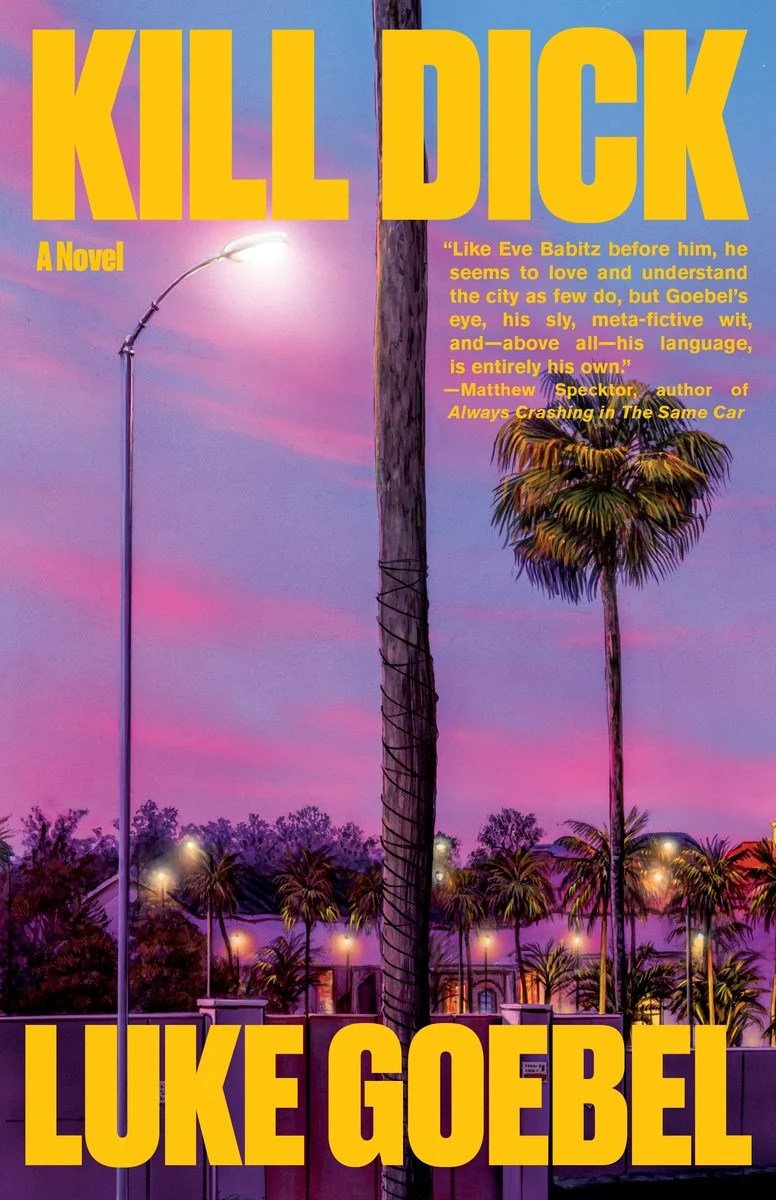
Readers entering the world of Luke Goebel’s new book, Kill Dick, should prepare to face the proverbial Good News and Bad News. On the downside, it’s a trip to the fall of 2016 when the “orange haze of doom” is not in the rearview mirror but instead steamrolling full speed ahead. An unfortunate stint in the time machine, perhaps even more terrifying than waking up to find yourself in the spring of 2020. This is an extreme world we are thrown into. A fever dream of privilege and power, of non-stop profits and losses, of opioid empires that burn everything they touch. This is wildfire. This is a cat and mouse game where both the cat and the mouse have completely lost their shit. On the upside, we are in the skilled hands of a writer like Luke Goebel. Just as Ken Kesey safely guided the Merry Pranksters through electric-kool-aid peril, Luke has your spirit in mind, gentle reader. Hold on to your stomach and take the leap.
It is the story of Susie Vogelman, a nineteen-year-old NYU dropout, facing crumbling worlds at every possible level, the micro and the macro, and everything in between. Her own breakdown, her family breakdown, her friends and loved ones, the city, the country, the whole damned world. It’s all crumbling. People around her are getting killed. A serial killer bent on performance art is killing junkies and leaving their bodies in various form of statement. It is way too much to deal with. As we meet Susie, her mind prefers other things:
That fall was full of drama, but Susie wasn’t paying too much attention. Not to the coming election, or “the killings,” or the orange haze of doom that loomed on the horizon. Her mind was on the winds that carried the tawny dust from all over Los Angeles. She listened to the howling, slurped some drool. Her skin was burning through her tanning oil, but that was okay. Back in New York, she always stayed so pale. She’d been home since she’d dropped out of NYU about, what—a year year and a half ago? Who could keep track of all the time? She’d spent most of it snoozing by the pool, feeling nothing, high. Dried cornflakes on her chin stuck like glue. She was safe. This was Brentwood. The barbarians at the gate didn’t know the guards in the entrance pavilion.
The cast of characters are quickly introduced: Her father, the Attorney for Dick Sickler, head of an opioid painkiller empire. Her former teacher from NYU, Phil Krolik, and his junkie twin brother Pete. There’s a killer on the loose, attacking street junkies and staging their bodies for ultimate shock value. The victims are too close to Susie for comfort. When it gets to be too much, Susie insists on shifting the narrative from first-person to third in a move that flirts with metafiction, but lands mostly on a narrator conscious of her story’s novelization. Susie knows her story must be told. Never a distraction, Goebel always smooths the waters. It’s amazing how we are drawn to sit with characters and scenes where the reasonable inclination would be to flee.
Several propellers keep the pages flying. Who is the killer? Will Susie save herself? Will Phil save his twin brother Pete? Will Dick get what he deserves? KILL DICK. Who is making that imperative? Who should answer the charge? Can any of us really be saved?
Perhaps the strongest propeller is Susie. Even with all of her flaws, it’s impossible not to root for her.It might be the trickery of a fun-house mirror, but there are a lot of angles to see her with, and all of them lead us to wanting to save her. Best-friend, ex-best-friend, girlfriend, ex-girlfriend, sister, daughter, granddaughter, genius, maniac, victim, killer. Even when you aren’t sure what she is, it’s impossible not to want her to survive. Maybe by being all of these things, she’s all of us:
I would need to devote myself entirely to my purpose, something Mom never accomplished, but maybe she was proud of me that I was digging into my addiction at such a young age, so I could get it out of the way, and become who I was meant to be as a mystic, as the family’s only hope, as a pure artist, as Apollo. Or was she just fucking with me?
One way she always wins is that she’s always able to see beauty. The same way California is undefeated. No matter where the plot leads, you can always take a second to appreciate the beauty:
To the right and out was Beverly Hills. The fading dream of empire. The sky was a theater of grey and silver with patches of blue and edges of white against the darker clouds. The blue sky and the sun were alive. I crinkled my eyes against the orange ball dropping west and slipped on some cheap scratched-up sunglasses I was happy to find hanging from the rearview mirror. Ahead, the mountains were lush green lit up almost monochromatically by the sun.
The book is as multifaceted as its characters. Depending on which angle you look at, you might see Thomas Pynchon, Hunter S. Thompson, Stanley Kubrick, or David Lynch. You might see Gibbons and the fall of Rome. You might see an unnatural progression from Beverly Hills, 90210 to Melrose Place to whatever this new thing is called. You might see Jay Gatsby on acid, a whole trail of green lights leading to nowhere. A strange new band covering “Born to Be Wild” in a tempo you can’t quite measure, but you know it’s different. It’s different.
The book felt generational to me. I don’t know if that’s even the correct term for it, but it clearly set its sights on the micro and the macro. It doesn’t go big to understand the small, or vice versa—the two views are completely embedded. The macro is a main character of the book, this state we find ourselves in now, whatever you want to call that. The post 9/11, post dot-com-bubble, post Banking collapse, the POST. The orange haze of doom. The haze of Oxy, the HAZE. This is the new GENERATION. In the face of the proverbial this is not us, the book forces us to admit that it is. This is absolutely who we are:
Blindness and darkness everywhere. Wasn’t that how everyone felt lately? Strange blinking days. Dim groping hours. Heading toward the worst election in the history of the nation. Fuck the nation. No … he [Peter] was an American. Perched precariously above the cliffs of disaster, ready for the smashing of democratic pillars that kept the whole system from tumbling down; a lot of losers were rooting for it, total destruction. They leaned into it, the vertigo, desperate for the plunge. He wasn’t stupid. He wasn’t wearing a Guy Fawkes mask, jerking off in his parents’ basement.
Maybe nothing makes a generation more than being forced to look at itself. Maybe that’s the way the ground is broken. The way of the Great Depression, of World War II and the Atomic Bomb, of the Sixties and its loaded table of Civil Rights, Viet Nam, Free Love, and LSD. The load of the lies and truths we tell ourselves. Out of the ashes of a generation that never got their fair denouement, comes the new boss and its late-stage capitalism, social media and influencer pageantry along with new drugs that can’t be played around with. Not for low stakes. If this isn’t the bottom, these people don’t know what is. And maybe that’s the book’s ultimate turnaround, these 2016 repeaters don’t know what 2020 to 2026 has in store for them. Yet.
Kill Dick, by Luke Goebel. Pasadena, California: Ren Hen Press, April 2026. 280 pages. $26.95, hardcover.
Al Kratz writes from Indianola, Iowa, which is a quiet hilly place south of Des Moines. His current obsession is blending rock history and journalism into his fiction. More about his work can be found at alkratz.com.
Check out HFR’s book catalog, publicity list, submission manager, and buy merch from our Spring store. Follow us on Instagram, Bluesky, and YouTube. Disclosure: HFR is an affiliate of Bookshop.org and we will earn a commission if you click through and make a purchase. Sales from Bookshop.org help support independent bookstores and small presses.

