
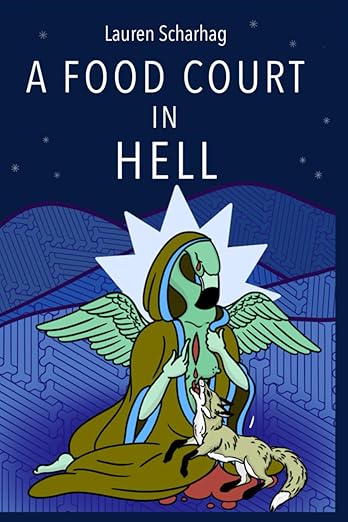
I am here to give people the good news about Lauren Scharhag, if you do not already know. She is a treasure of contemporary poetry; not only because she offers us our lost histories in vivid color and taste, but because she heals the exit and entry wounds as she works. She, in many ways, sacrifices herself for her truths, laying open her bare chest to the hyenas; becoming sick in drinking the antidote: “Eventually, every healer meets the disease they cannot cure.”
She speaks of the static after the old patriotic film on late night TV, the one that scared us awake as we “whistled past the graveyard and left us all behind to become ghosts.” She mythologizes and spiritualizes the mundane to work a spell on our magic-bereft society and she does so with an explosion of paint and a clarity of brushstrokes:
your name means throat
in the gullet a gargle a guttural language
a protruding tongue a tempest lexicon
where wind is your phonetics
and rain and marble your elocution
In Scharhag’s words, every evil in our world is a talisman of its own defeat:
I buy a balsa wood diablo puppet from a street vendor, crimson as sunset, to remind me of my shadow self.
Each symbol is a sin is an admission. We kill the fox to kill the shadow self when we ought to be burying it.
Let us all fly from these shadows and ashes and cages together. If the doorway isn’t open, we’ll gnaw our way through.
There are no devils but in our own fears, and our fears can be distilled, weaponized, spellbound, and used for our own escape.
She has conversations with death which many poets would shy away from. Thank God she is as brave as she is honest:
Death said, Build a scaffold. Make of yourself an offering to mosquitoes.
Their supply of teeth is endless.
Next, Death sent me a bouquet of crows. He said, Marinate yourself in key lime juice and lie down for the fire ants.
Somewhere, Death is waiting for Disney’s frozen head to thaw.
This body is just another pit stop. Death says, The road is all there is.
Scharhag infuses a sardonic humor into her work, which doesn’t do much to ease the suffering but it does show the idiocy of this reality and its set of contradictions. Somewhere in conjuring the darkness, Scharhag gains power over it from the inside, and she has a way of transmuting it through her craft and sarcasm enough to give it an enchantment and a force:
Please, let these hands hold out just long enough to finish. I am a nut cracked open, scraped of meat, shed skin, ash. Possession is a haunted body, a demon straddling this contraption like a mechanical bull rider. The sacrament’s just spook bread, host and holy ghost, just as I am bull and rider, spiritual switch-hitter. I buck. I drink fire. I am a tabernacle begging to be filled. Eventually, I will scratch my way out of this bone box. We bury to unbury. We are subsumed to resume. Sprinkle the earth with blood-red blooms. God is a kid spray-painting cocks on tombs. The silence of the grave is a lie. You can hear the party going on in the room next door, your lover’s voice asking, Baby, was it good for you?
Scharhag, like many of the better poets, somehow describes the indescribable, and does so with the flair and skill of a mystical tour guide. Yet, she is also travelling on this ghost bus with us, she has a stake in how the bones fall or lift. There is an immediate emotional and existential pull in these poems which is not only mesmerizing, but vital to restore a spiritual dimension to our flat TikTok screens.
Being a writer of prose, especially horror and fantasy, Scharhag is adept at writing dialogue and also stage directions like a screenplay:
Human sounds [machine-gun-fire-like laughter] [urinating forcefully] [loudly implied cannibalism]
Music [tense, percussive] [unsettling, atonal] [dire synth notes]
Ambient noise [cellphone bloops] [demonic mumbling] [audio warbles disconcertingly]
Descriptions that, themselves, defy description [Intensity intensifies] [Spock sobbing mathematically]
Text translation fails [These symbols mean stuff in Japanese]
Malapropisms and mondegreens that you hope are the fault of poor speech-to-text programs:
Read Off the Rent Those Reindeer
I did my job with a plum
Firefighters deal with people ejaculating
In A Food Court in Hell, Scharhag dazzles with her talent and her experimentation and hits us in the gut with her power. Throughout her many books of poetry and prose, she always weaves a hidden world into this one, through archetype and pop culture and the sirens wailing in the night. Every new offering from her is a necessary return to a dreamtime which is more real than reality, as she states: “They say all sorts of things aren’t real that are, and only a demon can slay a demon.” She is simultaneously the demon and the demon slayer, and all the sky and lava in between. Her words offer us dimensions laden with pomegranate and myrrh, ones which tie us to our ancestors, to our deaths, and to all the births we have left to live through.
A Food Court in Hell, by Lauren Scharhag. Independently published, November 2025. 88 pages. $15.99, paper.
Scott Ferry helps our Veterans heal as a RN in the Seattle area. His most recent books are 500 Hidden Teeth (Meat For Tea), Sapphires on the Graves (Glass Lyre), and dear tiny flowers (Sheila-Na-Gig).
Check out HFR’s book catalog, publicity list, submission manager, and buy merch from our Spring store. Follow us on Instagram, Bluesky, and YouTube. Disclosure: HFR is an affiliate of Bookshop.org and we will earn a commission if you click through and make a purchase. Sales from Bookshop.org help support independent bookstores and small presses.

