
In the kitchen, no one moves too quickly.
Plates are set down with care.
Chairs slide in small increments.
A cabinet door is closed with the flat of a palm instead of a snap.
Porcelain animals watch from mahogany shelves—
a fox mid-pounce, a deer with glassy eyes,
a white horse frozen in a permanent lift of one hoof.
They have outlived every conversation in this room.
They will outlive this one.
Family photos line the wall above the table.
Smiles held in place.
Eyes unblinking.
A wedding. A baptism. A man holding a baby he no longer holds.
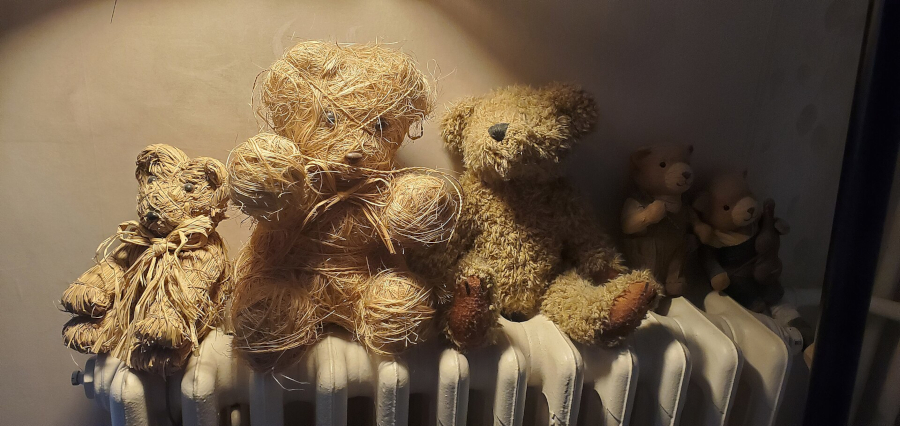
The bear sits at the head of the table.
He does not move.
The chair beneath him has learned his shape.
His breath is wrong.
A wet, dragging rattle that pulls up from somewhere deep and ruined.
Each inhale sticks. Each exhale comes loose in pieces.
The sound of something enormous failing.
The room orbits him.
They pass each other by memory—
the long way around,
the narrow path between rug and wall,
the place that does not wake what should not wake.
A fork stalls halfway to a mouth.
A glass sweats onto a coaster.
Someone laughs too loudly, then edits it into a cough.
They say he is tired.
They say he had a hard childhood.
They say he feels things deeply.
They do not say he is dying.
They do not say where the cub sleeps.
A door down the hall stays closed.
Inside it, a small body learns how to be quiet.
The bear exhales again.
The room bends.
Then Noemi speaks.
She has not learned the shape of the room.
She sits near the window, a woman the shape of sunlight.
Her hands rest openly on the table.
She does not lower her voice.
“So,” she says. “They say you have made something this year.”
Forks stop.
The bear opens one eye.
“What did you learn?”
The bear clears his throat.
A thick sound.
A mountain shifting.
“My capacity for love is huge,” he says.
He waits for approval.
The room exhales.
Someone nods.
Someone smiles.
Someone reaches for bread.
Noemi does not.
She looks at him the way you look at fur matted to asphalt—
trying to place the moment everything went wrong.
The way fur still holds shape.
Plates detour.
Chairs angle away.
Conversation learns new routes.
“He’s only sleeping, honey.”
Everyone speaks softly,
as if volume might be the thing that finally proves he isn’t.
Later, in the kitchen, she says it quietly.
Not to him.
To someone who will carry it.
“A dead bear,” she says.
“That’s what he is. A dead bear.”
They correct her.
“A deadbeat,” they say.
“Men like that.”
She shakes her head.
“No,” she says. “A bear.”
They say she hates men.
They say she doesn’t understand.
They say she has no right.
In the hallway, the door remains closed.
Inside it, a small body matches the rhythm.
Ari Cordovero is a writer based in Colorado. Her work explores femininity, lineage, and the strange architectures of intimacy. She has work forthcoming or published in Pictura Journal, Blood + Honey, and elsewhere, and is currently at work on a memoir-in-essays. She lives in the mountains with her daughter, Goose, where she is learning to find holiness in ordinary things.
Image: Harmonide, commons.wikimedia.org
Check out HFR’s book catalog, publicity list, submission manager, and buy merch from our Spring store. Follow us on Instagram, Bluesky, and YouTube. Disclosure: HFR is an affiliate of Bookshop.org and we will earn a commission if you click through and make a purchase. Sales from Bookshop.org help support independent bookstores and small presses.

