
Category: l’Hôtel Dauphin
-

Restored Fiction: “Slow 9/11” by Dolan Morgan
“Can you describe a time when someone betrayed you?” This question is posed to me by Jan during a round of the Ungame, which I play over lunch with a group of colleagues in our architecture firm on the 92nd floor. The Ungame looks deceptively like Candy Land but is described, in its product materials,…
-

“An Angry Bull Loose in a Video Store”: Jesse Hilson Reviews Steve Gergley’s Novel Skyscraper
Anyone who has shown up for a new job at a large, intricate organization and tried to get their bearings in the workplace will be able to relate to the germ of the idea behind Steve Gergley’s new novel Skyscraper. A 23-year-old man named Dan Simmons’s would like to play video games and watch action…
-

Shannon Hozinec Reviews Meghan Lamb’s New Novel COWARD
Meghan Lamb’s COWARD opens with a burning sky that smells of blood. This is no harbinger of the apocalypse, however, as one might assume—we are promised that this burning is “natural, […] a part of life”; that it happens every year, and that there is an “other side”—an end—within reach. We need only sit and wait until…
-

Review: Eric Williams on Can Xue’s Experimental Novella Mystery Train
There is a letter that Dante wrote to his patron, the powerful warlord of Verona Cangrande della Scala, in which the poet explains that, with regard to his work, “… non est simplex sensus, immo dici potest polysemos, hoc est plurium sensum,” meaning, roughly, that his Comedy “… hasn’t a simple meaning, rather it can…
-

The PornME Trinity, the 2nd Edition of David Leo Rice’s novella, reviewed by Dave Fitzgerald
Though I haven’t ever been able to source the original quote, Chuck Klosterman once shared a borrowed sentiment which has endured, for me, at least as strongly as anything else he’s ever written (and I’m a pretty big fan). The quote of the quote, from I Wear the Black Hat: Grappling with Villains, reads as…
-

“Risking Chaos”: Marcus Pactor Chats with David Leo Rice, Author of The New House
David Leo Rice writes singularly weird fiction about the experiences of artists and drifters wandering hallucinatory landscapes. His latest novel, The New House, is a kunstlerroman focused on a child named Jakob, who trains to be an artist in a town of sentient dolls, blood clots who are sisters and lovers and advisors, and men…
-

“Capturing the Is-ness of Liminal Events”: Avinash Rajendran’s Dual Review of Rites and Thin Places
“What are these dark days I see in this world so badly bent … How much longer can it last? How long can it go on?” Dylan asks prophetically in his 2020 album, Rough and Rowdy Ways, a question that has endured in our collective imagination for two years now. The Marxist theorist, Antonio Gramsci…
-

David Leo Rice’s New Novel The New House, reviewed by Dave Fitzgerald
My wife and I still talk often about the term “art monster”—first coined in Jenny Offill’s 2014 novel Dept. of Speculation, and introduced to us via Claire Dederer’s 2017 Paris Review article “What Do We Do With the Art of Monstrous Men?” (we don’t exactly have our fingers on the pulse, my wife and I).…
-
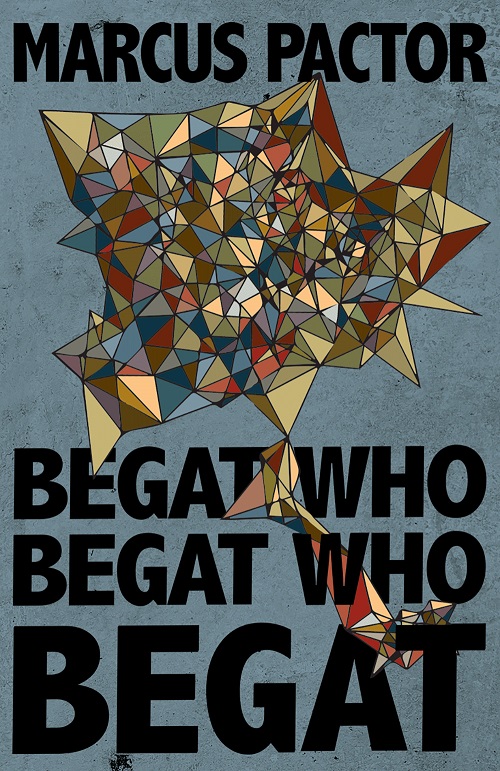
Begat Who Begat Who Begat, short stories by Marcus Pactor, reviewed by Maxwell Malone
Marcus Pactor’s sophomore short story collection, Begat Who Begat Who Begat, explores the deceptively complex topics of mundanity and domesticity through experimentation in both rhizomatic storytelling and narrative form. Over the course of the collection’s 122 pages, Pactor presents 17 stories situated just left of reality. Across varying subjects, such as a toilet that transmutes…

