
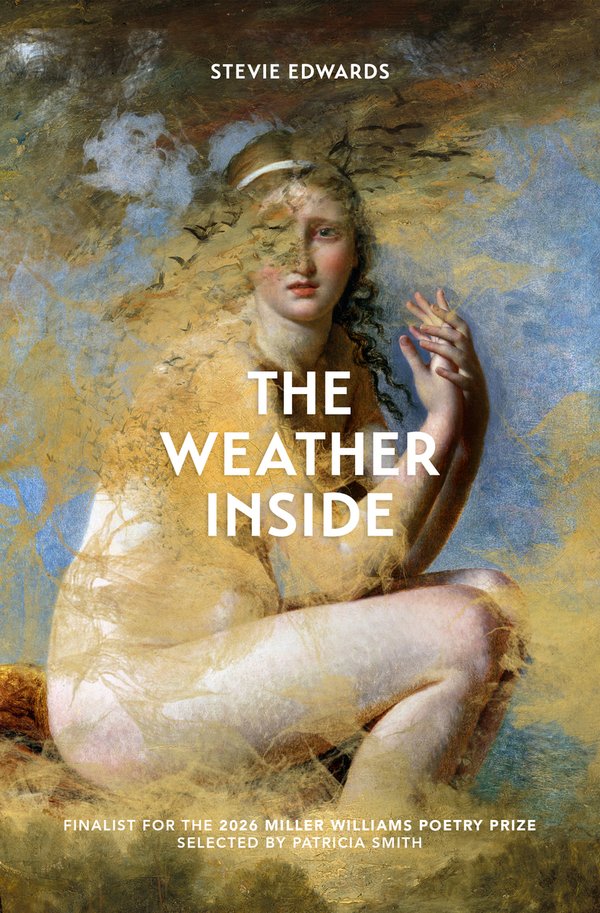
The Weather Inside, by Stevie Edwards, is a three-part collection of poems about the human longing for connection and how it strains against the necessity of standing alone. Here, occasional humor is used to bring us closer to the individual speaker’s perspective, opening private doors just a crack so we can not only see but feel what the weather’s like in there.
One of the main themes of this volume is childlessness, the unrelenting grief of knowing, in poems like “My Dear Felicity,” that “I haven’t made the right life to rock you to sleep” and in “Childless,” that holding someone else’s newborn may always be a “journey … / into the secret life / where I am a mother.” In “Apology,” while “the dream of a pigtailed girl / fades into the cold grey dusk. / February digs its icy nails / into my thigh, sits on my lap / and sighs.”
Another theme is how much calmer it can feel to stay sober and grow older. In “Ode to a Three-Bedroom House” we find “it’s easy, / easier, to live in this house than the shambles / of my twenties.” But the calm isn’t due to the bliss of ignorance; it’s simply a widening of perspective, accepting that, as Auden observed, suffering can take a “human position.” Like in “How to Make Beef Stew,” where we are instructed to
Brown the blood-red
cubes of sacrifice
and sprinkle a little flour,
salt, and pepper on top
so they cover the dead
animal a little like snow
can coat a body frozen
alone on the ground
with its guts bursting
through a new opening
it never wanted.
Part of getting calmer as the speaker ages is her growing urge to “be a slow animal, / to hold a spinal twist until / my left hip releases its history / of tensing against the world.”
But in the second part of the volume, we go deeper and find that calmness might be hiding chronic pain. In “The Lie” we’re told that
people are always saying they’re grateful
for how the storms they’ve survived have spun them
into the spells they are today,
but I know this is a lie we tell ourselves to swallow
the past, the spoonful of sugar
we need to keep it all down.
…. I know this
in my bones. It stings and aches, pops
when I turn my left hip.
Yes, it’s that same hip.
In “Yes Ma’am” the speaker wants to take up space, to present herself “as cruel and magical as I’ve earned the right to be by staying alive.” And in “Heat Wave” the façade of calmness is revealed when the speaker says “spray a little champagne on me / and I will melt into a pile of who I once was— / fire and spice, a menace to neighbors and lovers alike. / I am not that loudness anymore.”
The way the speaker of these poems presents herself is changing as she feels simultaneously calmer and fiercer about the necessity for self-presentation. At a “Gender Reveal Ceremony” she thinks “I was raised to want / to be the princess. I admire her / dresses but hate wearing anything / so tight around the waist.”
In part three, the supports for the seeming calmness of this current life are revealed, in an attempt to establish a perspective on the extent to which the speaker can say hers is a life well lived. In “Housekeeping,” for example, the speaker reflects on
how
greedy it feels to cook steaks in a house
grander than my parents’. To hire
someone, to have another human
scrub my dead skin and stray hairs
from a shower.
In “Elegy for an Office Plant,” the speaker realizes that “I treated you with the same / level of absent-minded neglect / as I was raised to despair.”
“How to Make Peach Cobbler,” works in contrast to the earlier beef stew recipe poem, declaring that
peach cobbler
a la mode is a mode of prayer,
of giving thanks for the summer,
which has been kind despite its burning
up the flowerpots.
We’re left with ideas about the personal, what’s close to home, what small things the speaker of these poems can control.
There’s a marked contrast in the tone of the poems from the beginning to the end of this volume; from the speaker’s unrequited longing in the first poem, “Father’s Day”:
It’s selfish,
but sometimes I look at my love’s
long dark lashes, his high cheekbones,
and think—O God, I need more
of him.
to the last poem of the volume, “Vows,” which shows a calm acceptance of the speaker’s childless state. She says, of the same love, her husband: “with your heart / I will be careful and behold it like the delicate neck / of a newborn.”
Knowing where the calmness is coming from helps the speaker feel in control of her life in a way she hasn’t felt before. As she says in “Self-Portrait as Chrysalis,”
a chrysalis is an overplayed image in poems,
but hear me out—I have spent twenty years in a cocoon
of alcohol, alcohol wrapping around all my youth’s
slime and growth. I have spent twenty years
waiting to see what happens when I grow up and learn
to handle my liquor.
Humor and an enlarging perspective make this volume more than just a personal journey; we feel the weather and see the details from each passing view, the experiences that help keep the speaker of these poems on the road to her own particular type of fruition.
The Weather Inside, by Stevie Edwards. Fayetteville, Arkansas: University of Arkansas Press, March 2026. 108 pages. $19.95, paper.
Jeanne Griggs is a reader, writer, traveler, and violinist. She directed the writing center at Kenyon College from 1991-2022. Her poems have appeared in the Mid-Atlantic Review, Lothlorien Poetry Journal, The Inquisitive Eater, One Art: A Journal of Poetry, Thimble Literary Review, Calliope, Meat for Tea, Mobius, and Autumn Sky Poetry Daily. She is the author of Postcard Poems (2021) and After Kenyon (2025), both from Broadstone Books. She reviews fiction and poetry at NecromancyNeverPays.com.
Check out HFR’s book catalog, publicity list, submission manager, and buy merch from our Spring store. Follow us on Instagram, Bluesky, and YouTube. Disclosure: HFR is an affiliate of Bookshop.org and we will earn a commission if you click through and make a purchase. Sales from Bookshop.org help support independent bookstores and small presses.

