
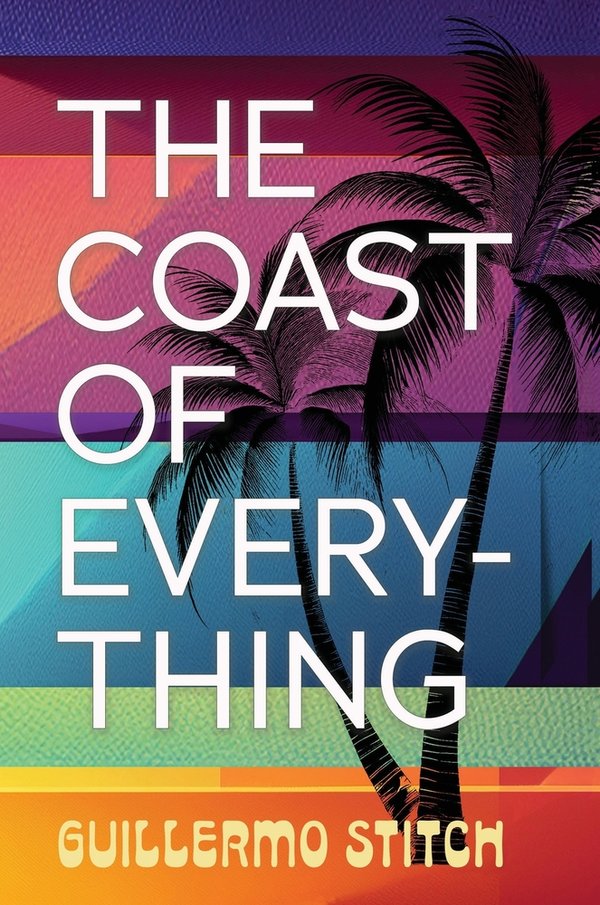
In Guillermo Stitch’s The Coast of Everything, the human compulsion to tell and hear stories triumphs over corporate and political attempts to suppress literature. Stitch’s sprawling and satisfying work comprises five interconnected, novel-length tales. Across these speculative stories, people are persecuted for engaging with literature. While similar novels, like Ray Bradbury’s Fahrenheit 451, are foreboding, Stitch’s work is surprisingly rambunctious, framing storytelling as a spontaneous, and therefore uncontainable, action.
The Coast of Everything is held together by a loose frame narrative. In it, a bedbound woman named Clara tells stories to her friends. Whereas Clara’s body is immobilized, her imagination is free. She spends most days looking at her bedroom ceiling, but rather than feel imprisoned, Clara “map[s] worlds” onto this space, using it like “the pages of her atlas,” creating stories that are wide in scope, stretching well into the future.
The first of these, “The Tale of the Enchanted Road,” satirizes how corporations have reshaped literature. While the government has labeled literary works contraband, readers can still access stories, albeit from corporations like Gripping Tails, who use them to pave roads. Admittedly, the plot of “The Tale of the Enchanted Road” is a little convoluted, though its satire is effective. When the protagonist, a journalist named Billy, interviews an executive from Gripping Tails, he’s told that the company puts stories “to use. It can seem surprising to us now that […] those early strategies, from product placement to search optimization, influencer content and so on, didn’t light the way sooner.” This flattening, both literal and metaphorical, of literature means that books have lost most of their cultural cache. Still, an underground resistance group called Gilgamesh tries to preserve books by circulating them.
Just as Billy is brought into Gilgamesh, however, the story pauses. Like David Mitchell’s Cloud Atlas, the stories in The Coast of Everything are nested, meaning that we have to wait hundreds of pages to see what happens to Billy. Meanwhile, “The Tale of the Porter and the Gin” begins, and it follows the story of Vince, the member of Gilgamesh who recruited Billy. The story shifts from a thriller to a comedy, as Vince encounters a crass Charles Dickens, who’s unfazed by the restrictions placed on literature. While Vince mourns that “there is no more literature,” Dickens merely responds, “Your reading days are behind you, my boy. Time to write,” a reminder that reading may be illegal, but writing hasn’t been affected at all.
This belief— that storytelling can never be stamped out of any culture—shapes so much of The Coast of Everything, especially its narration. Often, new stories begin by characters pulling aside another person and telling them something. This means that stories cancel each other out, and notions of authorship and point of view collapse. This is especially true in “The Tale of the Three Voyages,” which contains hundreds of digressions. While some will find this intriguing, others might be frustrated by the tale’s byzantine structure.
Just as much as people need to tell stories though, they also need to hear them, as evidenced by the work’s strongest story, “The Tale of the Isle of Truth.” Set on a remote, futuristic island, a society screens files to make sure that people aren’t circulating or reading literature. When they receive a concerning audio recording, Lil, and her father, Aren, play it for the others, and discover that the speaker’s life parallels their lives on the island. As the group listens to the recording, they must decide if the story is real or fiction, a question that troubles them given that it’s impossible to determine what fiction is.
This ambiguity compels the characters to reconsider what they understand about storytelling. For all their lives, they’ve been taught to fear stories. However, as they listen to the recording, which outlines the speaker’s realization that the government is corrupt, some characters, like Lil, experience wonderment. Because she’s never left the island, listening to the story means that “unknown has been added to the perfectly knowable” because she learns about other viewpoints. This wonderment compels her to subvert the government, a common theme that resurfaces in the other tales.
Ultimately, Stitch brings all these perspectives, characters, genres, digressions, and parodies together in fascinating ways. Of course, I’m barely scratching the surface of this gargantuan book, but this expansiveness is intentional. Stitch is acutely aware of the cultural and political pressures placed on contemporary literature; most notably, book bans, AI slop, and our dwindling attention spans. At the same time, his work is a jubilant reminder that any effort to curtail literature will ultimately fail because people can’t help but make new stories.
The Coast of Everything, by Guillermo Stitch. Montclair, New Jersey: Sagging Meniscus Press, June 2026. 760 pages. $37.99, paper.
Emily Hall has a PhD in English from the University of North Carolina at Greensboro, with an emphasis on avant-garde novels. Her flash prose has appeared, or is forthcoming, in places such as Passages North, 100 Word Story, Gooseberry Pie Lit, FlashFlood Journal, Short Reads, and Cherry Tree. Her reviews have appeared in places such as Necessary Fiction, The Washington Independent Review of Books, Ancillary Review of Books, and Portland Review. She’s a prose editor for Pictura Journal and lives in North Carolina with her husband.
Check out HFR’s book catalog, publicity list, submission manager, and buy merch from our Spring store. Follow us on Instagram, Bluesky, and YouTube. Disclosure: HFR is an affiliate of Bookshop.org and we will earn a commission if you click through and make a purchase. Sales from Bookshop.org help support independent bookstores and small presses.

