
“No gloves, no utensils,” was how the note ended. I didn’t notice this until I had parked in front of the house. I would usually leave the white to-go bag at the door, but for this order, it was requested that I enter the home. What came next was open to my interpretation, but the customer’s ultimate command was simple and clear: “Feed me.”
The house lay within a small ranch on the outskirts of town. The name “Cunningham” hung over the entrance to the long, narrow driveway, where, on both sides, fields of green grass stretched out. The land was vacant except for its landowner. Occasionally, though, a phantom moo would ring out.
Another car was parked at the end of the driveway. It was a white sedan with a rock embedded in its windshield—just like mine. A woman wearing a green jumpsuit, hood pulled back, walked out of the house.
“Good luck,” she said.
“What happened?” I asked.
She didn’t answer. She just opened her car door and slammed it shut, driving off.
I touched my hood to make sure it was still draped over my head. I then entered the residence.
In the dining room, a man with wrinkled skin and a long, gray ponytail was sitting in a wooden chair. When I greeted him, he didn’t reply. His gaze was fixed on a deer head mounted on the wall.
I set the bag on the table and removed its contents. Mr. Cunningham had ordered a ten-inch pepperoni pizza from Hell on Earth. Our eyes never met when I offered him a slice. He merely took the pizza into his mouth, bit down, chewed, swallowed, and ate more. The whole process reminded me of feeding paper into a shredder. The only difference was that when he got to the crust, I flipped it lengthwise, allowing him to eat it all at once.
For every slice, I made sure that my fingers avoided contact with Mr. Cunningham’s mouth. However, while finishing the last slice, he bit off half of the crust, which I thankfully caught, and when I fed him the remainder, his tongue stretched far beyond his lips and ran across each of my fingers. Because the meal was done, my only response was, “Have a nice day.”
On the drive home, I pretended that moist human flesh hadn’t protruded from a wet orifice and touched my skin. And when pretending fell short, I reminded myself that, a long time ago, I had dealt with much worse.
In the cafeteria, while eating a customer’s abandoned burrito, the day’s leaderboard displayed two names tied for first: Dakota Armstrong and Milo Sand had each received a one-thousand-dollar tip from Bob Cunningham, the highest in Hood’s history. In addition to immediately being considered “hoodlums of the month,” Dakota and I were assigned to exclusively serve Bob Cunningham.
From across a sea of green jumpsuits, I saw the woman from earlier, hood still off, eating a forsaken bowl of ramen. Briefly, we locked eyes. Then it was time for quiet hours.
Lying in bed, I reviewed the entrances, apartment codes, porches, and back doors of the city, like usual, but my thoughts drifted. Who was Dakota Armstrong? What did Bob Cunningham do to her?
When it was lights-out, I rose from my bed and crept past the aisles of bunks, peering out of the male dormitory door. I saw two masked individuals standing guard outside, each wielding an enormous metal fork.
“The rumors are true,” I said to myself. “Hood doesn’t allow its worker-residents any fraternizing in the middle of the night.”
I returned to my bed and tried to recall Dakota’s face. Within minutes, I was dreaming.
The following day, I returned to Bob Cunningham’s ranch. When I saw Dakota, I asked, “What did he want?”
“A bottle of sweet tea,” she answered.
“What about yesterday?”
“A bottle of Coke.”
“Did he lick you?” I wanted to ask.
But she was already gone.
Mr. Cunningham had ordered a spicy chicken sandwich from Please Help Me. I pressed the pillowy bun and craggy meat up against his mouth. He ate in much the same way as before, without incident. It was only when I offered the final bite that his tongue slid over my fingers.
This time it was obvious. The lick was no mistake.
I was tipped another thousand dollars, all of which Hood retained for my room and board, in addition to other “fees.” Not too long ago, I lived and worked separately. But I made myself miserable by constantly trying to prevent my life and my work from merging. So I chose to live like a monk, making Hood my monastery. I sold everything I owned, paid off most of my debts, and said goodbye to my friends and family. I devoted myself to delivery.
In the cafeteria, I sat next to Dakota. The forkmen took note but didn’t intervene. The cafeteria was a talking space, although nobody ever used it as such.
After a round of greetings, I asked, “Did Bob Cunningham lick your fingers?”
“Yes,” Dakota replied.
“Mine too.”
I was talking to another person, it dawned on me. After a day’s work, I was speaking out loud.
“What should we do about it?” I asked.
“Not tell anyone,” Dakota said.
I gave her a confused look.
“If we stay at the top of the leaderboard long enough,” she explained, “we will be invited to interview for supervisor roles.”
“So, do nothing?”
“No, not nothing. Bob only says to ‘quench’ him, not how.”
The forkmen shouted, interrupting my thoughts: “Dinner’s over! Quiet hours!”
Dakota and I departed to our dorms. I fell asleep thinking of all the ways I could feed Bob Cunningham without touching his tongue.
Initially, my methods worked. For spaghetti, I dangled each noodle above his lips and slowly descended it into his mouth, which slurped it up, leaving red marinara marks on his cheeks. For burgers, I pressed the bun and patty into his mouth faster than he could chew, briefly choking him. For boneless wings, I threw the buffalo-sauced meat at his lips, training him to open wide for each toss.
Dakota had similar success.
“Every time I give him a sip,” she told me, “I hold the base of the bottle. He hasn’t licked me since.”
“That’s good,” I said. “So, when do you think we’ll be invited to interview?”
“Soon, I hope. Bob has taken to holding the hand that doesn’t quench. He’s always after something extra.”
It was true. Bob held my hand whenever possible, but I deemed it a lesser problem, or maybe not even a problem. Plenty of people held hands in business: it was called handshaking.
The hand-holding, however, portended certain adjustments to Bob’s orders. He now only bought travel-size bottles of water, soda, coffee, and tea, which required dozens of servings per visit and provided plenty of access to Dakota’s fingers. Similarly, Bob only ate rice bowls, forcing me to hand-feed him every grain, which meant that his tongue ran up and down my fingers throughout all of his meals.
Bob had certainly outwitted us, but we endured his licking because we were convinced that the supervisor interview would come soon enough.
“I thought I would like delivery,” Dakota said one day in the cafeteria, eating a rejected salad. “But when I visit other people’s houses, it reminds me of when I lived out there, even if I try to ignore it.”
“How long have you felt this way?” I asked.
“Ever since Bob.”
“Me too.”
I then added: “I hear that the supervisors live and work in the same room, never leaving.”
“That’d be nice,” Dakota said, dreamily.
Whenever I lay in bed, conversations with Dakota replayed in my head. I didn’t talk to anyone else at Hood. Everyone, generally, kept to themselves. I wondered what Dakota was like before she worked here. I wondered how she passed the time in her dorm.
Months into serving Bob Cunningham, I woke up in the middle of the night to violent tremors all over my body. I quickly realized that two hands had caused these tremors—Dakota’s.
“How did you get in here?” I asked.
“I walked right in,” Dakota replied.
“Nobody tried to stop you?”
Dakota shook her head.
I invited her to join me in bed so that we could speak quietly, without making a scene. She slid in next to me, and I wrapped my arm around her since there was very little room. We looked up at the top bunk, staring into its vacant, wooden sky. Within seconds, I felt like I had successfully delivered a million, if not a billion, white to-go bags. I had been a fool working at Hood, I realized, but what was I to do?
“I need to tell you something,” Dakota said. “It’s about Bob.”
“What?”
“When I quenched him today, I pulled on his ponytail to tilt his head back, and I poured the bottle into his mouth but well above it, making a waterfall.”
“And?”
“He drank without licking me or holding my hand. And he acted the same way with the dozens of other bottles.”
“So it’s the ponytail—that’s the trick!”
But Dakota didn’t share my enthusiasm.
“The thing is,” she continued, “when I pulled the ponytail, it slowly grew longer. It was like a string coming out of a doll.”
I didn’t know how to reply. I just thought of how nice it would be to live on Bob’s ranch with Dakota.
I fell asleep dreaming of this ranch life, and when I woke up, Dakota was gone, as if she had been a dream too. But there was plenty of proof that she had been there: the citrusy smell of the pillow; the strands of long, black hair; the question ringing in my head, demanding an answer—Why was I alive?
The next time I served Bob Cunningham his rice bowl, I pulled his ponytail back, dropping the stir-friend grains into his mouth. Gradually, Bob’s hair stretched out of his skull, like a rope retracting from quicksand, so I constantly readjusted my fingers to keep his head tilted back. My coordination wasn’t perfect. Sometimes I dropped rice onto his cheeks or into his nostrils.
When there was more rice on Bob’s face than in his mouth, I reverted to feeding him directly. However, after Bob’s tongue twirled against each of my fingers, I thought of something else. I grasped the juicy, pink flesh and pulled. Bob’s tongue lengthened like that of a cartoon. And once I stopped, his tongue didn’t return to his mouth. It flopped outside of his lips, down to his chin.
The following evening, Dakota returned to my dorm.
“What did you do to Bob?” she asked.
“The same thing you did to him,” I said.
“But now when I quench him, water splashes onto the floor. And when I bend down to wipe it up, he lays his hand on my back.”
The image of Bob Cunningham’s wrinkled, bejeweled hand resting on Dakota became seared into my mind.
“Only pulling his hair or his tongue isn’t enough,” I said. “We need to pull both at the same time. We need to deliver together.”
“And then what will happen?”
“I have no idea. But there are these moments, you know?”
“Yes, there are moments …” Dakota said. We locked eyes. I felt like I had delivered every white to-go bag in existence, and now it was time to have my share.
Dakota touched my hood, but I stopped her from taking it off.
“Show me,” she said.
Slowly, I removed my hood. Dakota held my face in her hands.
“So this is Milo Sand,” she said.
“Almost.”
We had been told that no two hoodlums could be in the same house at the same time. But after Dakota’s nighttime visits, I wondered if that was true. She shouldn’t have been allowed in the male dorm, yet, without struggle, she was granted access. Maybe our daily tips bought us more than room and board. Or maybe there were no restrictions at Hood, none other than the ones that we made for ourselves. Regardless, I felt that we could do no harm to Bob Cunningham. Our only violence would be not showing up.
The next day, we drove to the ranch together. Dakota’s white sedan led mine.
Bob had ordered the usual: dozens of tiny bottles from the convenience store Fuck My Shit Up and a rice bowl from I Hate It Here. Just like when I fed him, Bob sat in the wooden chair for his quenching, staring at the wall-mounted deer head. He didn’t register now that Dakota and I were here together. The tip of his tongue dangled from his chin.
After Dakota and I set the white to-go bags on the table, Dakota grabbed Bob’s ponytail, and I grabbed his tongue. Like in a game of tug-o-war, we pulled towards ourselves. For the first time, I heard Bob’s voice, or at least the semblance of a voice. He grunted and whimpered as neither his ponytail nor his tongue grew any longer.
Instead, a crack formed at the top of Bob’s head. Blood seeped from his skull and trailed down his face.
Dakota and I continued to pull. Soon the crack in Bob’s head stretched down the length of his body. A line of blood bisected him. Dakota and I yanked harder. Blood pooled at our feet.
After ten minutes of uninterrupted pulling, Bob split open and fell onto the floor as if we had peeled a banana.
Within Bob, we discovered, resided two people—Dakota and myself. We were completely naked and covered in gooey, bloody pulp. Our memories of Hood ended right there.
And in the fields of the Cunningham ranch grazed many hungry cows.
Ryan Bender-Murphy received an MFA in poetry from the University of Texas at Austin and currently lives in Seattle, Washington. His fiction has appeared in 3:AM Magazine, Blue Mesa Review, Four Way Review, Oxford Magazine, and Red Rock Review, among other publications. Find him on Instagram at @ryan.bender.murphy.
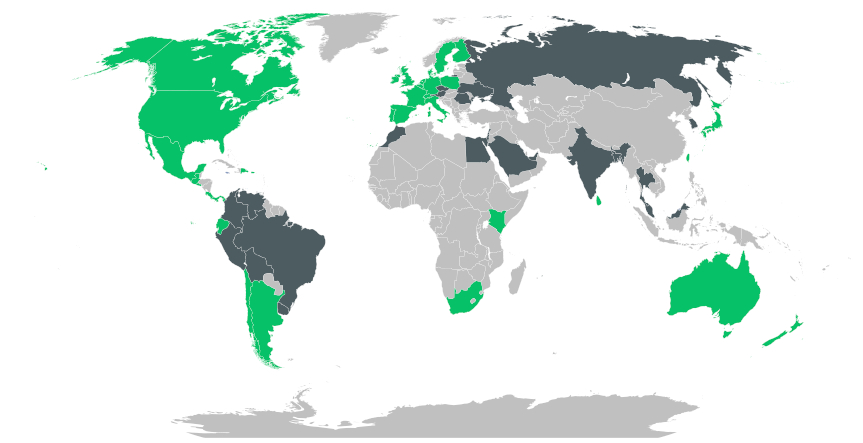
Image: Daniel.9, Map of countries where Uber Eats is currently available (in green) and where it has exited or is unavailable (in gray), commons.wikimedia.org
Check out HFR’s book catalog, publicity list, submission manager, and buy merch from our Spring store. Follow us on Instagram, Bluesky, and YouTube. Disclosure: HFR is an affiliate of Bookshop.org and we will earn a commission if you click through and make a purchase. Sales from Bookshop.org help support independent bookstores and small presses.

