
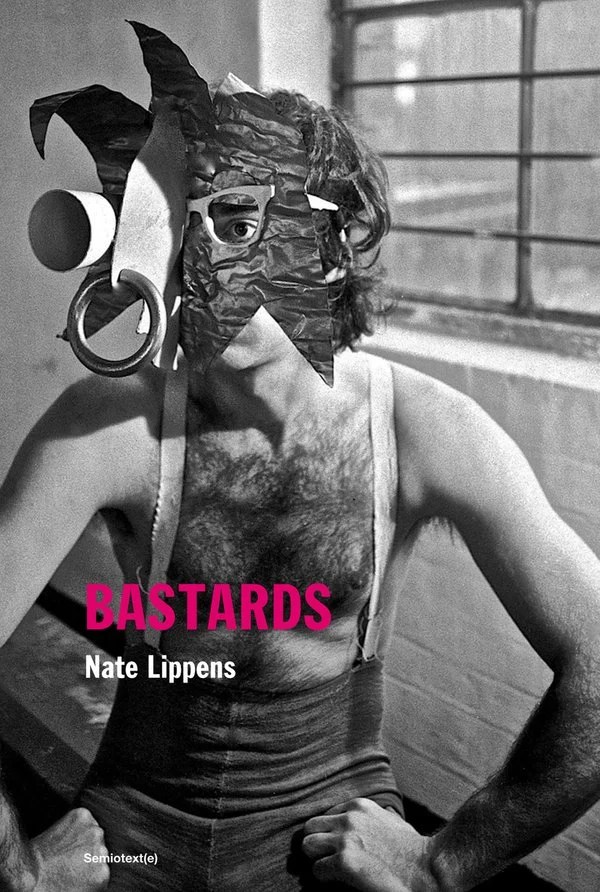
We collect memories and glean from experiences in the hope that they amount to something. Anything. We use these collections to fashion ourselves into something presentable. More human. We strive, struggle, fall short, and often fail. So much of what drives people to follow made up rules in order to play the game of life also makes them monsters. So what happens when a person ignores the need to live that life and graduates to a reality other people might view unfavorably? Nate Lippens states and magnificently asks, Who cares? “We knew the past was infinite, certainly more so than the future”
What begins with My Dead Book then continues with Ripcord and Bastards, Lippens’ Wisconsin trilogy wraps up the work with satisfying results. An outsider’s guess might be that the title refers to the people whose lives (and deaths) swirl around inside the book’s cover. Abandoned by life. Or at least what a vast contingent of humanity subscribes to as a “successful,” or proper “life.” No humanity exists in forced conformity. But in the course of just one hundred sixty pages, Lippens and company present an outcast thesis in defense of obsolescence.
The book is superbly written in non-linear, fragmented, and unfiltered prose that often reads poetic, given the beauty and fervor of its language. Very frank, Lippens pulls no punches in how he handles heavy topics. Remarkably, he also manages to inject wry humor throughout, refusing to take very much seriously for the sake of mental stability and survival. Hope, however, comes in many guises. Even during lower moments of the narrator and company’s lives, the author reminds us “[t]he disastrous mind circles what should have happened and didn’t and what shouldn’t have happened and did, wanting different results, a recount, better light.”
Characters from the preceding volumes show up in good measure to impart wisdom, offer comic relief, or reinforce the necessity of their prescribed existences as examples of winning. An alt-queer Greek chorus and simultaneous cheerleading squad. Elucidating, disjointed flashes fall in and out of time to form a cohesive narrative extolling the virtues of aging disrespectfully, surviving (or “remaining,” as the author comments), and making the most of the hand you’re dealt. But like those brilliant flashes, the brief book ends. After the final page, Lippens has left a searing vision of his world and how he navigates life burned into your brain to linger. Then, hours after reading, there comes the desire for more of his illumination and enlightenment.
It is easy to see how a casual reader could interpret pessimism from the streaks of raw life presented on the pages: “My life is like god, I no longer believe in it.” With each section, Lippens proves that inside a world of lowered expectations and prospects, true freedom can indeed exist. Name a better way to escape the unfair, unwanted anticipations of a world hellbent on fashioning people into malleable models of endless compliance. Cloistered inside a world of visual arts, literature, music, and performance, the characters escape the mundane, punishing realities of joblessness, failure, death, and other forms of loss with continued devotion to each other, above all else. Tribalism and its preceding individualism become the only logical response to a world that neither includes nor wants such distinctive personalities.
Lippens laments worlds and words gone by but avoids sappy sentimentalism: “We belong to another time. The past? The future? Which delusionist are we?” One moment, a friend complains how everyone is queer these days and that half are prudes, throwing back to the Hays Code. A few pages earlier, he writes about “the envy and malice of shadows watching our old world go.” Having survived the AIDS epidemic, drug addiction, shite boyfriends, and psychiatric wards, the author expertly communicates how much different the world turned out than he expected. Enduring all the above, inadvertently or not, should make the remaining years of a life lived so defiantly a veritable cake walk. Enter post-millennial malaise, late-stage capitalism, and homo assimilation to take their obliterating toll.
Another vital message of the book answers the age-old question: what good is aging in a society that values youth, freshness, vitality, the forever new? And, as an extension, how do elder queer generations find validation, or relevance at the very least, in a culture that overwhelmingly no longer really values their experiences and wisdom? Lippens responds to this throughout the book with his usual grace and candor. He says of these generations, “Ours are lives scattered without milestones. Accrual of years lived, stories collected and neglected, the switch turned on.” Even by mentioning a few of the joys and benefits of aging, like abandoning the romantic life, having his life treated as less real, he revels that “I’m primed to fail. Or quit.” And that becomes a completely plausible, desired, and venerable, option. Quitters never win is a motto he recalls from his middle school swimming pool: “But quitters never lose. They’re not in the game.” Another mighty, upper-case lesson learned in Lippens’ course on effective living in this wreck of a century.
Continuing would give too much away. Absorb the words and wisdom to see if they ring true. Recall the Buddha and his Kalama Sutta. Is the Wisconsin trilogy for everyone’s sensibilities? Probably not. Their loss, nonetheless. That doesn’t mean the work shouldn’t be read, studied, and canonized as an example of a wholly acceptable and credible path for subsisting. Is Lippens a viable voice or prophet of gay aging most of the community wants? He would probably venture to say, Who cares? The fact he gives us the miracle of his writing and insight makes him crucial. A legitimate sage with an exceptionally authentic voice in full command of his powers. Let us join hands and pray for more of his gospel.
Bastards, by Nate Lippens. Los Angeles, California: Semiotext(e), September 2026. 160 pages. $17.95, paper.
Jarrod Campbell is a writer living in the Northern Virginia suburbs of Washington D.C. His fiction, essays, reviews, and poetry have appeared online and in print with Heavy Feather Review, Northwest Review, Modern Literature, Wicked Gay Ways, and others. A collection of short stories, The Reason I’m Here (Stalking Horse Press, June 2023), was named an anticipated LGBTQIA+ read the month of its release by Lambda Literary Review.
Check out HFR’s book catalog, publicity list, submission manager, and buy merch from our Spring store. Follow us on Instagram, Bluesky, and YouTube. Disclosure: HFR is an affiliate of Bookshop.org and we will earn a commission if you click through and make a purchase. Sales from Bookshop.org help support independent bookstores and small presses.

