
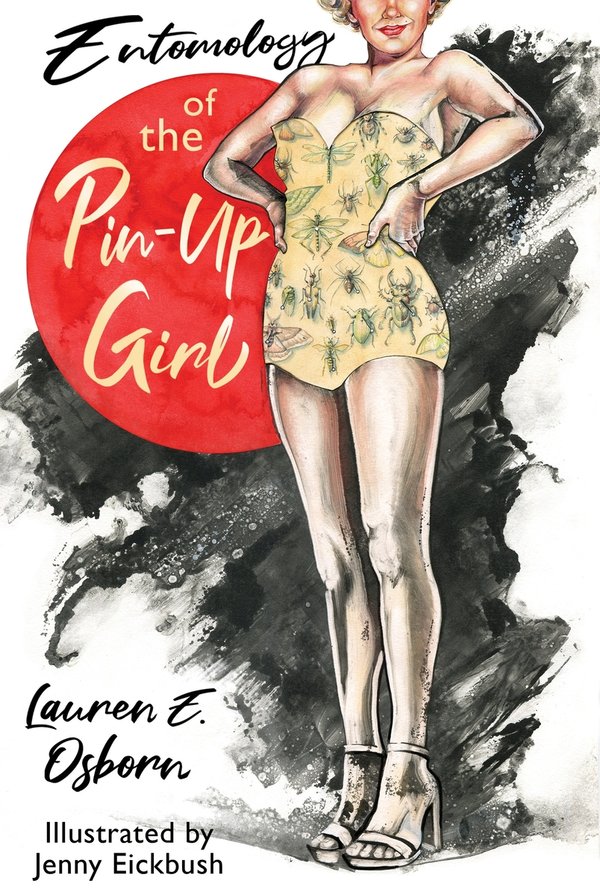
Lauren E. Osborn’s Entomology of the Pin-Up Girl opens with a dedication that is also a promise of what we’ll find inside: “for the insects and girls and those stuck somewhere in-between.” The stories that follow are at turns grotesque and funny, both timely and timeless for their exploration of femininity, monstrosity, and how thin the boundaries are between either. Rather than attempt to delineate these boundaries of predator/prey, Osborn takes us through flashes that are ultimately more about mimicry: to hide or hunt, and sometimes, both.
Osborn’s work does not let us settle into an easy or comfortable classification. Her characters molt, transform into different creatures, or are faced with the suspicion that something unknown is hiding behind the skin of a loved one. In “Don’t Come Looking for Me,” the presence of an ant-mimicking spider foreshadows the aggressive mimicry of a human predator and mass disappearances of neighbors, friends, and coworkers. Other stories in Osborn’s collection explore mimicry with a similar unnerving perspective. In “Ecdysis,” a wife notices a zipper on her husband’s back and wonders who (or what) is wearing her husband’s skin. In the final story, “Baby Teeth,” a woman plants her own tooth in the garden to grow a child, not realizing the destructive hunger she will pass along to this daughter.
There is humor in this mimicry, as well. For example, “Boy” sets aggressive mimicry, a tactic predators use to avoid detection by prey, against the threat of violence to the female narrator. The story opens with the narrator listing foods, including vulnerable species like leopard and vaquita, before concluding:
She ate pork belly and mashed potatoes. She ate blueberry and blackberry pie. She relished in risotto with beet reduction and binged on ice cream with a cookie dough center. She even tried vaquita, loris, and leopard—grilled, steamed, and friend. But she had never had boy. She never had boy grilled, she never had boy with lemon pepper seasoning. She never had boy on his back or on his belly. It was about time she had boy.
Catching boy was never a problem. Boy followed her around, watching her. Watching as she walked from the printer to the coffee machine at her office. Watching her take small sips of rum at the bar while she let the warm liquid spread across her tongue and down her slender throat. Watching as she lay on the beach, allowing the sun to crisp her edges. There was no shortage of boy to choose from.
The repetition of watching in several different settings outside of the office suggests something more sinister than merely “followed her around.” The list of vulnerable species at first appears to reflect the vulnerability of this narrator and threat of the boy’s gaze. However, instead of anxiety or trepidation, the narrator’s matter-of-factness is humorous. There is no shortage of boy, because boy has mistaken himself for the one in control, rather than realize he is the one being stalked as prey. A mistake many characters make throughout the collection.
Osborn also remixes familiar tales with this mimicry. In “Swan Eater,” Grete Samsa has her turn being transformed into a bug—a Solifugae, to be precise—but finds it a more fulfilling experience than her brother did. Grete’s new body is absent of the beauty her parents seek to leverage at the end of Kafka’s The Metamorphosis, but Grete is not upset: “she observed the curve of her bent, bristled legs …. It occurred to her that she always wished to be taller.” Grete dresses in the human clothes she had picked out pre transformation, a white silk dress that doesn’t rip, and looking in the mirror, “She saw herself at last as she had always felt.” The story ends before her suitor, Dr. Öfful, sees Grete transformed, leaving us to imagine Grete’s happy ending as a Solifugae in a white silk dress and wearing a purple hat.
Alongside these stories are striking illustrations by Jenny Eickbush. The illustration accompanying “Swan Eater” features a woman in a 1950s style wiggle dress, printed with lacework skulls. A floral hat pulled low hides her eyes and her shadow casts the outline of a Solifugae. In another illustration, a woman wearing a 1940s swimsuit sprawls in a field with skulls, butterflies covering her eyes. They’re an effective accompaniment to Osborn’s stories: though there are elements we might expect in a pin-up illustration, Eickbush reminds us of the dangers that lurk in the shadows that we might overlook.
Entomology of the Pin-Up Girl is a wonderfully surreal exploration of the unsteady line between predator and prey through the lens of beauty and monstrosity, particularly when the latter two are inextricable from one another. As “Tarantula” puts it, “a woman turned monster by perspective.” In these stories, there is no good nor evil, only the places in between where there is transformation. Entomology of the Pin-Up Girl asks us to take a second look at whose perspectives and what transformations are possible.
Entomology of the Pin-Up Girl, by Lauren E. Osborn. Ann Arbor, Michigan: Dzanc Books, May 2026. 160 pages. $17.95, paper.
Emily Capettini (she/they) is a queer fiction writer from the Midwest who loves a good ghost story. They are the author of Girl Detectives (Porkbelly Press, 2022) and Thistle (Omnidawn Publishing, 2015), and their work has appeared in Asterales, Passages North, Permafrost Magazine, and Okay Donkey, among many others. She is Associate Professor of English at Indiana State University, where she teaches courses in uncanny fiction, science fiction, and creative writing.
Check out HFR’s book catalog, publicity list, submission manager, and buy merch from our Spring store. Follow us on Instagram, Bluesky, and YouTube. Disclosure: HFR is an affiliate of Bookshop.org and we will earn a commission if you click through and make a purchase. Sales from Bookshop.org help support independent bookstores and small presses.

