
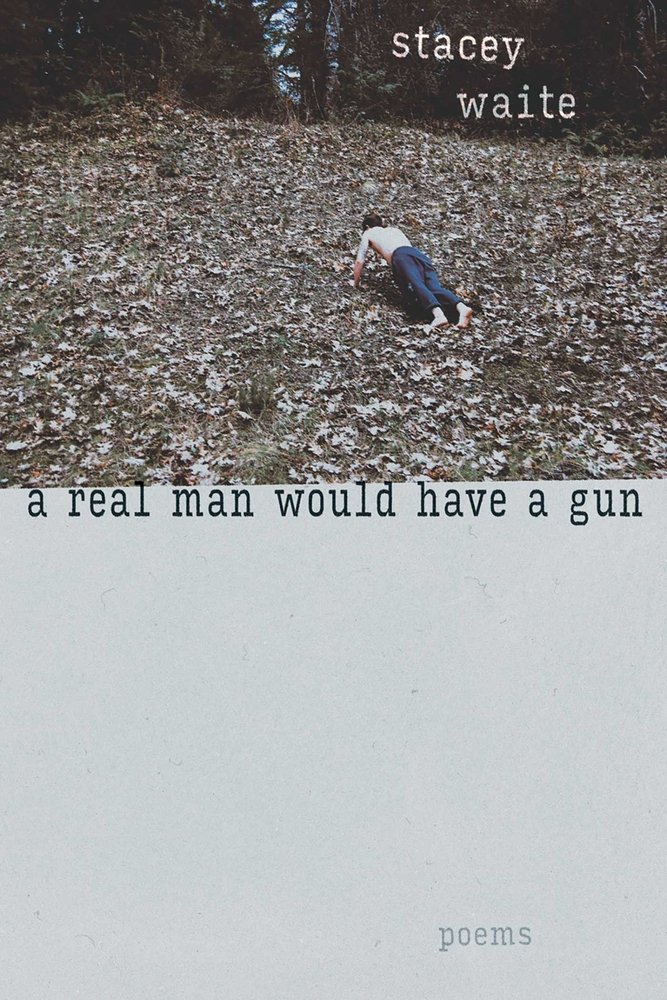

Stacey Waite’s A Real Man Would Have a Gun is as jarring and interrogative as its title signals. The poet’s newest release is highly autobiographical and features speakers who often find themselves somewhere between genders while society attempts to place a singular label upon them. Waite’s poems invite us to see the fluidity of gender, the possibility in not checking a box, the frustration of those not wanting to choose a pronoun or be accosted for the bathroom one chooses to use. In “Bathroom Poem,” the speaker is questioned by a woman for using the ladies’ room and Waite asks us to question our own ideas surrounding gender: “Sometimes my partner (who I / sometimes call my wife calls / me her husband.” Later in the poem, “Men Who Think I Am One of Them Speak”: I forget you’re a woman sometimes,” Waite begins, “So do I / except when / I don’t.” The poet’s tactful bouncing between genders emphasizes, both, the conflicts created when walls are erected around binaries and the personal strength Waite has put into breaking those walls down.
Waite’s collection is constructed around a pair of series, the first composed of nine poems title “Masculinity I” through “Masculinity 10.” Three pieces from this series, combined with eight from the other comprise the entire middle section of A Real Man Would Have a Gun. The poems in the latter-mentioned series are each titled, “Men Who Think I Am One of Them Speak:” and end with loaded and demeaning statements that are far too often part of the male lexicon; statements like, “We know that guy, and he is not a rapist,” “Check out that ass,” and “You know what I’m saying right?” When I saw Waite read from this series, she discussed how these poems examine moments when she has been in the company of men, who because of her masculine-presenting appearance, decide it’s acceptable to say things that men should decide are not okay to say at all. In “Men Who Think I Am One of Them Speak: You know what I’m saying right?” Waite begins:
Often said after
the sexiest thing
when they see
my face is not
doing the thing
a man’s face should
do when his buddy
says she’s a bitch
you know
what I’m saying
right?
She’s a slut
You know
What I’m saying right …
We feel immediately brought into uncomfortable conversations the speakers never asked to be part of. Not only do the titles indicate that these men think Waite’s a man, but that Waite aligns with a particular type of man, one focused on the physicality of female form and possessing a hyper-sexual imagination that they’re overconfident in vocalizing. Over this series of aggressions, both macro and micro, we are asked to consider the frequency that Waite and others like us experience this level of harassment and what we’ll do about it.
Waite shows us the power in reciprocating love toward those who see us and foster us, while cutting ties with those who hurt us and hold us back. Despite inviting us into myriad traumatic moments, the poet does so with gentleness and empathy, as a place to grow from. These are poems born from a person who has been through remarkable pain and yet remains capable of profound love. They also fuse moments of humor in unexpected ways such in “Notes on Matt Damon” and in the incredibly tender “Your Father”:
When they ask if I am your father,
say “I am your father,” in the dark voice
of Darth Vader or sing “I will be your father figure,
put your tiny hand in mine,” like you’re
the irreverent George Michael of the 80’s.
Here we can find ourselves smiling, maybe laughing, over these images and sounds, over the love involved in sharing movies and music between generations. The poem closes with a stanza that I feel throughout my whole body. I feel its dualities and contradictions, its allegiance to love, and its attention to the bond between a child and a parent who loves them:
When they ask if I am your father,
tell them how I taught you to be a man
by teaching you how to not be a man.
When they ask you if I am your father,
say, in the unshakeable calm
of your voice: if that is what you mean
then yeah, she’s my father.
Through reflections covering childhood through parenthood, Waite bounces through a lifelong search for identity and family while exploring gender and sexuality. A Real Man Would Have a Gun is an intricate portrait of a person working to carve out a hole of their own in the world. In “Some Notes on Family,” Waite turns to the second person and reminds us that when it comes to family, “You create it … Sometimes you revise it … You build it … You build it in places you never thought … and that’s how this works.” This advice on family is doubly emblematic of the way Waite approaches gender, finding what feels like home, regardless of what anyone else wants to call it.
A Real Man Would Have a Gun, by Stacey Waite. Albuquerque, New Mexico: University of New Mexico Press, February 2025. 88 pages. $18.95, paper.
Josh Nicolaisen lives in New Hampshire and teaches writing at Plymouth State University. He holds an MFA from Randolph College, is a Pushcart Prize nominee, and a recipient of the Plattner Award in Poetry. He has received support from Bread Loaf Environmental Writers Conference, Hewnoaks, and Martha’s Vineyard Institute of Creative Writing. His reviews have been published in Colorado Review, Revolute, and Gulf Coast. His poems have appeared in Hunger Mountain Review, Permafrost, Appalachian Review, Four Way Review, Bellingham Review, and elsewhere. Find him at oldmangardening.com/poetry.
Check out HFR’s book catalog, publicity list, submission manager, and buy merch from our Spring store. Follow us on Instagram, Bluesky, and YouTube. Disclosure: HFR is an affiliate of Bookshop.org and we will earn a commission if you click through and make a purchase. Sales from Bookshop.org help support independent bookstores and small presses.

