
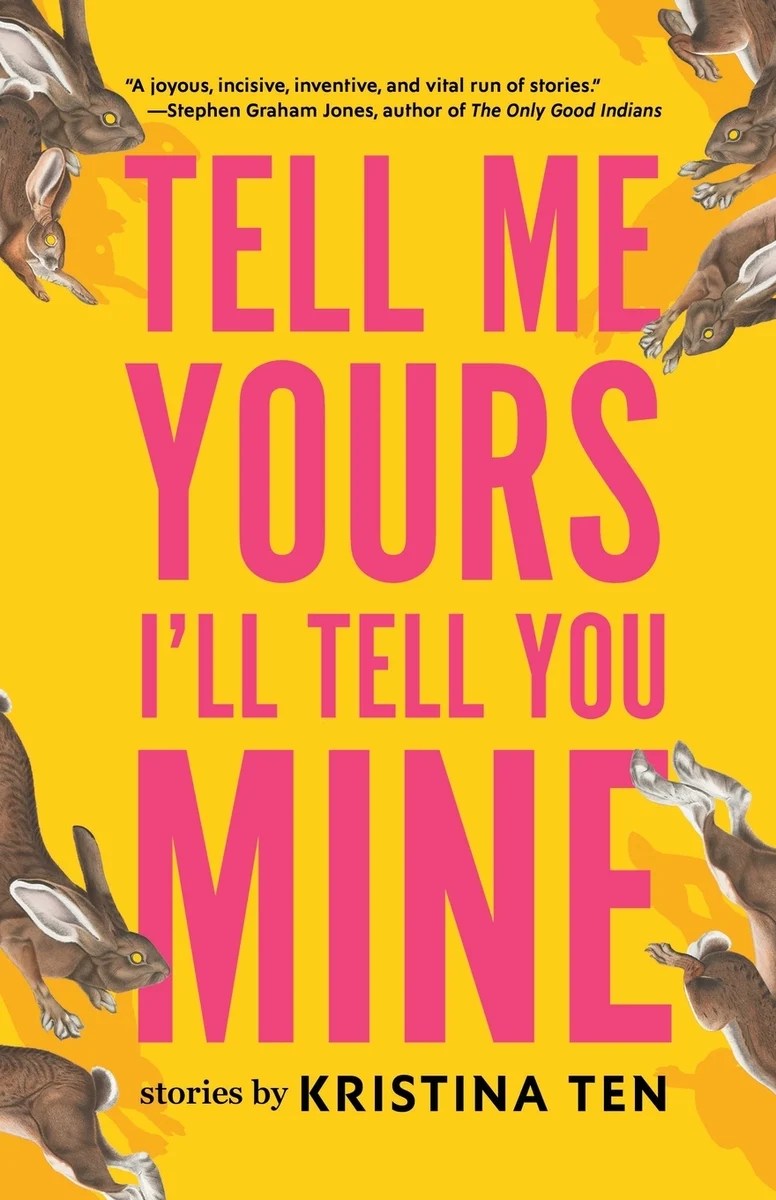
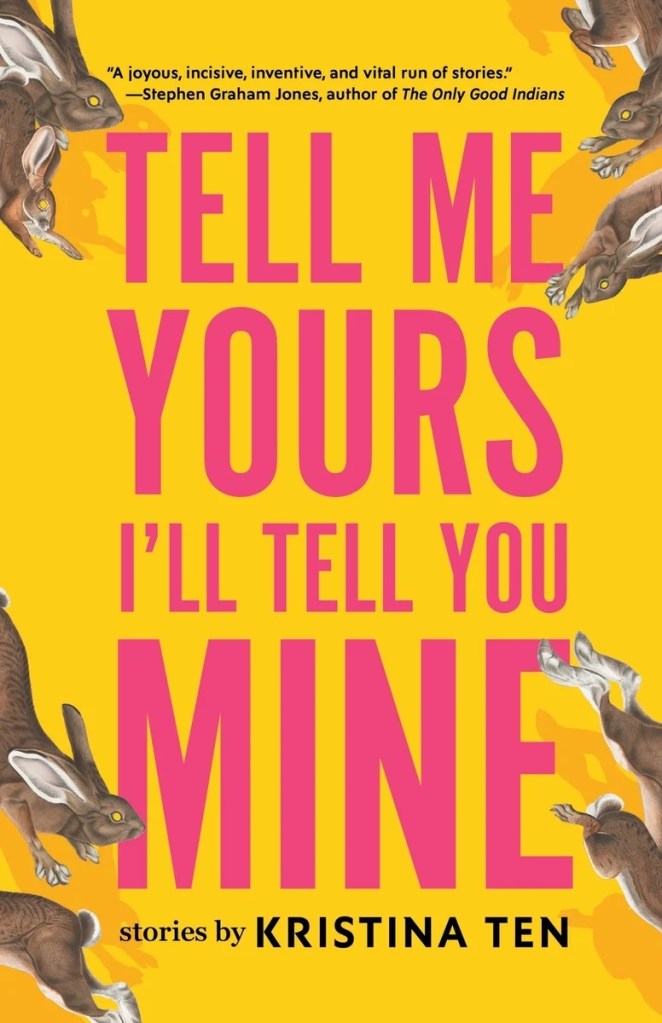
Kristina Ten’s debut short-story collection, Tell Me Yours, I’ll Tell You Mine, is filled with female protagonists who refuse to acquiesce. Delightfully defiant, and reminiscent of Dahlia de la Cerda’s riotous Reservoir Bitches, Ten’s characters shrug off taboos and aren’t afraid of using violence to ensure their autonomy.
Across the twelve stories in Tell Me Yours, I’ll Tell You Mine, Ten is fiercely honest about the obstacles that women face in contemporary society. For instance, in the collection’s strongest story, “The Advocate,” a woman wears a suit of armor to her doctor’s appointment. After a lifetime of doctors minimizing her health problems, Jae builds her armor out of “[p]eer-reviewed articles from medical journals, printed on heavy cardstock, then cut into strips and woven into something like chainmail.” Her medical appointments are depicted as tournaments that she constantly loses, and sometimes, her friends die during their own battles. The story capably satirizes the notion that women can single-handedly triumph over biases within the medical industry.
As “The Advocate” demonstrates, Ten often blurs the lines between genres. Some, like “The Flood, The Tumble,” the story of a female dragon held captive by a man who uses her scales to help him win card games, combine fantasy with psychological realism. Others, like “Bunny Ears,” could be considered either horror or magical realism. While Ten’s plots can be eccentric, their conflicts are recognizable, and she uses genre conventions to exaggerate the absurd conditions that limit each character’s choices.
This is most evident in “Approved Methods of Love Divination.” The story takes place in a futuristic society that uses odd rituals to determine whether young women are eligible for marriage. Told in the first personal plural, members of the society explain that the only woman to fail these tests was Sofia Kuzman. They narrate her history, infusing it with judgments about her inadequacy. When she fails to recite the alphabet while pulling on a soda can tab, for example, the narrators cruelly share that the divinators foresaw Sofia’s path towards her soulmate as a “potholed, sinkholed, dead-end street.” Eventually, though, we understand that these narrators are unreliable. Sofia accepts that she’ll never pass these tests, so she leaves the city, something that’s never happened before. Enraged by her decision, the narrators fault her inability to conform to prescribed gender roles, and in doing so, unwittingly reveal their own misogyny.
Perhaps unsurprisingly, many of these stories interrogate patriarchal views of women.
The opening story, “Keep Tabs on You,” is a concise, yet piercing, exploration of how men fail to see women as fully dimensional. In this work, an unnamed man collects “paper-doll women” that he can dress up and manipulate at whim. Although the man believes he’s the master of these women, he doesn’t realize that the dolls are sentient and “loathe him, of course.” Banding together, the dolls decide to cut him with their “paper-thin edges” until he bleeds to death. While the man knows that “[i]t doesn’t take much to vanish a paper-doll woman,” the women equally know that “it doesn’t take much to destroy a man either,” especially because the man underestimates them.
While Ten’s stories are ambitious in both their social criticism and literary experimentation, the speculative “Last Letter First” tackles too many subjects at once. The story centers on two women, Margosha and Duri, who must leave Earth to obtain the body modification procedures they want. While Duri wants to be sterilized, “[w]hat Margosha wants to modify is that there’s a baby inside her that she doesn’t want to be there.” Although Earth does allow people to get some body modifications, those relating to women’s fertility have been outlawed. The story obviously critiques the rise in anti-abortion laws since Roe v. Wade was overturned, but it also tackles climate change, freedom of speech, anti-trans laws, and police states. Because all of these issues are timely and important, they needed more space so they could fully resonate.
Despite all my analysis above, I feel like I’ve barely made a dent in the collection’s many themes. Stories like “The Dizzy Room” and “Adjective” provide fresh insight into the disorientation that immigrants feel as they acclimate to American culture. Meanwhile, “Another Round Again” and “Bunny Ears” are moving explorations of queer identity. Above all else, Tell Me Yours, I’ll Tell You Mine is an exciting collection, and I look forward to following Ten’s career.
Tell Me Yours, I’ll Tell You Mine, by Kristina Ten. Fairfax, Virginia: Stillhouse Press, October 2025. 322 pages. $18.00, paper.
Emily Hall has a PhD in contemporary Anglophone novels from the University of North Carolina at Greensboro. Her prose has appeared, or is forthcoming, in places such as Passages North, Cherry Tree, Portland Review, Necessary Fiction, 100 Word Story, and Blood Orange Review. She’s a prose reader for West Trade Review, and lives in North Carolina with her husband and two pets.
Check out HFR’s book catalog, publicity list, submission manager, and buy merch from our Spring store. Follow us on Instagram and YouTube. Disclosure: HFR is an affiliate of Bookshop.org and we will earn a commission if you click through and make a purchase. Sales from Bookshop.org help support independent bookstores and small presses.
 Heavy Feather Review