
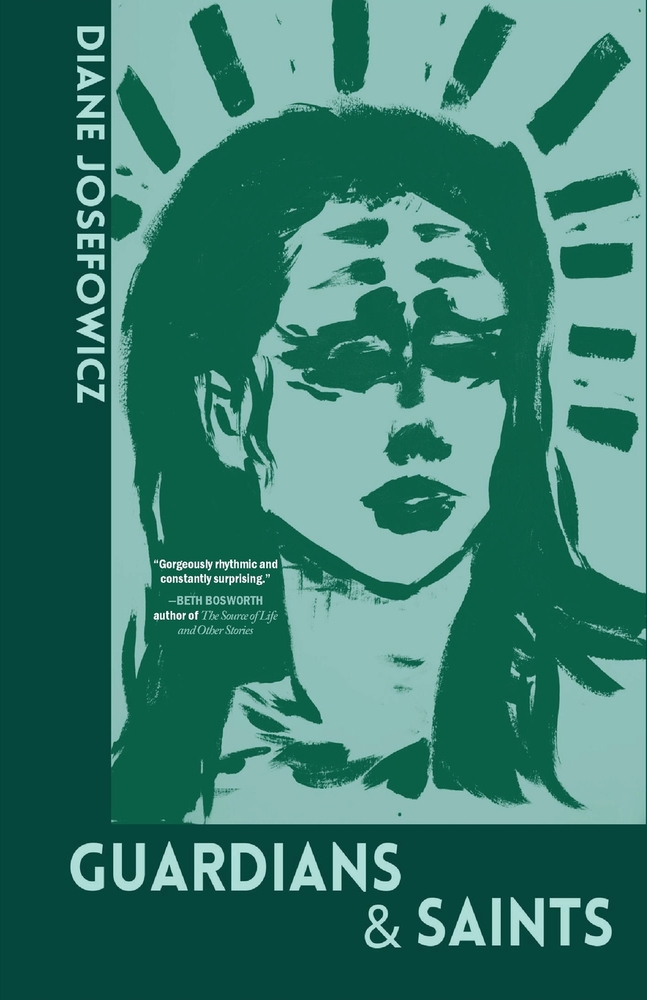
Connected stories make up much of this wonderfully gnarly collection, Josefowicz’s third book of fiction, yet each of the offerings stands (and sings) alone, too. Many of these eleven tales include a doctor—usually a psychiatrist—and characters who suffer mental or physical illness. Protagonists or important characters are articulate, relatable children who are bewildered and brave as they try to understand their families and the world. Josefowicz’s work details their predicaments and also their myriad connections to others, notably their guardians who are not always saints. As one of her psychiatrist characters suggests, his job is to doubt that “any story is the whole story.” Josefowicz leans into the expansive possibilities inherent in her tales, imbuing them with impressive depth and breadth. As one moves through this collection, the emotional effects on us are cumulative, something more often the purview of novels.
The first story, “The Dwindling,” is narrated by a new arrival to Dr. Querque’s Home for Dwindling Boys and Girls. The doctor greets her with apologies that the threshold is not what it used to be in a foyer decorated with a trio of woodwork angels who “clasp psalters to their chests as they raise their bulging eyes to heaven.” With its paucity of what the dwindling children truly need, the Home seems akin to Dickens’ workhouses, although a reference to a school bus places us in more recent years. Josefowicz’s style is sometimes language-forward; she can wax lyrical, make puns, amuse and dazzle us—but never at the cost of clarity or her concern for her characters. The dwindling’s story is a sad one, memorable for many reasons as is its prose, exemplified here by a description of Dr. Querque:
His ginger scent yields to a closet odor of damp wool and insecticide. Blocking the hallway’s meager light, he is pale and narrow as a celery stalk, fibrous, wholesome, and just as hard to swallow. His velveteen jacket shares the sea’s oil sheen.
Moving ahead to “The Radio,” we encounter another girl narrating a tale in which her quirky father, a playwright who writes for the radio, is described as “autochthonous and stalky as the local asparagus.” The girl’s mother is largely offstage, defending her dissertation on “the applicability of kinship analyses to the study of scientific research.” The father is the squeamish sort, and spends two months in bed after a butcher’s display upsets him, during which he hears “the mailman’s steps to and from the letterbox as shovelsful of dirt on his coffin.” He recovers, but the next time he is similarly offended, the results are dire.
In “Alberto: A Case Study,” the titular boy is taken in at an asylum in Bad Dürrenmatt. Initially, he is described as just one more of the “ordinary, shivering, frightened children with nowhere else to go.” My research revealed no extant place called Bad Dürrenmatt, but rather that Friedrich Dürrenmatt, a contemporary of Brecht, was a Swiss playwright who wrote a number of radio plays. This story’s doctor is its narrator Lunette’s father, a cigar-smoking psychiatrist who dies, leaving his daughter to run the asylum. “Lunette” is a name shared by a character in “The Dwindling”—could they be the same person? These stories with their many allusive details suggest one could easily fill a basket with literary Easter eggs, if so inclined.
With “I, Zinnia,” We encounter the first of this collection’s stories peopled by characters from or connected to Josefowicz’s novella L’Air du Temps (1985), which was published last year.As is the case with that novella, Zinnia—long-suffering big sister of Zenobia, daughter of unhappy parents—narrates. When her father deserts her ailing mother, Zinnia, now an adult, returns home to care for this difficult, paranoid woman who “smelled like she was afraid of the bathtub again.” Although this story represents a jump into this family’s future (in terms of where L’Air du Temps (1985) left off), the story, like Zinnia’s mother, spends much of its time wandering though this distant past, reminiscing about the mother’s young adult years when she shared an apartment with friends. The friends’ romantic histories and decisions come in for special consideration. Zinnia, who had seemed the least dysfunctional member of the Zompa family in L’Air du Temps, is now unemployed and keeping herself afloat with a pirated credit card. Yet the entire family hasn’t hit the skids: Zenobia, oozing competence, swoops in at the end. Oh, how the world surprises us!
The story “Dance Hall Days” addresses another chapter in the family’s history, a time when teenaged Zenobia languished in a mental hospital. The story appears after “I, Zinnia,” in this collection even though its chapter of the Zompa family history precedes it. Zenobia “knew her own flaws as well as anyone, looped some twine around her neck and suspended herself from the curtain rod alongside the brand-new curtains from Laura Ashley.” After Zenobia’s half-assed suicide attempt, we encounter a psychiatrist named Dr. Teller. Family counseling sessions and transference ensue.
Every story in Guardians & Saints is moving, smart, and powerful. Josefowicz’s prose, characters and families are complicated in all the right ways, in the ways that life itself is complicated. Don’t miss this stellar collection—it’s got staying power and heart. If we’re lucky, Josefowicz is already at work on another volume of fiction, sharing with us her observations about this fallen world.
Guardians & Saints, by Diane Josefowicz. Stevens Point, Wisconsin: Cornerstone Press, October 2025. 202 pages. $24.95, paper.
Sarah Bowen Holloway’s work has appeared in SmokeLong Quarterly‘s blog, Roi Fainéant, Emerge Literary Journal, The Ekphrastic Review, Cowboy Jamboree, and elsewhere. She’s @sarahholloway.bsky.social.
Check out HFR’s book catalog, publicity list, submission manager, and buy merch from our Spring store. Follow us on Instagram, Bluesky, and YouTube. Disclosure: HFR is an affiliate of Bookshop.org and we will earn a commission if you click through and make a purchase. Sales from Bookshop.org help support independent bookstores and small presses.

