
The Prayers of Strangers
He pulled off at the gas station on the side of the road, gravel and rubber. At the pump, the attendant asked him if he wanted to confess anything. He’d forgotten that things were different in New Jersey, that the attendant walked right up to ask you if you wanted to confess. He had nothing much to say, but he didn’t want to make the attendant feel useless, so he said he still thought about the time his best friend had walked in on him masturbating to the Colombian star, Sofia Vergara, that he thought, perhaps, by never speaking of it again, he’d damaged the relationship with his best friend who no longer returned his calls.
The attendant pumped his gas and prescribed seven Hail Marys for the masturbation, but the man found it insufficient. Certainly, the offense was worthy of at least fifty Hail Marys, the damaging of this relationship and more for never speaking of it. The car was full, but the attendant, seeing no one else coming, seemed inclined to offer more advice.
“And again I say to you, it is easier for a camel to go through the eye of a needle than for a rich man to enter the kingdom of God.”
It was a bit of a non-sequitur, but the man felt himself relieved, nonetheless. He’d been driving all night, trying to make his way to a roadside hotel where he’d make love to a woman he’d met on the internet. There was a virus. Everyone was scared. But he was so desperate to fuck. He felt no need to apologize to the attendant for the desire, no need to confess.
Later, he admired the ridges of her backbone as she lay in bed beside him. Her thighs were still wet with him. Hail Mary, he whispered to himself, over and over, while light patterned the wall.
The Shape of Things
He was up before first light. And he had driven down the old roads—patter of insects on the glass, the V of geese overhead. He pulled the truck into the dusty parking lot; motes swim the air. A hesitant sun. Scrim of clouds. He walks down the muddy path, thinking of his father, who used to take him hunting, decades ago now.
He remembers the smell of his father’s aftershave, filling the cab of the car. He remembers the first time he saw his father shoot, the mallard falling across the blued space of the sky. He’d spent the night sleeping with his new girlfriend, the smell of her still across his unwashed cheeks.
The slight breeze. The sounds of the marsh, clicking of insects, croak of bullfrogs. A heron’s thin legs in the dark water.
The shape of his life had changed and as he thought of her, he realized he’d made the kind of mistake you can only make three to four times in a life. He’d loved the wrong woman. He’d have to tell her when he got home, but he knew himself well enough to know that he wouldn’t. He lived inside his own shame.
For now, he hears the small thrashing of wings, and he raises the gun to his shoulder. The duck keeps flying long after his shot has rung out. The rest of the day to collect his failures.
Naming and Renaming
The child kept changing the names of the guinea pigs, first Lemon Cookie and Oreo, then Strawberry and Sophia. Then names which have now been lost to time. It confused the parents, who, like most parents, had expected the child to be normal. They were like horses in a field at night in search of a lost ocean.
The father worked in an office downtown. A building of cut glass, which looked like a ship which had foundered on some unknown shore. Sometimes he forgot the names of his colleagues, but he saw no relationship between the forgettings. His world at the office and his world at home bore no relationship to one another or so he said at the BBQ they were holding on the fourth in honor of some triumph fought over by dead men.
He was serving hot dogs, which his wife found unscrupulous. She had read somewhere that each piece of processed meat eaten reduced your life by three minutes. She could not verify where she had found this fact. Her husband said he found three minutes to be negligible. It was hard to argue.
The girl spent her whole summer inside, naming and renaming the guinea pigs. She didn’t find it strange at all. She found the animals slippery and their identity was constantly shifting. The larger one, sometimes nibbled on food and sometimes gorged. The little girl thought it stranger that we had a name attached at the very beginning, affixing it as a pin to our identity. In this, perhaps she was not mistaken.
Outside, there was a row of tall yellow flowers, which the girl couldn’t name. She’d seen a tiny yellow bird flitting among the flowers. Such was the beauty of the world, which she knew her parents could not see. At night, she watched the moonlight swan the yard, and she heard overhead, the distant sound of a duck’s repeated quack, which was the sound of a female mallard, she knew from reading a book.
Beneath her, the party was winding down. All of the friends of her parents had gone home, and they stood in the yard, which was full of paper plates and trash cans and soda bottles, confused as to what they had brought into being. It hadn’t been intentional, the husband thought, but it had happened, nonetheless.
He wished he had been a smoker instead of a drinker. The night was swaying. His wife was inside the house, crying at the kitchen sink. She said, there are too many damn dishes. I’m never doing this again, and he felt the truth of it. There were too many damn dishes. They would never do this again. The house was honeycombed with light. But he stayed out in the darkness, brooding over things.
Mini-interview with Andrew Bertaina
HFR: Can you share a moment that has shaped you as a writer (or continues to)?
AB: I think I am continually shaped by the words of Virginia Woolf. I don’t think I’d have realized I could write without hearing the rhythms of her prose and feeling that something about the reality we don’t express can almost be captured by words.
HFR: What are you reading?
AB: I am usually reading several things at once. I’m currently reading Ducks, Newburyport, and I recently finished Under the Volcano. I am also reading Still Alive, by LJ Pemberton, and Some Trees, by John Ashbery. Reading is the way I stay sane in the summer while I’m managing the children😊.
HFR: Can you tell us what prompted the three fictions?
AB: I actually wrote these at a yearly writing retreat I put together over Labor Day weekend. The goal is mainly to bond, but we also spend some time writing. The prompt was about taking something out of its usual context and apply another context. In “The Prayers of Strangers,” I had a guy going to a gas station as though it was a church. It was pretty much a one shot deal, which I love about prompts and creativity. The second piece, “The Shape of Things,” was also written on that retreat. I think I ignored its prompt and wrote deeply into feeling and landscape, which is pretty much my go to when writing, following the feeling into the wilderness. The final piece, “Naming and Renaming,” came out of a family situation where my step-daughter kept changing the names of the guinea pigs in our home, which felt wrong! I mean, I doubt that guinea pigs had enough language apprehension to make my discomfort relevant, but it piqued my interest.
HFR: What’s next? What are you working on?
AB: I’m currently working on some short stories. I tend to just follow where the writing wind blows. I write by the old-fashioned muse. If I’m interested, I can write really quickly. If I’m not interested, it can take months to generate anything.
HFR: Take the floor. Be political. Be fanatical. Be anything. What do you want to share?
AB: My wife and I are continually talking about the world we live in, the suffering, the cruelty, the environmental degradation and sort of willy nilly embrace of AI. It’s a lot. And we have kiddos we are trying to bring up and prepare for this world. Anyhow, we are doing our best to build community and make some small connections to make this little corner of our world a bit better.
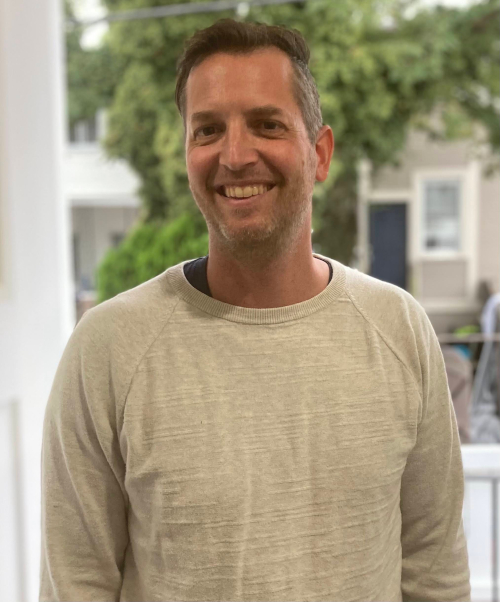
Andrew Bertaina is the author of the essay collection, The Body Is a Temporary Gathering Place (Autofocus 2024), the book length essay, Ethan Hawke & Me (Barrelhouse, 2025), and the short-story collection, One Person Away From You (Moon City Press Award Winner 2021). His work has appeared in The ThreePenny Review, New Letters, Prairie Schooner, Orion, and elsewhere.
Check out HFR’s book catalog, publicity list, submission manager, and buy merch from our Spring store. Follow us on Instagram and YouTube. Disclosure: HFR is an affiliate of Bookshop.org and we will earn a commission if you click through and make a purchase. Sales from Bookshop.org help support independent bookstores and small presses.
 Heavy Feather Review