
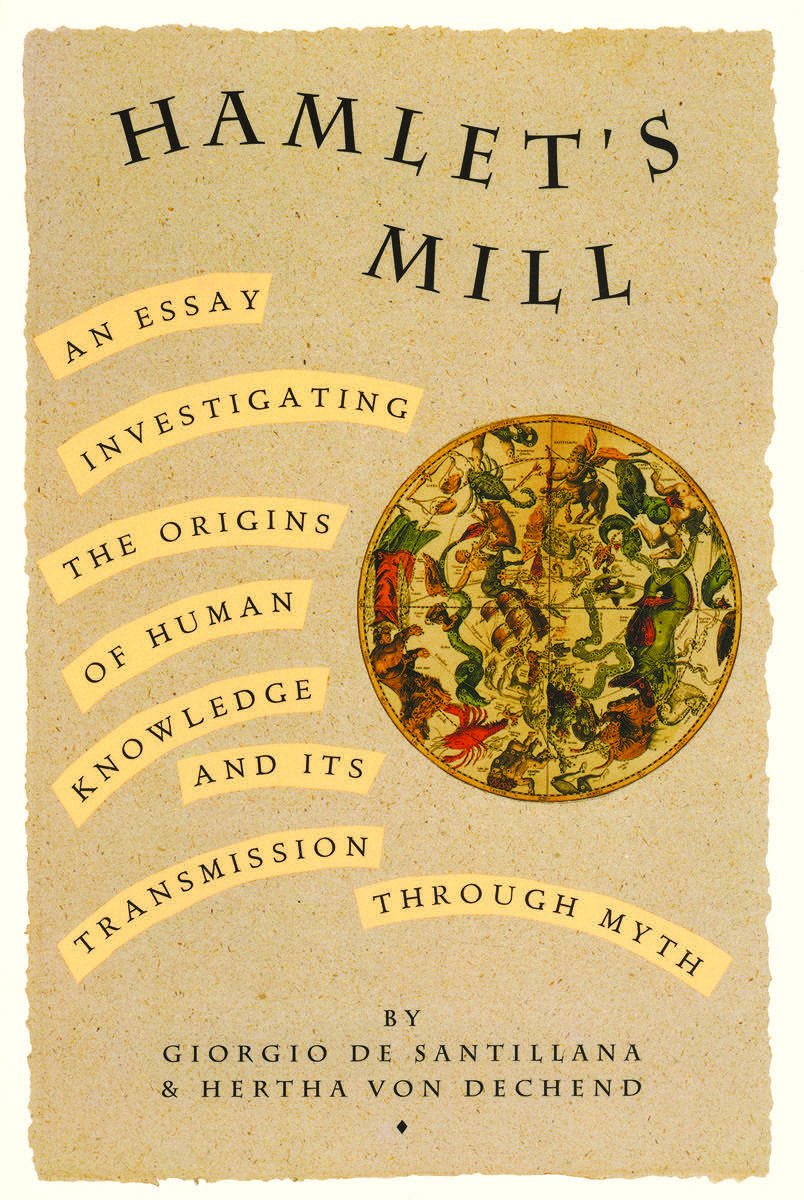
I didn’t go looking for Hamlet’s Mill. It found me—during a season of psychic weather when everything in my life felt dislodged, the usual maps no longer worked. I had drifted from most of my routines, including reading. But this book, pulled from a dusty shelf by accident or fate, offered a different kind of clarity: not comfort, not insight, but alignment. Something ancient stirred in its pages.
At first glance, it was baffling. Myth, astronomy, precession, cosmic mills, sidereal calendars. It read like a transmission from another epistemology. But even in its strangeness, I recognized something. A feeling that the world had once made symbolic sense—and that we had forgotten how to read it.
Originally published in 1969, Hamlet’s Mill by Giorgio de Santillana & Hertha von Dechend makes a provocative claim: that ancient myth is not primitive storytelling but encoded proto-science—an archive of astronomical knowledge written in symbolic form. The authors trace the recurring figure of a broken cosmic mill across Norse, Babylonian, Indian, and Greek traditions, interpreting it as a metaphor for the precession of the equinoxes. Long dismissed by academic historians, the book survives in footnotes, cult libraries, and the occasional republishing boom.
The book’s thesis proposes that myth is not merely story but storage: that the cosmological preoccupations of ancient peoples—precession, axial tilt, sidereal calendars, the constellations—left their residue not in star charts but in oral history sagas. The figure of Hamlet, traced through the archaeoastronomies of ancient Norse, Indian, Babylonian, Greek, Polynesian, Persian, and West African Dogon traditions, becomes the axis around which this grinding mythological machinery once turned. The celestial mechanism embodied in the rotation of the earth on its axis and linked to the rotation of the heavens grinding away through the ages. But the mill is broken, the sky no longer turns as it once did with Hamlet as the symbolic figure representing the disinherited cosmic ruler. The stories crack under their own accumulated symbolism. This review does not attempt to prove or disprove its thesis. Instead, it asks: why does this book still resonate? And what does it say about the symbolic debris we now live among?
Taken together with de Santillana’s earlier Origins of Scientific Thought: From Anaximander to Proclus (1961), the book forms a kind of double helix: one strand following the rational arc of Greek science, the other spiraling through mythic cosmologies. If the latter strand seems less legible to modern eyes, it may be because its grammar was symbolic, not syllogistic. One doesn’t have to accept the argument in full to feel its force. It is not a question of veracity, but of vibration. The book hums with an intuition that something vital slipped through the cracks of Enlightenment categories. Myth, in this reading, becomes neither primitive cosmology nor moral fable but the earliest stirrings of scientific discourse. What’s most remarkable is that many of their claims—once seen as fringe—are no longer entirely outside scholarly respectability. There’s now a whole field of studies re-evaluating the astronomical sophistication of ancient cultures (e.g., Göbekli Tepe alignments, Mayan Venus cycles, even the Nabta Playa structures in Egypt).
Others, more steeped in sanctioned forms of knowledge, have looked upon it with suspicion. A historian, courteous but firm, once noted in passing that the book had nothing to do with the history of science and everything to do with cross-cultural mythologies.1 The implication was clear: the categories were fixed, and this book did not belong. Hamlet’s Mill’s authors were quite resolute in their claims with respect to scientific origins. But perhaps it is the discomfort that matters. The way it refuses to sit still under any disciplinary light. The way it insists on leaning out over the edge. My argument is that its lasting force lies not in proof but in method—in how it renders the cosmos thinkable through symbol when measurement was still myth.
Hamlet’s Mill has long been faulted on two fronts: first, for associative method, moving too quickly from symbol to sky; second, for inferring scientific intent from narrative form. Those objections stand—no ancient cosmology can be “true” in the modern, empirical sense. Yet the book remains illuminating if we lower the claim: not that myth is science, but that, at times and in places, it stored and transmitted observations in symbolic form—an early, culturally embedded technology of attention to the heavens. On this reading, even when the astronomy fails, the form still teaches what mattered and how knowledge once moved.
That this connection remains unexplored is more than oversight—it is symptomatic. The interpretive machinery of Renaissance studies remains calibrated to religious, psychological, or textual concerns, but not to archaeoastronomical inheritance. Hamlet’s Mill hums at a frequency that disciplinary antennas don’t pick up. The neglect isn’t just disciplinary—it marks a broader cultural amnesia about how knowledge once turned on the same axis as story.
There’s no recorded evidence that Stephen Greenblatt, the leading New Historicist scholar of Shakespeare, has ever engaged with or cited Hamlet’s Mill. His major work Hamlet in Purgatory focuses on the religious anxieties and theological metaphors of Hamlet, particularly the tension between Protestant and Catholic worldviews in early modern England. Greenblatt situates Hamlet in its Renaissance context—Christian cosmology, political ritual, cultural poetics—not in the archaeoastronomical or myth-structural framework that Hamlet’s Mill proposes. His analysis draws on theological and historical archives, reliably tied to Elizabethan cultural anxieties, but makes no reference to mill symbolism as ancient cosmological encoding. Similarly, the late Harold Bloom, Greenblatt’s high-profile rival, never addressed Hamlet’s Mill—his Hamlet was a vessel of inwardness, not a relic of archaic cosmology.
Given that, its reception, predictably, has been oblique. Rather than academic citations, it left echoes elsewhere—in the footnotes of speculative writers, in the margins of 70s planetary consciousness movements and Whole Earth catalogues, in the attic seminars of churches-turned-nightclubs. It was in one such space that a series of weekly discussions took place under vaulted ceilings that would later pulse with strobe lights and sound systems. The irony never seemed ironic at the time. There was something fitting about cosmology unfolding in a sanctuary already half in ruin.2
If the book is haunted by an idea, it is this: that knowledge, once dislocated, returns as myth. Not as organized religion, but as fragment. A grinding mill, a mad prince, a sunken axis. The dominant readings of Hamlet have tended to emphasize the new interiority of the early modern subject, the fault lines of Elizabethan England, the language of loss and decay. All are instructive. But beneath them, something older stirs: not a psychological crisis, but a cosmological one. The prince, after all, does not merely grieve—he grinds, delays, orbits, like something stuck in a broken gear. What emerges is less a system than a field of disruptions—stories that no longer cohere but still point, faintly, to an order no longer legible. The motif persists, of course, resurfacing now and then in the contemporary scene—in brooding cinematic retellings, for example, where the ancient prince once again shoulders the weight of the turning sky.3
What Hamlet’s Mill argues—and what recent movies like The Northman helps visualize—is that Amleth/Hamlet is not just a literary figure but a cosmic archetype (in the Cassirer/Ricoeur sense of symbolic form): a mill-turner, one who upends the natural and moral order in response to some primordial fracture. In myth after myth—whether Sisyphus, Yudhishthira, or the Norse Amleth—we see a cosmic disruption, a betrayal or fall, followed by a transitional figure who must navigate chaos, revenge, memory, and fate. These myths aren’t just stories; they encode pre-scientific cosmologies, often mapped onto the stars, cycles, and turning of the great mill of time and fate.
In other traditions, this sense of dislocation takes other forms. Myth becomes archetype, then allegory, then psychic wound.4 What was once above becomes buried. What once structured time becomes symptom. These shifts are neither errors nor corrections, but transitions—a slow turning of the axis from cosmos to psyche to code. In certain accounts, even myth itself undergoes metamorphosis. It ceases to be merely cultural artifact and begins to operate as a kind of proto-science. One perspective, shaped by a belief in the historical unfolding of form, suggests that Greek myth, over time, began to resemble something like a scientific universal—not as abstraction, but as a structure emerging from within symbolic expression. Not allegory, not metaphor, but a pre-modern method for engaging natural law.5
This approach differs sharply from the Jungian school, which remains popular among spiritual seekers and MBTI consultants alike. Jung saw myth as symbolic shorthand for psychic archetypes and personal transformation—what Paul Ricoeur might call the “hermeneutics of suspicion” in its most baroque, self-regarding form. But Jung’s cosmology, rooted in astrological typologies and medieval quaternities, offered a closed and fatalistic vision: personalities fixed by birth, myths reduced to mirrors. Hamlet’s Mill, for all its flaws, attempts something more difficult: a reading of myth not as self-reflection but as cosmological operation. Where Jung wandered through dreams and alchemical forests in search of the self, de Santillana & von Dechend tried to read the sky.
This mythic encoding is less allegorical than world-making. Cassirer called such structures “symbolic forms”—primary modes of organizing experience. Ricoeur, in turn, saw myth as narrative wound, refiguring chaos into comprehension. Hamlet’s Mill thus reads less like analysis than invocation: a return of cosmological memory through form.
Other currents have circled the same gravity. Thinkers working in disparate registers have approached myth not merely as expression but as operation: as machinic process, as dialectical flash, as sacred expenditure.6 Their paths diverge, but their instincts converge. Each, in a different idiom, attempts to listen for the latent mechanics—a grinding, churning, spiraling torque beneath the narrative skin.
And in more recent writing, there is a call to reexamine the local cosmologies that once held these movements in place—not as nostalgia, but as necessity. The loss is not just epistemic; it is topological. Place and cosmos, once sutured, now float apart. The axis, once broken, may not be restored. But its fragments remain, embedded in language, in ruins, in the residual grammar of ritual.7
What was once a grinding mill—a cosmological engine—now sputters as symbolic residue. We have retained the diagrams but lost the myths; the calendars but not the cosmos. And yet, the figure persists: Hamlet, Amleth, the broken-turning axis. The mill turns, if only in metaphor.
So the book lingers. Not in seminar rooms, but in the hands of those who find it by accident—at a thrift shop, in a footnote, during a season of psychic weather. It does not offer a system. It offers only a trace. A noise, perhaps, mistaken for signal. Or a signal mistaken for myth.
Now we know that no ancient cosmology can be empirically true in the modern sense. The observable universe is too vast, too saturated with dark matter and dark energy whose nature remains unknown. Current estimates suggest that only about 4% of the cosmos consists of structured matter; the rest is an invisible medium measurable only in Planck units and Hubble constants. To scale it: if an atom were enlarged to the size of the Earth, a Planck-length entity would be about the size of that atom. Such magnitudes boggle the mind, yet they grant no empirical validation to the mythic architectures of the past. Their beauty lies not in accuracy but in the audacity of imagining a cosmos legible to human measure.
Now and then, myth returns not through solemn ritual or encoded saga but in the grotesque theater of civic life, its symbols scrambled and inverted. A carnival prince storms the citadel, gold-plated and microphone-clad, as if to remind us—though not in so many words—that the mill still turns, just not as expected. The axis reappears inverted, not as metaphysical order but as televised spectacle, where the sacred is profaned and the profane enshrined.8
Hamlet’s Mill: An Essay Investigating the Origins of Human Knowledge and Its Transmissions through Myth, by Giorgio de Santillana & Hertha von Dechend. Boston, Massachusetts: David R. Godine Publisher, March 2015. 538 pages. $28.95, paper.
Thomas B is an independent writer and analyst living in New York City. His essays explore the intersections of culture, history, and ideas in a fragmented world, with work appearing in literary and critical journals.
Check out HFR’s book catalog, publicity list, submission manager, and buy merch from our Spring store. Follow us on Instagram, Bluesky, and YouTube. Disclosure: HFR is an affiliate of Bookshop.org and we will earn a commission if you click through and make a purchase. Sales from Bookshop.org help support independent bookstores and small presses.
Footnotes
- Lorraine Daston, personal correspondence, 2025. ↩︎
- William Irwin Thompson, The Time Falling Bodies Take to Light (New York: St. Martin’s Press, 1981). ↩︎
- See Robert Eggers, dir., The Northman (2022), which dramatizes the Amleth legend that precedes Shakespeare’s Hamlet. ↩︎
- Paul Ricoeur, The Symbolism of Evil, trans. Emerson Buchanan (Boston: Beacon Press, 1967). ↩︎
- Alois Riegl, Historical Grammar of the Visual Arts, trans. Jacqueline E. Jung (New York: Zone Books, 2004), 315. ↩︎
- Georges Bataille, The Accursed Share, trans. Robert Hurley (New York: Zone Books, 1991); Walter Benjamin, The Arcades Project, trans. Howard Eiland and Kevin McLaughlin (Cambridge: Harvard University Press, 1999); Gilles Deleuze and Félix Guattari, A Thousand Plateaus: Capitalism and Schizophrenia, trans. Brian Massumi (Minneapolis: University of Minnesota Press, 1987). ↩︎
- Yuk Hui, Recursivity and Contingency (London: Rowman & Littlefield, 2019). ↩︎
- Consider the symbolic inversion of tradition and values represented by the most recent occupant of the pinnacle of political power, their gold-plated tower, the broken discourse, a carnival king. ↩︎

