
The third number of La Révolution surréaliste, appearing in April 1925, was remarkable for its inclusion of strident statements addressed to the Pope, the Dalai Lama, and the Buddhist Schools. Largely responsible for these items, as well as for overseeing the issue, was Antonin Artaud, (1896-1948), a recent addition to the Paris Surrealist group. In these contributions Artaud denounced purported decadence of the rationalism of the West in favor of the supposed soul-liberating wisdom of the East. To be sure, Artaud’s addresses may strike us as an attempt to negate the cultural Same in the name of a dubiously idealized image of the Other. But at the same time, they express what was a lifelong attraction to the esoteric and the heterodox.
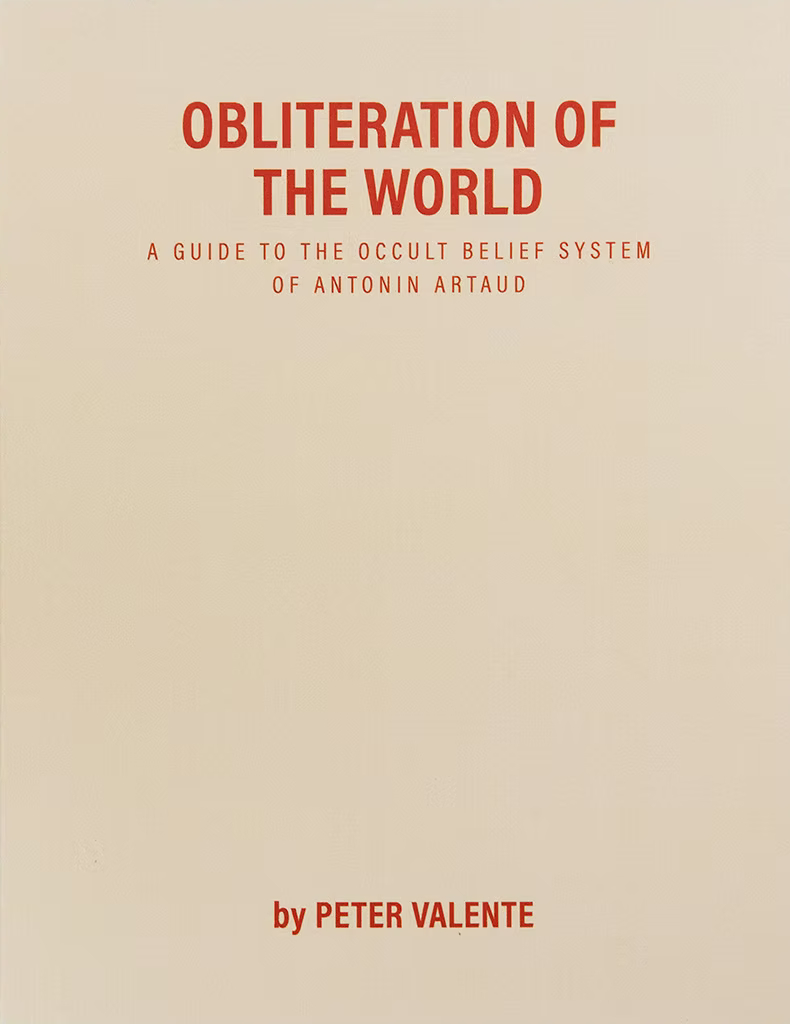
In Obliteration of the World: A Guide to the Occult Belief System of Antonin Artaud, Peter Valente examines that essential element of Artaud’s art and thought. Valente’s engagement with Artaud has been deep and ongoing; he’s translated and published selections of letters from the final years of Artaud’s life as well as a collection of Artaud’s writings of the 1930s on various subjects. Prior to those works he published a hybrid work blending his own writing with his translations of Artaud. This new book contains a collection of Valente’s original essays, which draw on Artaud’s 1940s correspondence with Surrealist poet and theoretician André Breton, painter Georges Braque, essayist and translator Marthe Robert, actress Colette Thomas, and Anie Besnard, his last romantic partner and a close confidante. In addition, Valente cites texts from the City Lights Artaud Anthology and other sources as well.
As the book’s subtitle advertises, what Valente sets out to provide is a guide—a kind of handbook for identifying and describing the esoteric themes that pervaded Artaud’s late writings, as well as for tracing their sources in, or coincidental parallels to, Kabbalah, Tarot, Tibetan Buddhism, Aleister Crowley’s occultism, and Gnosticism. This isn’t an easy task, since coherence wasn’t a quality Artaud strove for—in fact, quite the opposite. As Valente demonstrates repeatedly, the defeat of rationality was a key article of faith, and we can see this amply brought out in the texts quoted. Their language is as emotionally wrought as a primal scream and frequently vituperative, their structure is often fragmentary, and their content verging on the hallucinatory. This is not surprising, given that Artaud’s late writings came after years of opium addiction and in the wake of his mental breakdown of the late 1930s, following which he was institutionalized for nine years. Consequently, in deciphering these texts Valente is working from a verbal mosaic made up of tiles taken from disparate and sometimes conflicting sources, which were then associated and assembled according to a literally mad logic. His task is not easy, but he nevertheless succeeds in giving shape to, and making intelligible, Artaud’s anti-systematic system of belief.
One of the central and recurring motifs Valente finds in Artaud’s constellation of heterodoxies is a militant attitude toward thought itself. Artaud is in effect thinking against thinking. As Valente describes it, for Artaud ideas have a “disgusting physicality” that torment the mind and open a way for the dead God to inhabit and torture the body, rendering human being “simply a plaything in the hands of black magicians.” Further, the Western tradition serves only to “enslav[e] … in chains of reason.” One means of defeating the torment of the thought-haunted body is for language to “return to its origin … [in] a pre-linguistic chaos.”
Artaud put this last tenet into practice not only in his legendary January 1947 lecture-performance at the Théâtre du Vieux-Colombier in Paris, but in many of these writings as well. Much of what Valente quotes of Artaud’s makes for uncomfortable reading. But in their violence and disorganization, they are revealing not only of a man who had undergone mental dissolution aggravated by electroshock treatments and the poor living conditions of his confinement, but of an attitude toward existence that goes back to Artaud’s earlier years. The key to this attitude I believe consists in Artaud’s sui generis Gnosticism, something that Valente brings out and which had been remarked on by Jane Goodall, whom Valente cites, as well as others before her, notably Serge Hutin and later Susan Sontag. For Valente as well, Artaud’s Gnosticism is a touchstone.
It’s telling that when, shortly after meeting Breton in 1924 Artaud compared his poems to Breton’s, he noted that though his own were not as strong, unlike Breton, his “soul was physiologically damaged” and that he, Artaud, suffered “not only in the mind but in the flesh.” Artaud’s later writings, as Valente shows, are remarkable for how they reveal the artist’s tortured relationship to the fact of his embodiment, of his being a body endowed with consciousness in a corrupt material world—a paradigmatically Gnostic attitude toward the physical self and its existence. Artaud believed that procreation was, as Valente writes, “repulsive replication and endless repetition … unleash[ing] the demons of the abyss”: a replication that results in the multiplication of bodies, physical entities for which Artaud expressed a visceral disgust. This disgust is dramatically captured in the notion of the “body without organs”—an idea associated with Gilles Deleuze, but first articulated by Artaud. Valente presents a number of passages from Artaud’s writings and correspondence that touch on this idea, such as this extract from Artaud’s notebooks of the late 1940s: “No mouth / no tongue / no teeth / no larynx / no oesophagus / no stomach/ no guts / no anus / I will construct the man that I am.” The body without organs is a disembodied body, a body without anatomy, physiology, consciousness, cravings, satisfactions, and decay. Such a body is, as Valente asserts, inconceivable and ultimately “without form or representation.” For Artaud, this dematerialized and insensate body—Valente likens it to an astral body—would make for an existence “much richer, more real and true precisely because it is unthinkable,” as he put it in a 9 May 1946 letter to Marthe Robert. If, as later French thinkers have suggested, Artaud’s body-without-organs raises the specter of a crisis of representation, it is because—as his writings show time and time again—it is grounded in a deeper crisis of existence: the crisis of a “physiologically damaged” soul whose being in the world was to be alienated from the world and from the being that he was condemned to be.
The obliteration of the world is the Gnostic’s dream. Perhaps the purest expression of Artaud’s Gnostic wish to obliterate the world came at the very end of his life, in a 1948 interview that Valente quotes: “At this moment, I want to destroy my thought and my mind. Above all, thought, mind and consciousness. I do not want to suppose anything, admit anything, enter into anything, discuss anything …”
Obliteration of the World: A Guide to the Occult Belief System of Antonin Artaud, by Peter Valente. London, England: Infinity Land Press, March 2023. 106 pages. £15.00, paper.
Daniel Barbiero is a double bassist, composer, and writer in the Washington, DC area. He writes on the art, music, and literature of the classic avant-gardes of the 20th century, and on contemporary work, and is the author of the essay collection As Within, So Without (Arteidolia Press, 2021). Website: danielbarbiero.wordpress.com.
Check out HFR’s book catalog, publicity list, submission manager, and buy merch from our Spring store. Follow us on Instagram and YouTube. Disclosure: HFR is an affiliate of Bookshop.org and we will earn a commission if you click through and make a purchase. Sales from Bookshop.org help support independent bookstores and small presses.
 Heavy Feather Review