
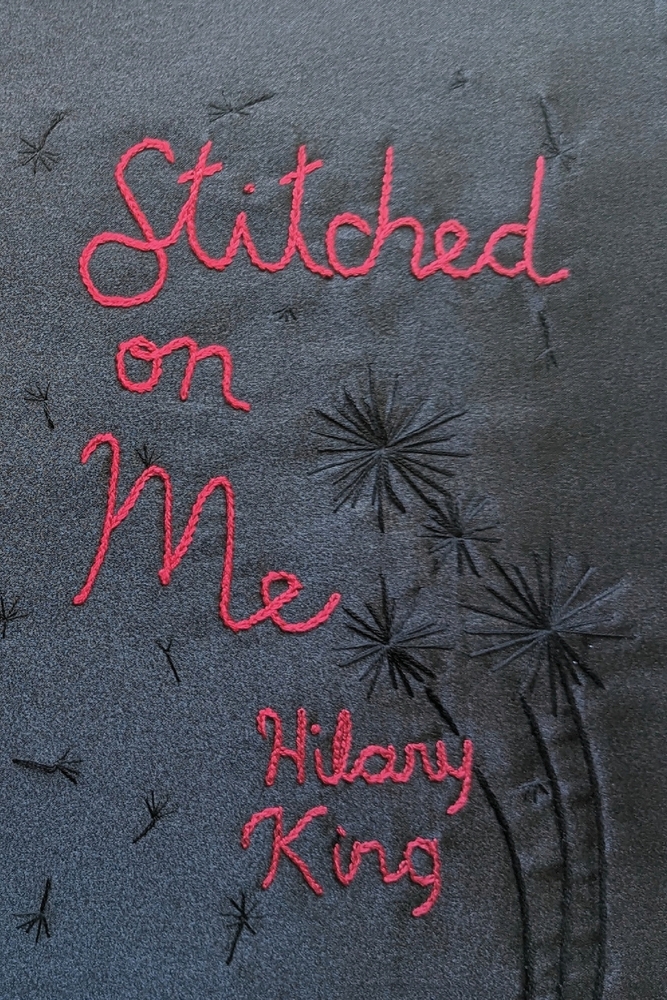
I have heard it said, too often, that nobody wants to read about middle-aged-women. Political candidates in 2025 are still asking why women “past 50” are worried about abortion and why should they have an opinion on abortion because they can no longer get pregnant? Stitched on Me, by poet Hilary King, is a blistering rebuke to such absurdities. As a society we must stop telling stupid little boys they are so smart and in the next breath putting down girls.
Whether the candidate meant post-menopausal women should be at home caregivers for their grandchildren, the statement remains a short-sighted attempt to rebuke any female over 50. If women’s only role in the world after fertility, is to provide childcare for younger generations, you’d think a candidate would realize that means those women still have a stake in the game. Moreover, bringing up new generations, is one of the most valuable and necessary jobs that exists. King intuitively knows this; and in her humor-laced war-cry, she lands amongst us, vibrant and ready to engage. From “Stitched on Me”:
Here we women root ourselves
in the humid soil of expectation.
Deference our genus.
Watch us bend towards each other.
You’re prettier.
You’re smarter.
It takes a woman who has lived some, to look back, not just in anger, but understanding, how we come to forge our destinies and what holds us back from doing so. If it is true that those who forget history are doomed to repeat it, then are we surprised we stand in a world where basic women’s rights are eroding? Women make up half the world, yet historically have had little say in decision-making. This appears to be repeating itself; the question is why? King takes us on a kaleidoscopic journey through her own experience(s), her mothers, and then women who came before us and tried to speak out against the tyranny of being female in a male-led-world. People like the poet Anne Sexton. From “Self-Portrait as Anne Sexton’s Typewriter”:
And Reader,
I leapt into mother’s violence, my keys of steel
clacking, my carriage swinging, my ribbon spooling
to be back alone with my mistress
By imagining these things; it is not about making subjects “safe” but reinforcing the point made, in examining it anew. How often can we stand to consider our histories and really think on how we came to be, without wanting to run from the truth? Poetry stands as a weathervane for family dynamics; throughout history, men have written of their parents, but women only more recently. When we write of our mothers, we bring back the history we have forgotten and remind ourselves why it’s so necessary to keep it in our minds. Because the mother is more than a single person, she is a symbol of all women. In her history of being denied rights, King understands, she stands as our totem against a repeated history. From “If My 1970s Childhood Had an Instagram Feed”:
My mother, her mother, all mothers:
Buttoning, straightening,
smoothing, pushing, reaching
down their daughter’s throat.
Trying to strangle the future.
In the titles of the poems themselves, there is a macabre humor that is so clever, so attenuated and well informed, you want to laugh out-loud just as you want to cry. The blend of seemingly diametric opposite emotions, is really just indicator that a poet is a magician, who can engage with us at a more primal level, in their effort to stir our response:
First sadness, and the last.
Every stitch between.
When we advocate for other women, we stand together. If we condemn memory to the past, we forget our origins. We live in a world where prescriptive religion tells us, women are second-class-citizens. Do we have to literally stich on ourselves, this radical idea of equality that has yet to be fully realized? From “What Women Wear for the Resurrection”:
By the end of this holiday of food,
family, and religion, a man has risen but a woman
wants to lie down and remove her own hot metal.
There is a quiet war-cry in the smart humor of Hilary King. She is a woman of her generation, where they weren’t divided by the precious that is technology, but literally beat the skin of drums to be heard and not dismissed. For those who think this fight a relic, should consider what happens to women after they pass their “sell by dates” that men do not possess. It is only when we see the subterfuge of superficial equality that we can access the truth of our ongoing war for equality and equity. Guising this fight in a degree of humor, is a method many poets are versed at, and King does abundantly well in this collection. From “The Updated Encyclopedia of Female Philosophers”:
I lay
them out in the shape of a middle-aged woman, then I lie on top of them
and pray. How many books does it take to change a light bulb? None. We’ve
memorized this darkness. I wake up with the corners of my personality
folded down and my margins full of notes.
For emerging generations, this polemic isn’t a woman riling at her ageing. In fact, quite the reverse. It is a coming to terms with, some aspects of mortality, while firmly staying in the race. There is no backing down here, only a call to arms, rebuking the notion that women run out of steam, wherein fact they grow and engage, every bit youth’s equal. From “Learning to Accelerate”:
What a relief
it is to be
the engine, to be not
the passenger
but the creator
of speed.
Generational abuse, in the neglect of female-egalitarianism, cannot be remedied by pretending it didn’t happen, and ignoring women of other generations, in your longing to be the now generation yourself. The smart woman will equally rely upon herself and her ancestors, to swell together in protest, coming at it from myriad directions, to tear down the fallacy that women do have a sell-by-date, when they’ve proven over-and-over the reverse is true. From “Skip the Scarf”:
For Christmas don’t give me jewelry or perfume.
I want a vending machine, I tell my family.
A food truck, a car wash, and also
a strip mall. I want an empire.
Hilary King’s work is, ironically, refreshing. I say this with full knowledge such writings existed in abundance in the first feminist wave. But refreshing can be literal. A wet towel to a hot face. Reading these clever observations of a woman’s life, with lines like “Time hides in a new dish towel,” it is impossible not to relate deeply, at any juncture in life and be aware that all of us will reach the same point, so making that point bearable is key but not enough. We don’t want compromise any longer, we want to leave the relics of control behind us, and inherit a world where gender isn’t an excuse for hypocrisy. From “What Daughters Wear to Fly”:
In airports all over the world,
girls are preparing to fly.
They travel without the armor
of their mothers.
Just when you worried that feminism had taken a back bench in defeat, books like Stitched on Me remind us, women don’t hide anymore, they run for office. Women don’t stop being beautiful at 50, they get a young lover. Women aren’t going to be acquiescent anymore, they’re taking over and having strong daughters and aware sons. The shift is real. The art of any poet, is to predict that and let us know it’s coming and this time, we’re not going to acquiesce.
Stitched on Me, by Hilary King. Riot in Your Throat Press, October 2024. 72 pages. $17.00, paper.
Candice Louisa Daquin is of Egyptian/French heritage, an immigrant to America she currently works with Raw Earth Ink and Tint Journal among other publishing houses, as an editor and consultant. She is a trauma psychotherapist by training and an advocate of immigration reform and LGBTQ equality.
Check out HFR’s book catalog, publicity list, submission manager, and buy merch from our Spring store. Follow us on Instagram and YouTube. Disclosure: HFR is an affiliate of Bookshop.org and we will earn a commission if you click through and make a purchase. Sales from Bookshop.org help support independent bookstores and small presses.
 Heavy Feather Review