
I’ve tried to make this call four or five times this week. Now that my mother is finally on the other end, I find myself wishing I were once again hearing her voicemail greeting instead.
Growing up, when I answered the house phone, the caller would inevitably launch into conversation. “I’m Morgan,” I would interrupt.
“Oh my god, you sound just like your mom.”
“I know. I’ll get her.”
When I hear my mom’s voice now, I remember this. I try to think of talking to her as talking to myself, to make it easier to tell her that I’m dating a woman. That I want, maybe, for them to meet, one day, eventually, if possible.
I’ve never shared my dating life with my mom, and we’ve agreed for both of our sakes to just not talk politics. Still, she’s the first person I call when I’m sad, scared, in pain. I know she’d do anything for me. She’s forever loved her daughters too much. “You don’t need to worry about taking care of us anymore. I’m nearly thirty,” I’ve reminded her time and time again. “Do something for you!”
“Hey, Moog, what’s up?” I expect the sound of her voice to be soothing. It always has been. Now though, the sound of her voice terrifies me. It holds so much power …
My fingers twist a strand of my hair, a nervous habit I’ve had since I was a child.
*
As a toddler I had what my mom, often in an exhalation of frustration as she adjusted my perpetually slipping clips, called “poker-straight” hair.
*
Samson’s power resided in his hair. But hair and love have always been unruly things. And Samson fell in love with Delilah. She leveraged his love to learn his secret and, when he was vulnerable in her lap, strip his power from him. I can imagine Samson looking up at his love, tasting what must have been a bitter draft of shock and devastation, shaken, as his locks fell from his head. At the hand of another.
Or so the story is often told. It wasn’t the hair, though, that was the source of Samson’s power—it was his vow to God, which included not cutting his hair. It wasn’t the hair. It was what it represented.
*
On Monday I sat in the dark in my graduate student office, a converted dorm room with a cabinet door hanging precariously from its one remaining hinge. I dialed my mother but got no answer, just her whispered, pre-recorded invitation to “Leave a message. Thanks.” A few minutes later I got a text reply letting me know that she was at the hospital where she works as a neonatal nurse, so she couldn’t answer my call. “But you can text me.” I typed out a response, then deleted it, then typed it again: “No, I can’t.”
This isn’t a conversation I can have over text.
“Are you OK?”
“I’m fine. Not the fake fine, but fine for real.”
Which is true.
I am fine.
But it’s a strange sort of fine, an incomplete and independent strain.
I am fine. But I’m not sure she will be when she finds out. And so I’m fine, but just for now.
*
I was born with my mom’s thick hair, but not its blondness. For a while I had its straightness. Like many girls during adolescence, I shaved away the dark hair growing in places it didn’t use to, but the hair on my head also changed. It started to grow curly like my dad’s, and I worried I’d caused this.
When I was eight, my dad left a note on the kitchen counter and didn’t come home again. While I eventually saw him again, my parents’ divorce was messy, and to cope I pulled out my hair. Standing in front of the bathroom mirror in the secret hours, I’d pluck one strand at a time in a grim trance night after night until the scalp behind my ears was bald.
After I accidentally drew blood and sought Mom’s help, we were both upset. I asked if my hair would grow back, and she answered in a huff, “It could grow back red and curly!”
My hair hadn’t turned red, but at fourteen, it was becoming increasingly wild. I couldn’t tame my frizzy curls, so I resorted to spending nearly an hour in front of the bathroom mirror, hair held up in clips so that I could let it down layer-by-layer to straighten it in sections. By the end my arms were shaking, and the result was never quite right.
The girls I idolized had hair that looked effortlessly sleek. My hair looked worked over, and throughout the day, it would slowly break out of the straight jacket I’d tried to tie it in.
*
In whatever version of the Grimm brothers’ fairy tale “Rapunzel” you read, her long hair is everything. It becomes the missing stairs that the prince uses to reach her. “Rapunzel, Rapunzel, let down your hair …” And she does, until her captor, Dame Gothel, learns that another has been climbing Rapunzel’s tresses and chops them off.
Rapunzel must have felt lost, or loosed, in that moment. As though she had been cut from the world rather than her hair cut from her body.
She was cast out—without knowledge of the world outside her tower or her hair—but eventually reunited with her prince. In some versions, the prince’s touch magically causes her hair to grow back.
Whether she gets her hair back in the end or not, it is not—was never—just hers.
*
At my counseling appointment last week, my therapist and I made a plan to spend the next session—this session—preparing me to have a conversation with my mother when I go home for the holidays, still three weeks away. So, today my therapist can’t comprehend my newfound bravery when I tell her about my attempted phone call.
I guffaw at the compliment. The problem is that I can’t wait, I explain. Procrastination, for me, lives in decision-making, not action-taking. So, last session, when I’d made up my mind to tell my mother, I wanted to hurry up and get it over with. It’s not bravery but a lack thereof that drives me. I fear my courage will not last (and sure enough, only splinters remain by the time I actually reach my mother).
In the days following the appointment, I make several more calls but never reach her.
Finally, after placing an unanswered call on Sunday morning, I give up. That’s it, I rant while driving uptown to get dinner. Doesn’t she care at all? If our roles were reversed …
By the time I finish monologue-ing, I have a missed call.
When I get home, I call back.
With each ring my heart beats harder. By the time she answers, I have to hunch my shoulders forward to relieve the pain of my heart pounding in my chest, and as I do my hair falls in front of my face.
I ramble for a bit, “The weather is good.” I can’t concentrate enough to really evaluate the weather, but she’s a thousand miles away. “It’s cold.” I hate the cold. The weather cannot be both good and cold. “My dog likes it.” Why I am I still talking about the weather? I can barely hear myself talking, and I don’t hear her replies.
I tuck my hair behind my ears and take a dramatic breath that makes me cringe and tell her: I’ve been seeing someone for two months, and I’m not sure if the relationship itself is serious (I don’t tell her I hope it is), but I’m serious about it, and I want to be able to talk about it, so she has to know, I just want her to know, the person I’m seeing, I, I’m dating a—I have a girlfriend.
*
When I was in first grade my mom took me to get my hair cut, and my hairdresser either was brand new to the profession or grossly misunderstood my mother’s request for the popular-at-the-time reverse wedge because I left with what didn’t even deserve the label of bowl-cut.
I’m not sure if I cried immediately, but I know I cried several days later in my mom’s car after tennis camp.
“Are you a boy?” One of the other girls asked at the start of the lesson, face hidden behind her racket.
“No,” I laughed, thinking she was playing a game, until she asked again and her tone was more accusatory than inquiry.
“Are you sure? You look like a boy.”
“Yeah, your hair is so short.” A few more girls had gathered around us, and I gathered things weren’t looking good for me. “You should play over there,” another one of them said, pointing across the net, “with the boys.”
“But I’m a girl.”
Even though the coach let me play with the girls, they never believed I was one of them. My mom’s solution was to let me get my ears pierced. The next day the other girls argued boys could have pierced ears, so I was still a boy.
*
In high school I’d run the mile home after the last bell of the day to watch Cardcaptor Sakura on the WB. The anime features Sakura, an average girl who accidentally sets spirits free and then gets tasked with recapturing them to save the world from imminent disaster.
She had green eyes and brown hair like me, but her hairstyle was impossible to imitate—though not for lack of trying. She had two long sections framing her face, and then the rest of it was boyishly short, though she somehow managed to form two high pigtails from it.
My efforts to copy her look usually ended before I left the bathroom. The one time I was satisfied enough to exit the house to rollerblade just like Sakura did, my mom asked what I had done to my hair in a tone that implied I had taken a hatchet to it. I never tried again after that. My hair wasn’t the right kind of magic and nor was it wholly mine.
*
I’m met with silence.
And suddenly all the iterations of this conversation that I’d rehearsed in my head have ghosted me, and I also have no words. The silence, both empty and full, floats between us, exorcised only by a monotone “oh” and “OK” and “I don’t know what to say.”
I’m mad at myself for not knowing what to say either. I repeat idiotically that I wanted her to know and had to tell her and didn’t think it was fair to my girlfriend otherwise. The silence possesses us, pushes us out and away from each other again.
She says something about not being surprised, which I don’t fully believe, before she concludes, “Just don’t do anything weird to your hair.”
*
By college, I had learned how to manage my hair and appreciated being able to wear it straight or curly. I played with different styles of braids. Some days I cared how it looked. Often I did not.
One weekend in a hotel room with my equestrian teammates, we each dyed a strand of our hair pink. I was afraid. I’d never dyed my hair and it seemed like the sort of thing you couldn’t undo. Once pink, the strand would be pink and my natural brown irretrievable.
After I’d done it, though, I found I didn’t want to go back anyway. Occasionally I’d catch sight of that splash of pink in the mirror and remember I belonged to a team. After the color faded, I kept dying it, and tried other colors.
It seemed preposterous that I’d ever thought dying my hair would put some part of my truest self out of reach. As my roots grew out, my natural color returned.
*
Medusa is known for turning those who looked upon her to stone and having hair of serpents. According to myth she was born with neither of these traits. She was born beautiful.
Her beauty was blamed for compelling Poseidon to rape her, and he did so in the temple of Athena. Such desecration sent the goddess of war into a rage, and Athena punished Medusa, twice unjustly blamed then, by turning her hair to snakes, rendering her face hideous enough to turn people who looked upon it to stone.
Always the hair.
It wasn’t her choice, but it became her power.
*
The laugh that my mom hears at the other end of the line is humorless and dismissive and affronted and dozens of other feelings that I won’t articulate to her. “Mom,” I groan, “I like my hair. I’m not changing.”
My hand goes to my hair then, curls piled atop my head in a tortoiseshell clip. It’s getting long. Finally past my shoulders. I’ve been growing it out for just over two years.
“Good. I wouldn’t want you to.”
*
For many years my mother wore her hair short. Short enough that when my youngest sister was a toddler, she pointed to Ellen DeGeneres on TV and swore it was our mother.
My mother’s hair, blond and highlighted, currently falls just above her shoulders, only a few inches shorter than mine is now.
About three years ago I donated my hair, something I’ve done a few times. After I chopped the twelve inches off, my hair fell just below my chin. My mother liked the cut, encouraged me to keep it that way. And I did for a while.
The shorter length was easier to care for. The longer my hair is, the longer it takes to dry and style—but only if I bother to do either. I wanted to be able to not care. I wanted to pull it back in a ponytail and not think about it.
*
After I hang up, in an ugly moment of resentment, I consider cutting my hair out of spite, but I dismiss the thought. If I cut my hair, it won’t be for such a small rebellion. The day I go to a salon and surrender my hair to a pair of scissors, it will be because it is no longer a part of me anyway. When losing it won’t be a loss at all. The sheared ends on the floor around the salon’s chair, a shedding of something else entirely.
What I told my mom is true—I like my hair and it’s taken me a long time to get to this point. Even though my hair hasn’t changed, it no longer feels unruly. Not because it’s been tamed—I realize now that was impossible— but rather I’ve been untamed. It is not my hair that is unruly, but me.
Morgan Rose-Marie (née Riedl) is a queer writer and an Assistant Professor at Utah Valley University. She has a PhD from Ohio University and an MA from Colorado State University. Her essays have been featured in The Normal School, Sonora Review, and Entropy, and her poetry in Thin Air Magazine.
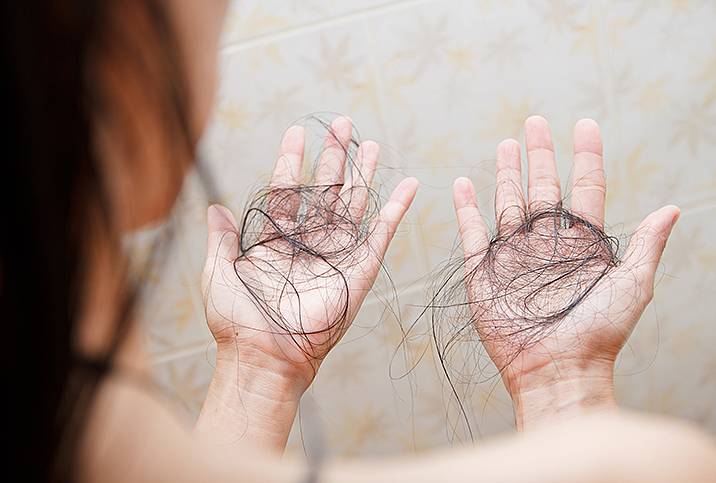
Image: giddy.com
Check out HFR’s book catalog, publicity list, submission manager, and buy merch from our Spring store. Follow us on Instagram and YouTube. Disclosure: HFR is an affiliate of Bookshop.org and we will earn a commission if you click through and make a purchase. Sales from Bookshop.org help support independent bookstores and small presses.
 Heavy Feather Review