
This is a fragment from a forthcoming book (THE RED ABSURD). The section is THE FASSBINDER TAPES.
TAPE
ONE
He swore to all the world and to himself that he would remain decent. And as long as he had money, he remained decent. But then he ran out of money, which was a moment he had been waiting for, to show them all what he was made of.
ALFRED DÖBLIN (Berlin Alexanderplatz)
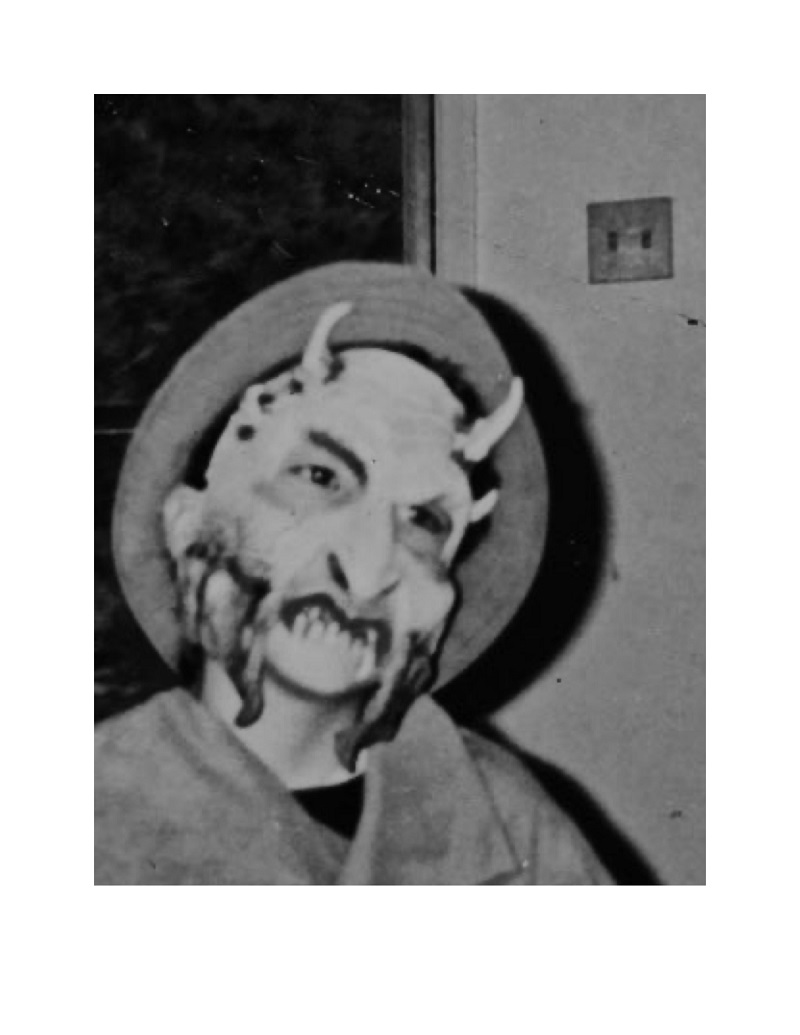
A soft halloween mask sits sympathetically on my face, moderately restricting the breath, restriction causing a kind of oxygen delirium. The mouth uncovered, why so determined to breathe and breed difficulty through the nose?
restriction & plastic
In the mirror a pliant demon appears, intimidating for once, bony and blemished face behind the plasticity of a celebratory habit, acceptable also for once, an appreciated scapegrace, an admired devil.
deliverance & plastic & divine artificiality
The genre of terror returns, forevermore, the surety of wellbeing out the door, but what form presses on, loves bites tears haunts possesses intimates and every so often kills you? Alterity, not only anarchic, recognizable otherness: psychotic homicidal diabolical, like attachment gone wrong, like a perverted love.
The soft halloween mask I’ve seen in a photo, vulgar at present, memory surpassing material evidence, nostalgia failing, come what may, uniquely for one in metamorphosis, not cocooned by past sentimentalized happenings.
Dogmatized larva live defensively, incapable of much more than speeches to a frustrated audience.
A mutant, I wanted to be, to be infernal in front of anyone willing to look, because I could not, without a false face, be a person, the type that wants to cause real trouble—Gabriel as an ogre under a bridge, the evil I yearned for, learning what I should from my defect. But this was failure, also. I wasn’t born to be this. What selfhood one longs for, is forever beyond their grasp.
I was born into a much more fathomless, worn out, desperate perdition, unlike the malevolence birthed out of grandiosity, in the manner of a murderess and her infamous victims, or villainy sprouting from the head of villainy, mine was none alike, none akin, no cinema to it (unless tired and gray, in the manner of a Swedish film or a Hungarian novel)—not quite destitution and not quite a living provision either.
When interiority is externalized in the face, like it is above, abnormality is manifest and understandably ridiculed, fear on first sight, panic at what could be you someday, an ungodly thing caught behind a couch, stuck in a bed, exposed in obscene settings, strewn among the finery. Born to be stretched downward, shame: glorious, because evolution will take care and complicity will take care of the rest.
Then again, distortions have their origin in some unidentified place, at a time unknown to anyone. A degenerate, for example, has a mother, a father, a definite beginning, and an explicit conclusion, in mud, from clay to muck to dirt to air sucked in a titan’s mouth, pulled into bulging red lungs—perversity playing out from the exact place you were spawned from and, before remembrance, you return to that place, now engulfed in flames and hurriedly receding.
Shortly after, my mutation increased tenfold, criminality was the rule, followed disobeyed imagined, but orgiastic nonetheless, a locus of things nearing.
Corpses: alive—a wretched boy—modernism consistently behind schedule and indistinguishabilities ceremonially introduced.
TAPE
THREE

There is but one truly serious philosophical problem, and that is suicide. Judging whether life is or is not worth living amounts to answering the fundamental question of philosophy. All the rest … comes afterwards.
ALBERT CAMUS (The Myth of Sisyphus)
Suicide does not, in all cases, make bad sense, it is not always done in bad faith, not to say I’m an advocate but I don’t rebuke the practiced end, when it betides, nor is the tropology lost on me, nor do I take the event literally, nor does the emblematic delight: attract or repel. “Albert sits in a tub, waiting by a window for the sight of deafening rain,” the Albert of my adolescence. I changed my name too—sentences confounded, metaphors mixed, garbled senses.
In the altered carnival, a new image comes into focus, unused narratives like The Brothers Grimm in a high desert, even then: I craved a city, dangerous & explosive, where a hostile critic might live, sitting at a mahogany desk—where that selfsame critic craves a desert, a barren community identical to mine. I must be an artist of advantage, Nosferatu is a king here, on gothic steps sits a wolf, on a clay slab a snake slithers, the everyday concrete grifts into folklore, folk tales swindle their way onto a damned stage. There’s a story I haven’t read and one that I would not write, nor do I tell it now.
An oddity strips off its costume and stares at itself, a place of wonderful things is out of reach, a humanized skeleton revised by a library of gifted ghosts & maternal foreboding in some of my favorite films, the ones I chose to watch in secret, books the very same, darkly enormous, ones about totem & taboo, one is about giving up on art and finding noble deaths, naive unworldly primal and then one day Pasolini & Bela Tarr: borrowed, kept, another day the raptured body of Ivy Compton Burnett, aromatic as Chantal Akerman, Mark E. Smith, & Leslie Scalapino. Language found me hunched over, living in my back water brain case, an unadorned tormenting of a passing shape, to breathe only, only to breathe.
LM Rivera lives in New Mexico. His work has appeared in journals and magazines. He is the author of The Drunkards and Against Heidegger (both from Omnidawn).
Check out HFR’s book catalog, publicity list, submission manager, and buy merch from our Spring store. Follow us on Instagram and YouTube. Disclosure: HFR is an affiliate of Bookshop.org and we will earn a commission if you click through and make a purchase. Sales from Bookshop.org help support independent bookstores and small presses.
 Heavy Feather Review