
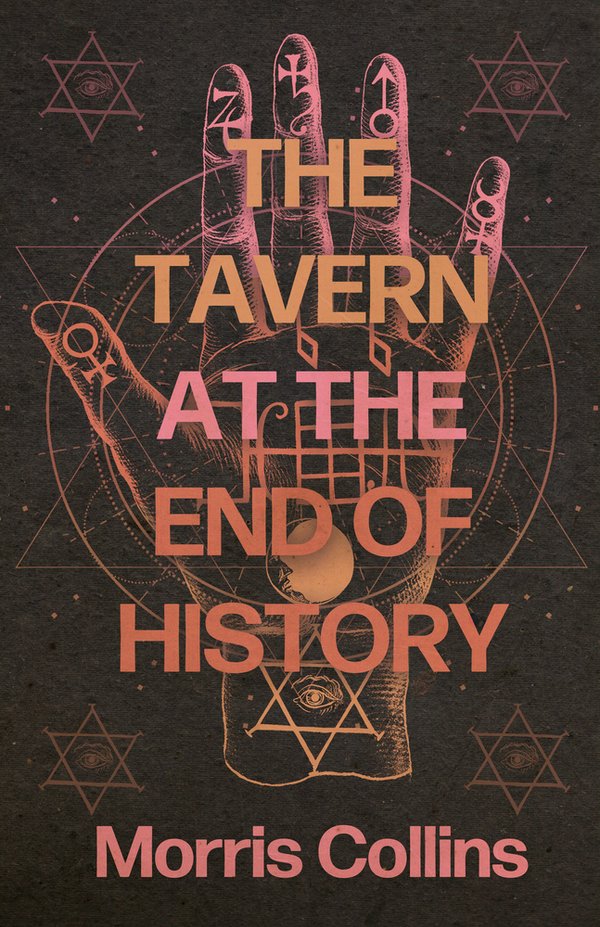
Those who choose to enter Morris Collins’ second novel, The Tavern at the End of History, should do so with a focused mind and a strong heart. It’s a philosophically complex, emotionally wrenching experience. Among its rewards are opportunities to think and reckon deeply with the “black hole … at the heart of the century” (that is, the Holocaust), to study redemption after fatal mistakes, and to grapple with the meaning of memory in a political era that’s painfully familiar to those who know any amount of Jewish history.
The Tavern at the End of History’s first third behaves as relatively familiar contemporary fiction in New York City. Jacob, a professor of Jewish philosophy, bats weakly at his failing marriage and floundering career, while Rachel, a would-be museum curator whose professional arc has fallen flat, tries to find meaning in her grief-ridden life. Jacob and Rachel connect through Baer, an inciting incident disguised as an impoverished Holocaust survivor. Baer pushes these two people in their early 30s, both of whom have screwed their inner lives up very badly, to visit coastal Maine in search of a precious piece of art.
When they arrive in Maine, the novel takes a turn, to say the least. Awaiting them is a sanitarium and extensive grounds known as Nod—in secular terms, the land of sleep and dreams (first coined by Jonathan Swift), and in the Hebrew Bible, the place where Cain settled after murdering his brother. The full meaning of “Nod” to Collins and to the characters in the book is slippery—not either a place for those who forsake or are forsaken by God, or a land of dreams and sub-reality; but both. The estate in the novel is owned by Alex Baruch, a figure comparable to Elie Wiesel or Viktor Frankl, except that Baruch has been publicly disgraced as “a radiant sham” whose Holocaust survival story is not true. Collins writes with startling lyricism as Baruch:
Nothing mattered. I was a wicked scrabbling thing, the human world flamed out and fell like a leaf from the birches on the other side of the river—it seemed that ornamental and unnecessary and frail, and I was huddled in the long bare winter of my survival, and then the war was over.
The sanitarium is not professionally structured or run; it’s less a real place, as the New York of the book’s first section is, and more of a purgatory for characters of uncertain mortal status. At night, these characters gather at the nominal tavern to tell their stories for a group of partially alive wooden angels (really) whose memories and linguistic capacities have failed them.
Memory is possibly the most prominent idea in this novel of ideas. Collins acknowledges through Jacob’s father and mother that, of the extremes of remembering the Shoah, neither is tenable:
[H]is father knew that all was spoiled, that snow was ash, the subway a death train, the factory on the other side of the river a crematorium spilling human smoke, and his mother was equally certain that the past was a ghost the world needed to exorcize, that the future was the only real thing, fully defined, already tended the fertile homestead for those whose righteousness had no memory.
A singular meaning of “memory” as it relates to the characters and events of this book feels impossible to pin down. The angels trail off in the middle of their jokes and stories, because they can neither remember nor forget them. Collins never settles on a definite meaning regarding memory, but its thematic significance thumps under the entire novel like a bass line.
“The knock” is another recurring motif, although it, too, has uncertain resonance. Rachel perseverates in detail about a door-knock in the Song of Songs, and later, a literal knock at a literal door brings a crucial character named Eli into the story. The knock is an opportunity, but also a warning of danger. Secret police knocking, potential lovers knocking, mythical trickster figures knocking. What metaphorical door these figures knock upon deepens the mystery, philosophically; the third, shortest section of the novel is titled “The Door,” and to what it refers is wholly open to interpretation.
The Tavern at the End of History is a deeply thought-out novel, an existential exploration of grief, community, and inheritance. These themes are specifically considered in the novel via Jewishness, and in some ways, that makes the book insular. This non-Jewish reviewer is certain she missed a lot of Jewish cultural references—stories told from the Hebrew Bible, jokes told by Jewish grandfathers, character tropes I couldn’t recognize. Eli is described on the novel’s back cover as a dybbuk, a term I didn’t even know and a characterization that resists full clarity, just as Eli’s words do. Collins is exceedingly well-read, and I have the sense that he is writing in a tradition with which I’m unfamiliar, which is part of why the turn the novel takes in the second section surprised me so utterly. But it was not a negative surprise, and my experience reading the novel was a rich and intellectually challenging one, not someone talking over my head about a culture I don’t understand. Plus, Collins’ insights and deft turns of phrase mark him out as a rare writer: “a face as bland and wobbly as a scoop of ice cream,” “the landscape … glowed as if seen through honey,” “one of those New York jokes, so idiosyncratic that though you realized you were witnessing a joke, you had no idea what made it funny.”
As the living survivors of the Holocaust leave us, as we move into third and fourth generations beyond that black hole, the way Jewish and secular cultures tell and remember the stories of the Shoah will inevitably evolve. This novel feels like a powerful shove in that process. Telling the stories is not enough; understanding the inherited memories of those stories must be part of the next century’s evaluations. There is no particular call to action here, no slogan against any contemporary genocide (although the events in Charlottesville in August 2017 do play a role in the book), but instead a distraught bulwarking of knowledge and experience. None of our questioning or philosophizing will make the Holocaust, or the tragedies of our individual lives, make sense, Collins posits. But it will help us have conversations with each other, to remember what’s lost, and to appreciate what’s between and among us as human beings. Answering the knock is better than ignoring it, no matter who is on the other side.
The Tavern at the End of History, by Morris Collins. Ann Arbor, Michigan: Dzanc Books, February 2026. 326 pages. $27.95, hardcover.
Katharine Coldiron is the author of five books, including Junk Film and the PEN-longlisted Out There in the Dark. Find her at kcoldiron.com.
Check out HFR’s book catalog, publicity list, submission manager, and buy merch from our Spring store. Follow us on Instagram, Bluesky, and YouTube. Disclosure: HFR is an affiliate of Bookshop.org and we will earn a commission if you click through and make a purchase. Sales from Bookshop.org help support independent bookstores and small presses.
 Heavy Feather Review