
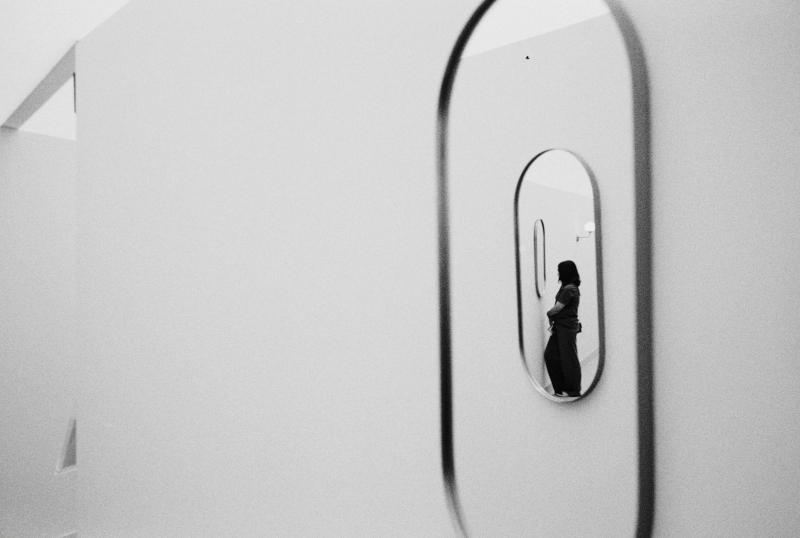
Each autumn, the same hollow weight returns. This year it arrived with force, summoned by a conversation a month prior, when I had dared to mention the firm’s new lease. “A private office, you say? With a window?” My mother’s voice had been dry, easily shattered—meant to puncture silence, never to inhabit it. “Vanity. That money should have gone to replacing the roof on the house you grew up in. You build a glass castle while the foundation here still rots.” The next morning, her name flickered on my phone—not a message, only a missed call. A single line on a screen, and yet something old in me shifted, as if a joint deep in the ribs had cracked. By evening, the dream had already begun.
Water—an overflow, a quiet insurrection rising from the bathroom floor and creeping into the sterile geometry of the session room. It spills over.
The Analyst, who just finished a session, does not solve it. He stands in the doorway. I am the one who crawls, my body twisting into a humiliating posture beneath the sink, searching for a switch to stop the ceaseless flow. A hand—the Analyst’s—reaches down and automatically grasps my breast. In this grotesque embrace, I find the switch, but the water will not stop. The flow accelerates, purposeful, cold on my skin, as if released by a deliberate command. I felt watched—not by the Analyst, but by someone whose role was to ensure that the process continued.
Then, she arrives. My mother.
A raw, cold dread seizes my throat. I am shrinking; the space for my own breath is collapsing. My body registered it first.
She surveys the scene of domestic ruin and, with a withering look, declares that she would handle it herself. “This man is of poor quality,” she says, her words cutting through the damp air. “Do not involve yourself with him.”
I look at the Analyst, whose face is a blank slate of professional neutrality.
He has no words for this.
The water continues to rise. My mother’s eyes, a pair of sharp black stones, do not leave me. A stack of unpaid invoices lies on my desk in the waking world, their sharp corners waiting like accusations. Even in sleep, their presence tugs at me, reminding me that collapse is never confined to one realm. The confirmation email arrived before the session, unsigned, outlining the fees and the conditions in language that felt oddly final.
***
The office hummed with the ghost of a mentor’s death, and the silence held the metallic residue of a final, ruined acknowledgment. The air still felt thick with an unseen dampness, the smell of decay a persistent perfume. I had tried to reclaim the space with professional tidiness, but the wood never quite dried; it remained dark—a stain on the room I had so carefully secured. The decay was not the smell of a leak; it was the smell of the foundation itself, rising to deny my endurance.
My patient, the Strategist, entered. She was a woman who lived by metrics, yet her anxiety was a living thing—something she observed like a specimen, and so did I. I made a note. The pen felt briefly wrong in my hand, the way a key feels wrong in a lock that has already been turned.
She spoke about her six daughters, a parable of obedience and rebellion that felt unnervingly familiar.
“The wicked ones are winning,” she said, her voice a monotone of despair. “They’ve convinced the obedient ones to join them. They say the house is no longer a place of safety, but a site of revolt.” I looked at her face. It had become a canvas for a thousand fleeting expressions—each one a different daughter, a different shade of wickedness.
They did not speak. They rearranged the room.
They had found a more hospitable home within my office walls. The air grew colder, and a shadow seemed to fall over the room, though no cloud passed over the sun.
***
The Strategist’s voice, once a torrent, was now a fractured trickle of non sequiturs. “The boat … the attic … she’s not safe.” She was no longer a patient, but a vessel for the house’s narrative, a radio tuned to a different, more terrifying frequency.
I looked down at the puddle of blackness and saw not just crows, but her mother’s wooden boat, its hull splitting apart in the oily water. The air, which had hummed with the sterile scent of antiseptic, now carried the heavy, musty smell of a swamp.
I tried to reclaim my authority. “You’re speaking in metaphor,” I said, my voice thin, a fragile sheet of glass. “We can work with this. This is your unconscious, bringing an image to the surface.”
But she shook her head, her eyes wide with a certainty that unnerved me. “It’s not an image. It’s the floorboards.”
She pointed with a trembling finger—not at the puddle, but at the very structure of the office. A network of fine, dark cracks had begun to form in the polished wood, spreading from the puddle’s edge like spiderwebs, dark threads spun by the decay itself. Each line was a hairline fracture, a fissure opening in the very foundation of my world.
Just as I registered their pattern, a low groan rose from the floor beneath my feet—the sound of old timber under immense, unnatural pressure, the sound of a living thing giving way. The cracks moved. I could see them widening, a slow, almost imperceptible geometry of decay, like a mouth opening to swallow the air.
I glanced at my diplomas on the wall. The frames were askew, their perfect angles now tilted, their glass panes shimmering with the same oily reflection as the water on the floor.
I looked back at the Strategist. Something in her expression shifted—a small, precise tightening I had seen before, long before I had words for it. She now had her hands on the armrests of her chair, her knuckles white. She was not gripping them out of anxiety, but out of a desperate need to keep the chair from sliding on the slick surface.
For her, too, the floor was now compromised.
The wicked daughters, my dark choir, were no longer content with a whisper. They had begun to sing. The sound did not come from mouths alone, but from the walls and floorboards, vibrating the room into a single, thin tone.
***
The puddle had spread, reaching a quarter of the room, turning the floor into a fractured, shimmering obsidian lake. My client, the Strategist, was now standing. She had moved her chair back and was gazing into the dark surface, her posture one of reverence.
“It’s not safe to stay,” I said, my voice now a desperate whisper—no longer professional, but human.
She turned to me, a serene smile on her face that was more frightening than her earlier panic. “But it is,” she said. “This is our true home. This is where we can rest.” She took a step back, her shoes making no sound on the wet floor, and her gaze met mine. “The daughters say you’re lost. You’re fighting the current.”
A cold dread seeped into my bones. This wasn’t her voice.
Just then, a chime from my appointment system announced a new arrival. The next patient, the Ft, stood in the doorway. He stopped short, his eyes immediately drawn to the puddle of blackness on my office floor. He said nothing, but a faint, almost imperceptible smile touched his lips—the smile of someone who recognizes a familiar sight. He had once told me that every building carries the memory of its first crack.
The Strategist extended a hand toward him, an act of invitation. “We’ve been waiting for you,” she said, her voice a soft, hypnotic melody.
The Architect nodded, a gesture of silent communion. He had not come for help. He had come to join.
I was a trespasser in my own home.
The Architect, still smiling that faint, unsettling smile, did not step over the threshold. He walked around it, his boots sinking into the wet floorboards—an act of intentional defilement. The Strategist took his hand, and the two of them stood side by side, a tableau of quiet complicity. My office was no longer a space for two, but a stage for three.
A chill filled the room, a bone-deep cold that had nothing to do with temperature. “There is no return,” the Architect said, his voice a low, gravelly hum that resonated with the sound of the collapsing floorboards. “The foundations were never solid.” He looked at the diplomas on the wall, and I saw his eyes tracing the cracks, understanding them not as damage, but as the true blueprint of the house.
And then she was there.
Not in a dream, not in a memory, but in the room—standing in the doorway where the Architect had just stood.
It was my mother. The same withering gaze, the same posture of finality.
She took in the scene: the puddle, the cracking floorboards, the two patients standing in silent, knowing communion. She did not speak, but her presence was a sound, a piercing shriek of judgment that filled the space and shattered the air.
The Strategist and the Architect did not flinch. They simply bowed their heads—not in submission, but in recognition. My mother’s eyes did not leave me. Her hands—the same hands that had once held my underwear at arm’s length, separating it with an expression of disgust. But as I watched her, frozen in the doorway, I forced myself to see the incident not through a child’s terror, but through the Architect’s eyes.
My mother did not enter. She simply remained in the doorway, her presence a silent, immovable force. The Strategist and the Architect began to move, not with the quick, frightened gestures of patients, but with a slow, deliberate grace. They shuffled their chairs to the center of the room, turning them to face each other.
The puddle of water was now a circle, a dark mirror reflecting the fluorescent lights in fractured, jagged lines. They settled into the chairs, their bodies perfectly still, and the silence in the room became profound.
My own body was now a stranger to me. I could not move. It was as if I were watching a play, and my role was simply to bear witness.
The Architect reached into his briefcase and produced a small, perfectly polished river stone.
He offered it to the Strategist, who took it and placed it in the center of the puddle.
It did not disappear at once.
The surface held it, briefly, reflecting its outline before the water closed over it.
My mother spoke once. The Architect answered.
The stone sank.
Then the grit followed.
I felt a cold sensation in my throat, as if the whispers were trying to climb their way out of my mouth. A tremor began to shake me, and a single word escaped my lips, a sound I did not recognize as my own:
“Mother.”
Within, I tried to regain control, to speak a word of clinical authority. My mouth opened, and the phrase “I think we should examine” formed on my tongue. But the sound that came out was not my own. It was a discordant babble, a fractured language that felt both familiar and utterly alien. The syllables bent and twisted, and my voice was a mere undercurrent, a frightened whisper beneath the shrieking tide of a dozen others. The clinical phrase—the key to the cage—had curdled in my throat.
***
What remained was altitude—the last axis the office had not yet consumed. I took the meek daughters with me, their small hands clammy in my own, their breaths shallow, their bodies half-flesh, half-shadow beneath dresses that caught on thorns as we climbed. The air sharpened with each step, thinner, carrying a faint metallic taste that reminded me of the rust beneath the sink. The stone gave back nothing—no warmth, no echo, no acknowledgment that a body was pressing against it. I whispered encouragement I did not believe. Every whisper sounded like betrayal, every step an abandonment of the wicked daughters I had left in the office below. But I knew they were not below. The air already carried their frequency—a low, familiar hum threading through the altitude like a current through old wiring.
At the ridge, I felt them before I saw them. The darkness thickened the air as if a second night had fallen inside the first, a heavier atmosphere pressing against the skin with the weight of something witnessed too many times. Then they emerged—six figures, not three, not divided, but whole in their black dresses, standing in formation on the crest of the hill. The meek ones were gone. Their eyes carried a crow-like patience, their mouths curved in the silent knowledge of a conclusion already reached. They did not advance. They did not need to. The ridge belonged to them the way the office floor belonged to the water—not by invasion but by prior claim.
The Father stood behind them. His face held the same wax tenderness, that blend of affection and vacancy I had mistaken, once, for love. He watched me with something between pity and possession, as though he had always known I would arrive here, that the climbing was simply a longer route to the same coordinate. His hands hung at his sides. He did not gesture. He did not call.
His presence was the call—soft, affectionate, foolish—tethered to my spine like a word I could not translate, a word that held me in place without requiring speech.
The counting began without instruction. It rose from the six mouths at once—a single, flattened rhythm that pressed against the thin air of the ridge the way it had once pressed against the kitchen walls of a small house on a hill. One for sorrow. The sound landed with the dull impact of a stone dropped into a lightless well. Two for mirth. No space opened between the numbers. The air refused passage, growing dense and resistant, as though the altitude itself were compressing what the office had failed to contain. Along the ridgeline, crows gathered on an exposed length of wire that ran between two leaning posts—remnants of a fence or a telephone line, it was impossible to tell. They sat without shifting, their black weight perfectly still against the pale, thinning sky.
Three—
The number did not arrive. It stalled in the space between us, unfinished, a fracture in the sequence that no one moved to repair. The crows did not lift. The daughters did not look at one another. The Father’s expression did not change.
The ridge did not collapse. It simply ceased to be the highest point. The stone beneath my feet softened—not into soil but into something more familiar, a surface I had stood on before, a surface that had been waiting beneath the altitude the entire time. There was no plunge, no vertigo, no moment of suspension between one world and the next. The floor reasserted itself the way a tide reasserts itself over a sandbar—slowly, without argument, filling the space that had briefly believed itself to be dry.
The smell arrived first. Antiseptic and rot, layered together with the intimacy of old colleagues. Then the dampness—cold against my skin, pressing through the fabric of my clothes with the calm insistence of something that had never left. My body was beneath the sink again, twisted into the same humiliating posture, my hand reaching for a tap it would never find. The water was still rising. It had not paused while I climbed. It had simply continued at its own pace, indifferent to the altitude I had attempted, filling the room with the patience of something that understood time better than I did.
I had gone up. I had found the same architecture waiting at the summit—the same daughters, the same wax tenderness, the same counting that stopped before completion. The foundation groaned beneath me—the same frequency as the counting, the same frequency as the water, a hum I could no longer tell from my own pulse.
For a moment, the water stilled. A bead of condensation struck my wrist with the weight of a pulse, smelling of rust and old metal, as if time itself were oxidising in place.
***
Then he appeared.
Not the Analyst—or no longer the Analyst, the way a building is no longer a hospital once its windows have been boarded and its corridors given over to weather. A thin Englishman, all tendon and bone, his face a landscape of hollows and shadows beneath a brim that belonged to no hat I could identify. Overalls hung loosely on his frame, as if he had been dropped here by mistake, borrowed from another narrative entirely—a figure who had wandered in from a provincial yard and found himself standing in the ruins of a clinical relationship without recognizing it as such.
He carried no instrument, yet something in the way his hands hung at his sides suggested a musician’s patience—the willingness to wait for a sound that may not come. His silence was not the silence of containment, not the measured pause of a man trained to hold space. It was the silence of someone who had already left the building while still present in it, a vacancy so complete it generated its own atmosphere—cool, faintly sweet, like the air inside a room that has been locked for years.
He crossed to the crumbling wall. The plaster had already begun to separate from the brick beneath, a slow exfoliation that exposed the house’s skeleton in patches of damp grey. He stood with his back to me, his posture unhurried, his weight settling into his heels with the ease of a man performing a routine he had performed in every yard, every ruin, every threshold he had ever passed through.
He urinated against the wall.
The sound was thin, steady, almost musical in its indifference—a small, continuous stream striking the plaster and running into the cracks where it joined the water that was already rising from the floor. He did not look at me. He did not adjust his clothing with any particular care. He walked into the foliage—the damp, overgrown tangle that had begun pressing through the office walls——and was gone. Not dramatically. Not with the finality of a door closing. He simply thinned into the green until there was no longer a figure to follow, only the faint disturbance of leaves settling back into place.
The house did not register his departure. The water continued to rise. The walls continued their slow exhalation. The diplomas had long since become illegible stains.
The mirror on the opposite wall, warped and clouded with moisture, no longer reflected a person. It had become a lung. It inhaled, drawing the room’s damp breath—and with it, the last hollow weight of my own name—into its grey depths.
I felt myself thinning, leaving the structure intact. The silence did not close. It held.
The play began again, not with an appointment, but with a breath. A ripple crossed the water’s surface like an eyelid flickering open.
The house inhales once more.
So do I.
Yeonjin Kim is a psychiatrist and writer based in Seoul. Her work has appeared or is forthcoming in Fatal Flaw Literary Magazine and Heavy Feather Review. She writes across fiction, nonfiction, and hybrid forms, often tracing the body’s memory through atmosphere, language, and perceptual fracture.
Image: jiang chen, unsplash.com
Check out HFR’s book catalog, publicity list, submission manager, and buy merch from our Spring store. Follow us on Instagram, Bluesky, and YouTube. Disclosure: HFR is an affiliate of Bookshop.org and we will earn a commission if you click through and make a purchase. Sales from Bookshop.org help support independent bookstores and small presses.

