
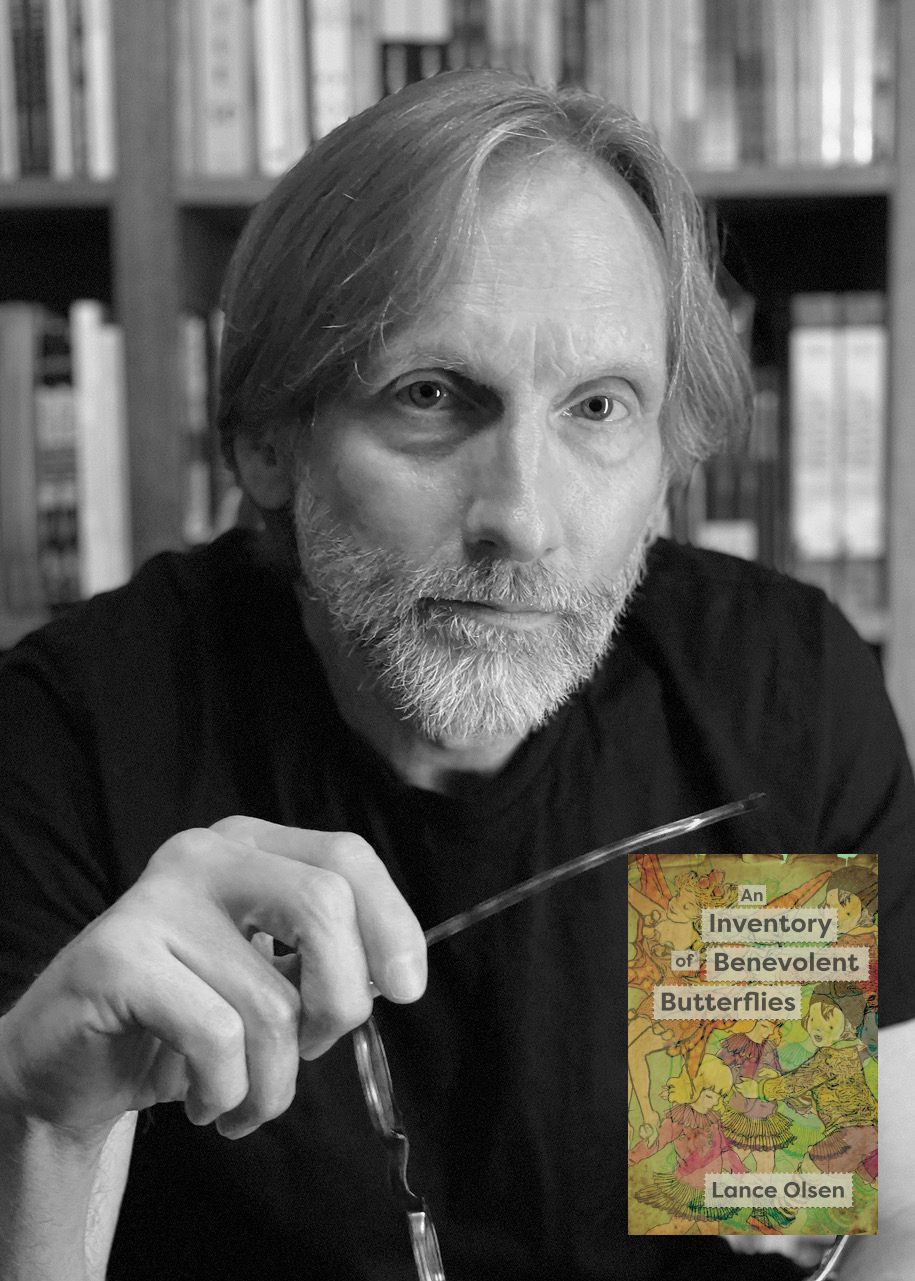
Lance Olsen is one of America’s most formally inventive and intellectually stimulating novelists. Few writers have been as consistently excellent over the past thirty-plus years. In that time, he has evolved from a cutting-edge sci-fi writer into a wizard of form and narrative, infusing his singular works with poetically imaginative language as well as a rare range and depth of knowledge.
His work has earned him, among other recognitions and awards, a Guggenheim, Berlin Prize, DAAD Artist-in-Berlin Residency, NEA Fellowship, and Pushcart Prize. He served for many years as Chair of the Board of Directors at FC2.
Marcus Pactor: What drew you to Harry Darger, and how much of his ten-thousand-or-so page novel did you read?
Lance Olsen: Back in 1997 I chanced upon the first major comprehensive exhibit of Darger’s work, this at the American Folk Art Museum in New York. Twenty-four years later, I wrote the first sentence of An Inventory of Benevolent Butterflies. In between I read everything about him I could get my hands on while socializing with his incredible collages.
From the start, I was drawn to the singular mind of a man who for decades spent his days as a custodian mopping floors, taking out the trash, cleaning dishes, and wrapping bandages in various Chicago hospitals, his nights writing and making art that explored the private mythology he concocted about the horrific adventures of the Vivian Girls, whose mission it was to free the child slaves of the world (though always in the long run failing).
Because Darger left so few traces behind aside from that work, extraordinarily little is known about his biography, save that he existed hand to mouth for most of his 81 years in a cluttered 17.6-by-13.9 room at a boardinghouse, living as near to a solitary, repetitive existence as possible—except in his imagination, which was on fire.
He didn’t care about recognition.
He didn’t care about celebrity.
He created for himself—and to save himself.
How can one not be drawn to such a being?
But to your question: I only read around in his books, which, as you suggest, are head-bangingly long. In the Realms of the Unreal, for instance, is thirteen volumes and 15,145 pages. Even his autobiography, The History of My Life, consists of what passes for a 206-page memoir (which I did read all the way through) followed by a 5,000-page account of a killer tornado called Sweetie Pie (which I didn’t).
The writerly difficulty is that Darger, self-taught, had no sense of style, grammar, syntax, narrative components, character- or world-building. He read very little, repeated scenes and ideas in his writing ad nauseum. Truth to tell, his is grievously boring prose that one must slog through.
I therefore took extensive license, imagining my way into the language my version of Henry Darger uses: a non-sequitur lyricality designed to approximate his magnificent, askew, radical interiority.
Another way of saying this: for me An Inventory of Benevolent Butterflies is at the heart of its heart an exercise in the problematics of reading.
MP: Darger’s misanthropic narration is charming and often hilarious, especially his creative names for nuns. It reminds me of Thomas Bernhard’s and Robert Lopez’s best haters of men. But I don’t recall those excellencies’ misanthropes pitted against such a large assortment of living and dead figures. Darger wrestles with family, bullies, neighbors, his one friend and maybe lover, clergy, God, and hallucinatory spiders with weird red symbols. Did anything beyond the bounds of Darger’s biography drive you to this variety?
LO: Let me start by answering how much I adore Bernhard’s and Lopez’s misanthropes. They’re amazing creatures, stylistically explosive, fraught, both incredibly funny and shot through with sorrow. That’s what makes them so much fun to read about, so complicatedly human to experience.
It’s possible Henry was autistic, and, as you suggest, probable he was gay in a sociohistorical moment (he lived from 1892 to 1973) whose erasure of such identities was often very close to absolute—even as he attended Catholic mass several times a day to beat down the fiends squealing inside him, packed his room with religious memorabilia, and carried on lifelong combat with a furious, pitiless god.
That much is documented.
But so much about him, so many of his motivations, his inner dynamics, quotidian details, even whole years of his life, I invented to account for what we do know.
MP: The aforementioned spiders give Darger a charge and mission to create art. They and their language—a mix of biblical cadence and gentle mockery—constitute some of the novel’s most spectacular passages. I still can’t figure out, though, whether they are an entirely fictional depiction or a depiction of Darger’s actual belief. How much of the spiders and the rest of the novel fictional?
LO: The spiders are wholly fictional. Almost always the external, biographical facts (where he worked, say, where he lived, the people who crowded him up, the asylum in which his father stuck him when Darger was eight because said father believed Henry masturbated too much) are genuine, whereas his subjectivity and what happened in the liminal spaces between those biographical data points is purely dreamed up.
That’s why I think of An Inventory of Benevolent Butterflies in a sense as a speculative fiction. It’s fiction that speculates—about who Henry might have been, what might have driven him, the minutiae of his life, how he might have constructed himself to himself and for others … but also about the very idea of writing into existence a biological figure that left so little in his wake besides his art, so much to our imaginations, which is to say An Inventory of Benevolent Butterflies is also at a subtextual level about the predicaments of dealing with pastness.
MP: Your novels have long featured multiple protagonists. Those protagonists often operate in different places, sometimes even different historical moments. But your last three novels—this one, Always Crashing in the Same Car, and Absolute Away—focus on a single protagonist. Rather than a plurality of lives, these novels instead depict the multiplicity (unfinalizability?) of a single life. What led you to this shift in approach?
LO: What a great observation, Marcus. I think I simply moved my obsessions with the multiple from the external to the internal, resituated the unfinalizable, as Bakhtin called it. So while a number of my novels before Always Crashing were interested in giving thought to Nietzsche’s idea of perspectivism—the relativity inherent in any constellation of points of view—the novels you mention are interested in giving thought to the polyphony, or, better, cacophony, within a single mind, a single body, which are by nature never single; are interested in how we’re all walking hallucinations of wholeness, cohesion, continuity, solidity of self.
That said, the novel I’m working on now, about the history of surgery, returns to my fascination with the external multiple. Some things life won’t let you get away from.
MP: The novel’s narraticules appear to have two modes: one Marksonian, another Bernhardian. Narraticules in the Marksonian mode share not only the clipped brevity but the cadence and syntax of Markson’s late work. Those in the Bernhardian mode are not a tenth as long as Bernhard’s most famous roller coasters, but they nonetheless wheel and loop, ascend and drop, favoring speed, surprise, and constant sprays of acidic misanthropy. Supposing I’m correct here, how much or little did you have Bernhard and Markson in mind while composing? How did you balance each mode?
LO: Again, such a wonderful reading. Thanks ever so much for your readerly attentiveness, especially in this age where attentiveness has for most become as passé as the toys at the bottom of Cracker Jack’s boxes.
I’m only chewing over your insight for the first time, so let me see what I think. What I’ve always loved about (and perhaps absorbed from) Bernhard’s explosive prose are his hypotactic sentence-like objects, the way they rhythmically tumble (and sometimes bumble) on and on, refining and qualifying themselves into oblivion, hilariously ranting words and propositions to death. And what I’ve always loved (and perhaps absorbed from) (later) Markson’s clipped prose are his nearly epigrammatic sentence- and paragraph-like objects, his syllogistic phrasings, the way they accomplish themselves by doing exactly opposite from what those of Bernhard are up to: compression, clarity, sheared syntactic startle.
They must have both been working inside me at some level, though much of the time I was prosing An Inventory of Benevolent Butterflies I was thinking of another breath-taker altogether: the Beckett of The Unnamable, with those otherworldly, self-immolating sentences that continually undo themselves through syntactic and grammatical expunction, how they give us something in their first movement, only to take it away in its second: I can’t go on, I’ll go on.
In some ways, I think of An Inventory of Benevolent Butterflies as a love song to the great Sam.
Which brings up a yet larger mania of mine: my fixation on how every form suggests a philosophy—how for me no sentence is merely itself, but rather through its structure (not just content) a mode of perception, belief, theorization, being-in-the-world.
If all a sentence is doing is saying stuff, then it’s an instance of typing, not writing.
MP: Speaking of roller coasters, late in the novel we get an amazing loop and link to two of your previous novels, Theories of Forgetting and There’s No Place Like Time. Did you foresee this loop in advance, or did it suddenly arrive upon you? What did you see in Darger’s story that reminded you of those previous novels?
LO: About halfway through composing the first draft of An Inventory of Benevolent Butterflies, I found myself wondering what might happen, in light of the sorts of things we’ve been talking about with respect to the historical record’s paucity of information when it comes to Henry, if the novel were to posit briefly, fleetingly, another ontological/narratological possibility for the reader: what if the Henry Darger inhabiting its pages turns out not to be the “real” Darger at all, whatever we might mean by that adjective, but rather a Henry hallucinated by another unhinged character, one from those previous novels of mine (which deal with the ontological/epistemological blurs fiction is so good at provoking), a proposition that would in turn point to yet another readerly opportunity: that that character imagining Henry might be being imagined by still another, and so on, in infinite Borgesian regression.
My character Alana, who lives in both Theories and There’s No Place, dissipates at the hands of a virus called The Frost during a pandemic and falls into a fugue state—unless, those novels suggest, Alana is in fact the creation of her artist-daughter Aila’s imagination that forms part of one of her conceptual exhibits investigating the fiction we call family.
Not that anyone needs to know about any of these metafictional shenanigans, of course, to read and (I hope) enjoy An Inventory of Benevolent Butterflies. Coming up with and contemplating these problems just gives me gladness.
MP: Visual art in fiction generally complements or supplements prose in a clear fashion. Yet Andi Olsen’s contribution—photos of a young girl and her family and (I hope I’m using this term correctly) a double-exposed adult version of the girl mimicking her childhood poses—disturbed my reading by their seemingly total disconnection from the prose development. How much of this disturbance is intentional? What is the aim of such a disturbance?
LO: That’s right: an image in this context usually acts as an illustration of the primary text (think about how newspapers or encyclopedias work), or the primary text acts as an explanation of the illustration. They affirm and secure each other’s existence.
The images in An Inventory of Benevolent Butterflies attempt to do the opposite: create a field of semiotic static between the visual and written, a sort of narrative jamming, which I would like to think leads to an activation and unlatching of readerly options.
The images originally came from a project Andi was working on as I was writing An Inventory of Benevolent Butterflies, one that reflects upon what’s called the Theseus Paradox, first recorded by Plutarch in the first century A.D., and which asks the question: Does an object that has all of its components replaced (as in the planks comprising Theseus’s ship over the course of his voyages) remain the same object or become a different one?
In other words, we’re back to the thematics of identity and the multiple, and hence to An Inventory of Benevolent Butterflies being at the heart of its heart an exercise in the problematics of reading, since a problematics of reading ultimately proffers a problematics of being.
I asked Andi if I might use thirteen of her images from her work-in-progress (one image for each of Henry’s unlucky thirteen chapters), titled I Am What You Have Forgotten, and recontextualize them in a new exhibition space—that of the printed page. She sweetly agreed, which was terrific, because I revere her art and felt in this case it would further texture An Inventory of Benevolent Butterflies in engaging ways.
I like to think in An Inventory of Benevolent Butterflies those images function—or at least can function, if viewed through a certain optic—as x-rays of Henry Darger’s collages, which are at the end of the day all about all the damaged slave children who live inside the damaged slave adult, how each asks why time tastes like metal splinters in the mouth.
Marcus Pactor is the author of Begat Who Begat Who Begat (Astrophil Press) and Vs. Death Noises (Subito Press). The latter book won the 2011 Subito Press Prize for Fiction. His story “Megaberry Crunch” was selected for Best Small Fictions 2021. His work has most recently appeared in The Rupture, Always Crashing, and 3:AM Magazine. He lives and works in Jacksonville, Florida.
Check out HFR’s book catalog, publicity list, submission manager, and buy merch from our Spring store. Follow us on Instagram, Bluesky, and YouTube. Disclosure: HFR is an affiliate of Bookshop.org and we will earn a commission if you click through and make a purchase. Sales from Bookshop.org help support independent bookstores and small presses.

