
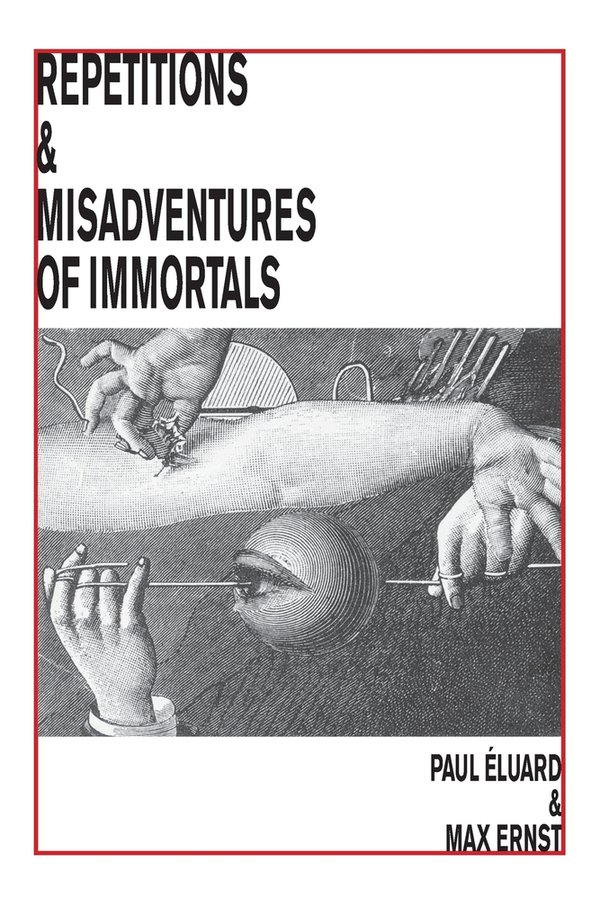
“Max and I were at Verdun together and used to shoot at each other.” This was how French poet Paul Éluard drolly described his first encounter with the German artist Max Ernst. Each had served in his country’s army during the First World War and had fought on opposite sides during the battle of Verdun. When they actually met it was under happier circumstances in autumn 1921, when Éluard, along with his wife Gala, went to Cologne to visit Ernst. The three hit it off, and the next year Ernst left his wife to relocate to Paris and move in with the Éluards, where they established an unorthodox relationship that has been described as a marriage-a-trois.
Ernst, a leader in Cologne Dada, had been known since 1919 to the Paris Dada group gathered around Éluard, André Breton, Louis Aragon, Philippe Soupault, Francis Picabia, and others. Impressed with a set of collages Ernst had sent to Picabia, the Paris Dadas put on a show of Ernst’s paintings, drawings, and collages at the Au Sans Pareil bookstore in spring 1921. Ernst himself couldn’t attend, having been denied a visa by the government in retaliation for demonstrations he organized in Cologne. But once he resettled in Paris, Ernst joined Paris Dada, which eventually became the Surrealist group.
Early on in their friendship, Éluard & Ernst collaborated on two projects that put together the former’s collages with the latter’s poetry: Repetitions and Les Malheurs des immortels, both published in 1922. Originally issued separately, both books are now available together as a single volume in Repetitions & Misadventures of Immortals, a new English translation by Gian Lombardo.
Repetitions and Les Malheurs des immortels were the products of two different processes. For the first book, created in 1921, Éluard selected ten of Ernst’s collages to accompany the thirty-three poems he’d already written. With Les Malheurs des immortels, produced in 1922 while Ernst was still in Cologne, the two worked more closely. Ernst once again provided the collaged images, twenty in all, to each of which a text would be written in response. But now, instead of having Éluard compose the texts solely by himself, Ernst was brought into the process as the two traded bits of writing and rewriting back and forth by mail and then assembled them into finished, jointly authored texts of poetic prose.
Éluard’s poems in Repetitions are permeated by a gentle sensuality. Here, for example, is “Suite” in Lombardo’s translation:
For the brilliance in the air of the day’s delights
For thriving effortlessly on the tastes of colors
For feasting on love’s laughter
For eyes opening at the last instant
She’s totally blissed out.
The poem’s celebration of the languid pleasures of the sights and sounds of a bright day, possibly in spring when the blossoms are out, carries an undertone of the kind of psychologized eroticism that often colors Éluard’s verse. Lombardo brings out with his choice of “For feasting on love’s laughter” for Éluard’s “Pour se régaler des amours pour rire.” We find it again in in the first two stanzas of “All the More Reason (Raison de plus)”:
Lights in air
Air around a column, half-spent, half-lit,
Let the children in,
Every greeting, every kiss, every thanks.
Around her mouth,
Her laugh’s invariably different,
It’s a treat, it’s desire, it’s torture
A madwoman, a flower, a Creole strolling by.
Lombardo captures here the lyrical directness of Éluard’s voice, even as the poet addresses the emotional complications of the erotic bond.
In Misadventures of Immortals the texts take on a phantasmagorical tone as Ernst adds his sensibility to Éluard’s. Here, for example, is Lombardo’s version of “Le Fagot Harmonieux,” translated as “Mellifluous Armful of Kindling”:
The spark that attracts mosquitoes to sports no longer decorates the buttonholes of farmers in the Alps and Caucasus. Threads of a bulky multi-colored spool slowed down ball movement and blocked the goal. Thankfully, since the shininess of their firearms made the duelists lower their gaze. The bystanders’ derision intoxicated them with modesty. But, then, you can’t be drunk all your life.
This is Éluard & Ernst’s interpretation of a collage containing images of a gun, a table for pinning down objects, insect wings, and a geometric figure made of concentric circles. Out of this melange the two concoct a disjunctive story encompassing a soccer game and a duel, the ending to which is a witty rejoinder to one of the scenes they describe. The shifts in imagery and action are abrupt and freely associated, as in an experimental film montage or a dream.
The dreamlike displacements of the narratives in Misadventures of Immortals complement the uncanny tableaux set out in Ernst’s collages, all of which are reproduced in Lombardo’s edition. (Repetitions includes all of the original text’s collages as well.) With their juxtaposed bits of engravings taken from 19th century scientific and medical texts, fashion catalogues, and popular magazines, Ernst’s often bizarre, hybrid figures inhabit strange scenarios reflecting the influence of de Chirico’s metaphysical paintings as well as the work of Freud, which Ernst read while a student of psychiatry at the University of Bonn before the war.
Fifteen years after the publication of these two books Ernst described his conception of collage as consisting in “the union of two apparently incompatible realities on an apparently unsuitable scale.” This urge to combine the logically uncombinable is something Breton had seen in Ernst’s work from the beginning. In his short essay for Ernst’s 1921 exhibit at Au Sans Pareil, Breton wrote of “the marvelous ability to reach out, without leaving the field of our experience, to two distinct realities and bring them together to create a spark.” This early formulation of what would become the Surrealist concept of the image accurately describes not only the collages in Repetitions and Les Malheurs des immortels, but the overall effects of both books’ provocative pairings of the visual and the verbal as well. In effect, these early collaborations between Éluard & Ernst—there would be others in the future—represent one of the first manifestations of Surrealism even before the movement was officially established in 1924.
This edition of Repetitions & Misadventures of Immortals is a nicely produced, near-facsimile recreation of both of the Éluard-Ernst collaborations. Lombardo’s translations convey the sense of the originals in an accessible, contemporary American English. Although it would’ve been nice to have the French texts included, we can still enjoy the experience of seeing the collages as we read the accompanying texts. (For those who are interested, both Repetitions and Les Malheurs des immortels have been digitized and are readily accessible on the web.)
Like Les Champs magnetiques, an automatic text coauthored by Breton and Soupault in spring 1919, Repetitions and Les Malheurs des immortels are important works marking the transition from Dada to Surrealism. In words and images they capture that volatile moment when the former’s irrationality for the sake of irrationality was mutating into the latter’s irrationalism for the sake of revelation. It’s good to have them in English in this attractive volume.
Repetitions & Misadventures of Immortals, by Paul Éluard & Max Ernst. Translated by Gian Lombardo. Niantic, Conneticut: Quale Press, March 2025. 102 pages. $16.00, paper.
Daniel Barbiero is a double bassist, composer, and writer in the Washington, DC area. He writes on the art, music, and literature of the classic avant-gardes of the 20th century, and on contemporary work, and is the author of the essay collection As Within, So Without (Arteidolia Press, 2021). Website: danielbarbiero.wordpress.com.
Check out HFR’s book catalog, publicity list, submission manager, and buy merch from our Spring store. Follow us on Instagram, Bluesky, and YouTube. Disclosure: HFR is an affiliate of Bookshop.org and we will earn a commission if you click through and make a purchase. Sales from Bookshop.org help support independent bookstores and small presses.

