
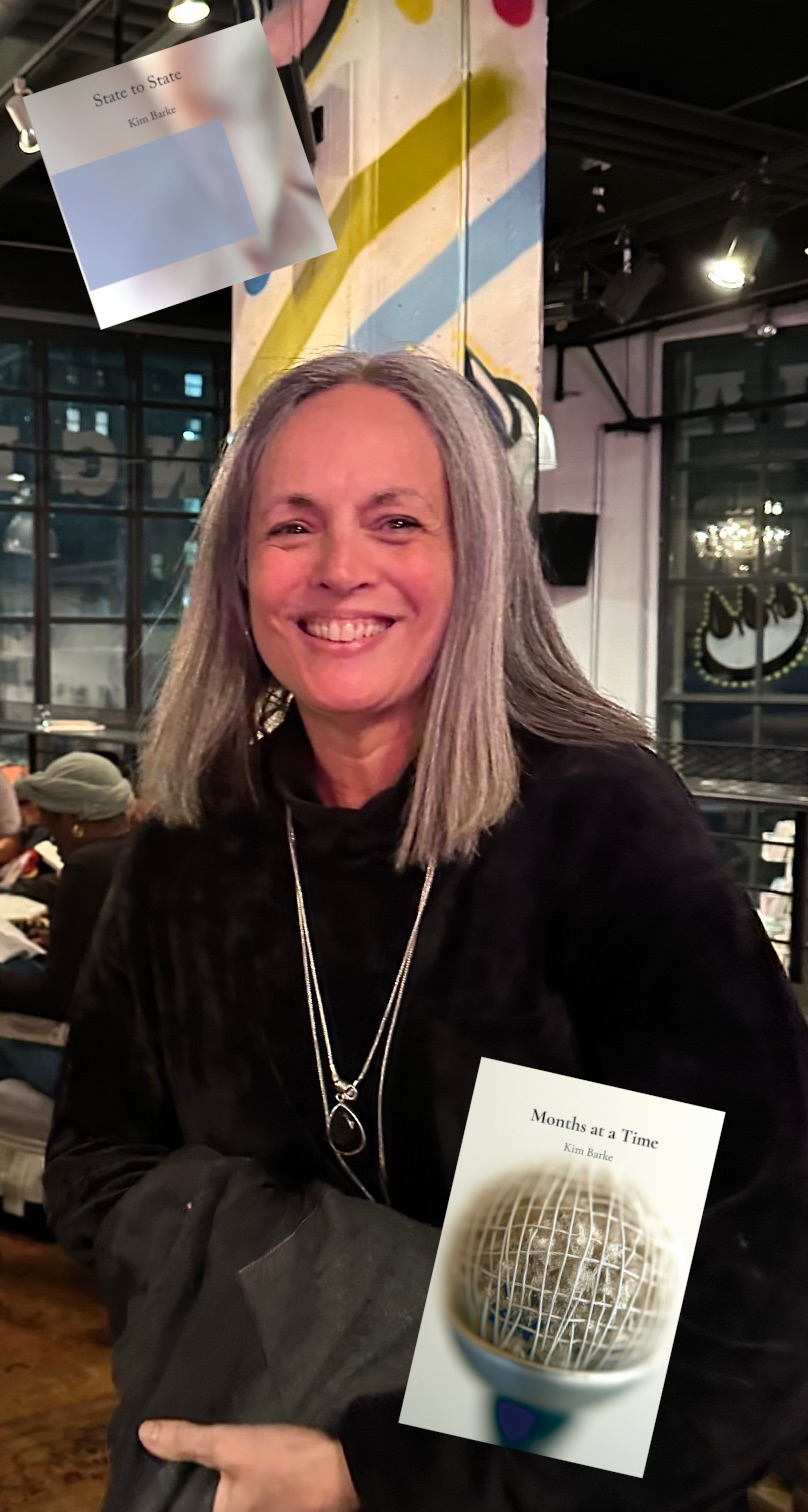
Kim Barke is a queer poet, playwright, composer, publisher, and creative director whose work defies conventional categorization. She holds a PhD in pharmacology and toxicology and an MFA in creative writing, and has worked in advertising for over 25 years, earning nine Cannes Lions among numerous other accolades. She is the author of three poetry collections, and wrote and performed Blocks of Sensation, a one-person show that premiered at Time and Space Limited in Hudson, New York, and opened at the 2024 NYC Fringe Festival. Her album Claverack Winter, composed of field recordings and modular synthesis, will be released this fall.
Vi Khi Nao: Kim, there is an eight-year gap between your State to State and your recent collection Months at a Time. Were they written from the same impulses of observation about the world in you and around you or is there a different fabric of abstractions and time between the two bodies of work?
Kim Barke: I see them as very different books. State to State was crafted, forged even. I worked and reworked every line. It did not come easily, and my life was difficult at that time too. I was in relationships with people who both inspired and deflated me. Months at a Time is a more intuitive book. The poems flowed from the universe, surprising me much of the time. In between those two books I wrote two plays, one of which I performed in 2024.
VKN: May I ask why it was difficult for you? Despite its resistance, did writing State to State help you cope? In what ways did they deflate you? And, how were you able to find a balloon in your path again? Or do they move more like a hydraulic, pumping system of despair to create repair?
KB: For many years I was attracted to narcissists and paid for the short bursts of charismatic high with a terrorizing feeling of abandonment. I wrote to survive. Now I see aesthetics as a means of survival. We hunt for beauty and can become depressed without it. But survival is just the floor. With practice, hunting for beauty becomes making it, and making it produces more, and suddenly you have a generative engine carrying you somewhere you couldn’t have reached by surviving alone.
VKN: When you hunt, when you hunt to survive, are you more of an archer or a sniper?
KB: That’s a great question because there are so many different ways to think about those modes. I would like to say archer, because it’s so much more romantic, but I am a geek and love technology. The archer is an archetype! Can I be an archetype and still catch raw beauty?
VKN: You can be anything you wish to be. Raw beauty in a jar of honey is a type of paradigm, an active motif in reshaping the mythology of self. Also, archery requires chalk … which is soft and tender … and can’t easily be weaponized despite its ability to otherwise. Being a sniper allows one to camouflage … to lay low … while one hunts. I think your State of State feels more archery in its poetic and photographic outputs, but Months at a Time—your weapon of choice seems more tactical. And, I think the point of penetration is born from introducing sharp humor and dynamic erotism into your poetry. On page 12, “Take vinegar on / your sweet nipples to make / them bearable to mortals (me)” and page 13, “I am 5’4” and haven’t been / able to do a handstand. / I have an anxious pelvis, / So my yoga instructor said / But between us, / my pelvis has always / seemed friendly.” I love the understated humor in these two stanzas. As if you were able to do a handstand with your poetry. With language. With words. The readers are able to enter your upside down world and you are so right: your pelvis poetry is super friendly. There is a lucid accessibility to your work.
KB: I haven’t used chalk in archery, but have in rock climbing, which is far from laying low. Very exposed and completely dependent on other people to hold your life on ropes. I had a rock climbing instructor who recited Elizabeth Bishop to me on a tiny ledge, so small that it only held our toes. Camouflage attracts me. I prefer to be underestimated. Exposure in the world is not something I desire.
Yes, there is nothing funny in State to State! It’s dark when you are hiding under the bed. Even though I wrote most of Months at a Time in the pandemic I was having so much fun.
Thank you for calling out those lines. Aside from the utter gorgeousness of your language, one of the things I love about your work, and you as a person, is your sense of humor. You finding it in mine … better than a spreadsheet! I wanted to be a comedian when I was a child. I took joke books out of the library and read them in front of the mirror.
VKN: Thank you, Kim. I am not surprised that you wanted to be a comedian. I see the quick wit in your work. I love your mic drops. Here is one I really love: page 22 from Months at a Time—by the way, how did you decide on that title?—“Dad falling down the basement / stairs, down the trap door / cerebral hemorrhage. / No problem with his aged, / shrunken brain.” And, also, whenever these bright, humorous lines from you … I also sensed that you had squeezed from the rock of pain into something powerful and poetic onto a piece of paper. I see you finding an ideal home for your pain through your words. Besides being a poet, photographer, and musician, you are also a scientist. How does this all work together in your world? They are different containers of your existence, of your different selves, or do they work together behind the scenes to create the main projection/fabric of Kim?
KB: Underlying it all is curiosity and a sense of wonder. I am always on the highway to awe and the vehicle can change. Presence and practice are the engine, intuition is the fuel, and making things, finding and creating beauty, that’s the destination. Some think that science has disenchanted the world, and I understand why they think that. It saddens me that so many people miss out on the vast beauty in the esoterism that science offers. Maybe it seems odd to think of science as esoteric, but it is secret for the most part, requires initiation, and damn does it deliver once you have done the work.
VKN: You mentioned a couple of times in your collection, “Sometimes at the end of the day, I talk / to ‘god,’ who is also really me.” How does this god usually respond to you in this type of conversation? Is it like an infinity pool where it pushes the water of your thoughts to the edge? Or is it a deep dive into the unknown? The abyss between you and the end of your day?
KB: I talk to myself a lot and am not ashamed of it. Thankfully we all wear headphones now, so nobody knows. When I am in my house upstate no one cares. But at night it is special. It’s pillow talk to the universe, or my birth mother, or a god I may have believed in at some point, a beneficent being who listens and answers questions and helps me fall asleep. I allow myself a bit of childishness and it works.
VKN: I am happy to hear that. Is it safe to assume that the photographs that accompany your State to State are born from a similar poetic voice? Were they ekphrastic exercises or do they behave more like sapphic lovers—your photography and your poems from this collection—one thrives side by side, shaping the ephemeral tenderness and sagacious abstractions of your poetic consciousness. I almost read your photographs as the instruments in the background, creating a cyclic tempo while the poems are solo vocals … the two moving in rhythm with each other. Is this how you conceived them when you placed them next to each other?
KB: Not ekphrastic, but adjacent. I thought at the time that they added subliminal meaning almost in collage with the text. I love your reading though. The idea of orchestration among elements in a piece appeals to me since I think a lot about music composition and aim for generating complexity by juxtaposition of simpler elements versus writing complex verse.
VKN: While State to State moves like a lucid ardor of latent abstraction, a kind of awake bucolic dormancy, Months at a Time feels more metropolitan, more in the city. There is a bustling of life, a life filled with familiar, kinship care … There are several moments, particularly on page 26 where the two collections meet (like when two bodies of water decide to meet each and go on a date! A pelagic date!): “Your delight, your desire / feeds me. Your skin / seizes me. / I have / to tell you and I can’t do it. / I can’t express this feeling. // It’s not lust. Don’t / decay expression.” These eight lines seem to bring the musician, the comedian, the poet, the scientist, the photographer in you. They all move within this current of lucidity and abstraction and abandonment and I love it. It has so much fiber, life, and pulse and it makes me want to reach out to a branch in your poetic tree and break one small twig and bring it home. Not to put it in between two pages of a book, not as a bookmark, but as a placeholder for things that are too ephemeral to age, to break. What would you want the next book to address? To branch out?
KB: Those lines came from falling in love, which might explain why they can’t quite hold still. When you’re in it you want to say everything and language keeps failing you and you write toward the feeling anyway. That poem is the gap between what the body knows and what words can do.
A placeholder for things that are too ephemeral to age, to break … I want to keep that. I’m going to carry that twig.
I’d love to write more prose poems. They act like puzzles and jokes that have slept together and are getting coffee in the morning. You do them so well. I love Charles Simic’s work too.
VKN: What is your favorite poem from State to State? And, Months at a Time? And, will you impart why? I would love to know.
KB: “Ochre” in State to State. While I did have to use tweezers to place every word in that poem the title came to me in a liminal state and it describes one of the most intense experiences I ever had. “Bunsen Burner” is a close second. I love thinking about the fact that the sun will burn out.
In Months at a Time my favorite is “Alone, February.” Hands down. It came to me all at once one morning when I was writing in my journal as a gift from …?
VKN: Oh, I love “Alone, February” too. I really love “I’m stuck under the / Couch looking for a lost / Earring. It fits my / One ear so well. The / Ear that hears waves / And not particles.” Have you ever used a salad tong or a spatula to place words on a poem?
KB: No, but I should try. My tweezers are losing their edge. Maybe a rubber spatula or a rubber chicken. I do make good salads.
VKN: What are you working on right now? And, what makes your salads good? What is your secret, Kim? And, how do you describe your music? What are you making when you make music? From page 16 of State to State: “Tell me more about the hungry ghost. Is it consuming [you] as [you] continually consume?”
KB: I’m working on an album that I hope to release in the fall. There are six songs that express different aspects of winter—“Feeding the Birds,” “Making a Fire,” and “The Dark,” to name a few—and each is about ten minutes long. This whole idea started with a vision during an acupuncture session of a storyboard with six little drawings. The songs come from the drawings. I use a mixture of field recordings, modular synthesis, and some acoustic recordings.
The secret to the salads is in the dressing. I follow Amy Chaplin’s recipes and make salad dressing in the blender with fresh carrots or beets, cashews, garlic, lemon juice and olive oil. They are so brightly saturated with color from the fresh vegetables that it makes me want to eat more salad.
In that poem, the hungry ghost was a reference from my yoga instructor Mark Morford. We were on a week-long retreat in Guatemala, and he asked us to think about what we were consuming. It went straight into the poem. I’ve tried ever since to spend more time creating than consuming. That’s the practice, really. The hungry ghost doesn’t go away but it finds better things to do.
VKN: That is so amazing and exciting, Kim!!! Thank you for sharing your culinary secret with me! My mom agrees with you that the secret in a great salad is the dressing. She makes hers with olive oil and lime juice and freshly ground black pepper from Vietnam. Fall should be a supreme exciting time for you!! Will you be touring for the album like a rockstar? How will you disseminate your music? Is it like a poetry reading tour? Or is it a different beast entirely?
KB: Your mom’s recipe sounds delicious.
I will be releasing the album on Bandcamp and will do a few online listening parties and maybe some local performances.
VKN: It is quite delicious. I love her salads. So does her fiance. Speaking of love, your wife is a visual artist. Have you thought about marrying your music with her visual art?
KB: Yes! One thing that is fun about electronic music is that the scores are nonconventional. They can be anything you would like if it helps you make decisions about the composition. She did a drawing for me once that served as the score for a soundbath piece. Also, the poem “Egg-Darts” is ekphrastic based on one of her drawings. She intends to do an illustration at some point based on one of my poems.
VKN: Yes, I noticed! I was trying to pull that poem out because I noted that ekphrastic inspiration but you got there before I did. It helps when you are the midwife and mother of the poem! And, what is the link to your Bandcamp?
KB: I have a few songs on there now, but if people follow they will get the notifications when the album is released. Also, the song “Pucon” has the poem “Pucon” as spoken word.
VKN: Thank you so much, Kim, for your time and for being so generous with us! I love getting to know you through your work!
KB: Thank you, Vi. It was a delight. I’m such a huge fan of your work. It’s wonderful to spend time talking about creativity with you.
POST-SCRIPT INTERVIEW:
[4/15/26, 7:43:14 PM] VI KHI NAO: Also I forgot to ask about your ghazal and your father
[4/15/26, 7:44:28 PM] Kim Barke: My ghazal? I think the only one I have is in my first book which I didn’t send you
[4/15/26, 7:45:37 PM] VI KHI NAO: Ghazal?
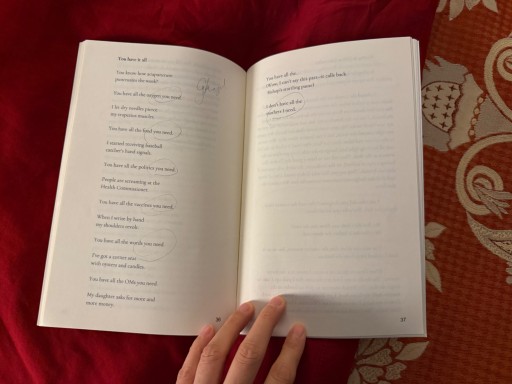
[4/15/26, 7:46:07 PM] Kim Barke: Ah but there is only one Vi Khi Nao
[4/15/26, 7:46:22 PM] VI KHI NAO: We can skip the ghazal
[4/15/26, 7:46:27 PM] Kim Barke: Oh that one
[4/15/26, 7:46:34 PM] VI KHI NAO: Maybe just your father?
[4/15/26, 7:46:45 PM] Kim Barke: It could be but wasn’t intentional
[4/15/26, 7:46:52 PM] VI KHI NAO: I wanted to ask about your father’s poetry
[4/15/26, 7:47:02 PM] Kim Barke: Yes do
[4/15/26, 7:47:07 PM] VI KHI NAO: And if you were influenced by his work
[4/15/26, 7:47:21 PM] VI KHI NAO: At all
[4/15/26, 7:47:33 PM] VI KHI NAO: And what your relationship to ghazals
[4/15/26, 7:47:54 PM] VI KHI NAO: And what he would think about your poems? Would he be a critic or lover
[4/15/26, 7:47:57 PM] VI KHI NAO: Etc
[4/15/26, 7:48:22 PM] VI KHI NAO: Half-ghazal?
[4/15/26, 7:48:49 PM] VI KHI NAO: You at the intersection between two cultures
[4/15/26, 7:48:54 PM] Kim Barke: I must be doing it naturally without realizing
[4/15/26, 7:48:57 PM] Kim Barke: Wild
[4/15/26, 7:49:05 PM] VI KHI NAO: Yes
[4/15/26, 7:49:17 PM] VI KHI NAO: I wanted to explore your super consciousness
[4/15/26, 7:49:27 PM] VI KHI NAO: The scientific part of you
[4/15/26, 7:49:34 PM] VI KHI NAO: The part that hears particles too
[4/15/26, 7:52:53 PM] Kim Barke: It’s lonely there, like the world in Piranesi
KB: My father was a secular intellectual and revolutionary. In Iran, he was with the left gathered around the dah shab, ten nights of poetry readings in 1977. Poetry fueled the revolution. I believe that poetry can be much more powerful than we realize. It has the power to take down regimes.
My father wrote poetry himself, though I’ve only seen a fragment, in an email my sister sent me. Six framed photographs of contemporary Iranian poets hung in his office, and when he moved to a long-term care facility, they went over his bed. He read my first book and bought a copy for everyone in the extended family, then wrote to tell me I was a good poet and that someday I might even be a great one. That letter lives in me.
If that poem is a ghazal I had no idea. It must move through me from my ancestors. I did write one deliberately in my first book, What the Tide Brings; I love the form. Talking about this makes me want to write songs based on new ghazals. The repetition would work beautifully in sung lyrics.
Science is esoteric. It requires initiation through rigorous study and once you’ve done the work it delivers a beauty that is almost unbearable. You want so badly to share that wonder with people who haven’t studied and most of the time you can’t get there. That’s the loneliness.
Vi Khi Nao is a queer Vietnamese-American writer working across poetry, fiction, theater, film, and collaborative art. She won the 2016 Nightboat Poetry Prize for The Old Philosopher and the 2017 Ronald Sukenick Innovative Fiction Prize for A Brief Alphabet of Torture. Her latest novel, The Italy Letters, was published by Melville House Publishing. Her forthcoming poetry collection, The Figurative Orations of Odd Nerdrum, will be out with Changes Press in 2027. Her poetry collection Three Sapphic Movements, and her novel, Fish in Exile, are currently being translated into French by Marie Gazeau. She has held fellowships with the Black Mountain Institute, Casa Como (Hawthornden Foundation), MASS MoCA, and the Iowa Arts Council, and will join the DAAD Artists‑in‑Berlin Program as a 2027 fellow. More: vikhinao.com.
Check out HFR’s book catalog, publicity list, submission manager, and buy merch from our Spring store. Follow us on Instagram, Bluesky, and YouTube. Disclosure: HFR is an affiliate of Bookshop.org and we will earn a commission if you click through and make a purchase. Sales from Bookshop.org help support independent bookstores and small presses.

