
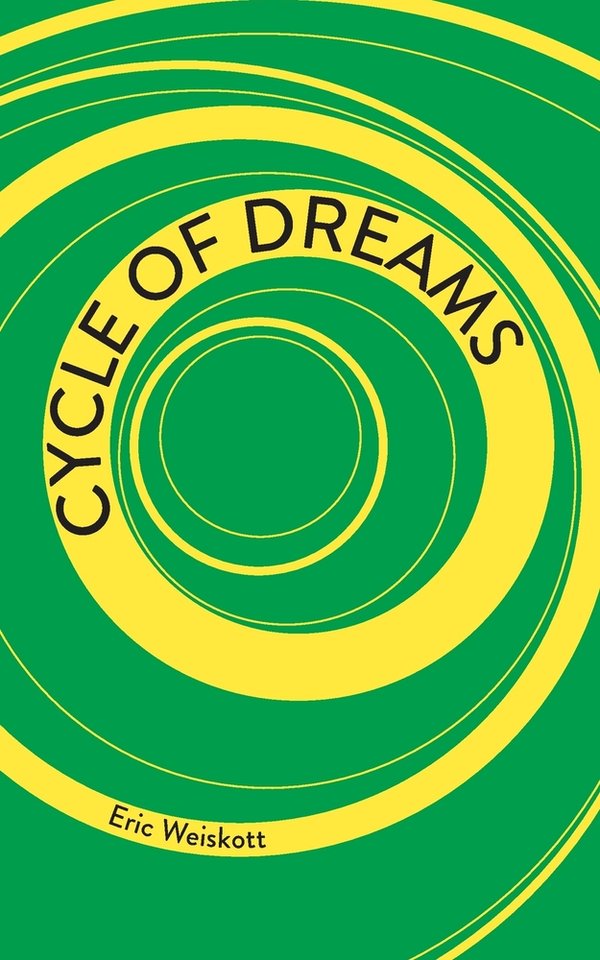
In Cycle of Dreams, Eric Weiskott presents this notion of an individual on a quest. It’s a common notion in literature to be on a quest, whether that quest be spiritual or a journey from one physical place to another. The verse in the book is structured and there’s a playfulness and simplicity to Weiskott’s language. In the poem “Song for Pragmatic Communists,” we find an individual questioning and making sense of how to become a citizen in a system he’s part of. There is a powerful image in the section “Prologue to a Vision” moving from sleepstate to one of waking:
I’d non-violently suffer him
His preferred hunting patterns
It’s everyone for themselves”
Tell me the meaning of my dream
You crafty readers if you know
Here, Weiskott is calling on us to make sense of the meaning of his dream, or, as the next section is titled, “Inner Dream.” There’s a strong sense of place in Cycle of Dreams. Whether it’s Long Island Sound, Connecticut, Massachusetts, or Vermont, a disparity unfolds between dream landscape and real landscape. There’s also a linguistic dichotomy which presents itself throughout the text, moving from one word to another, i.e., “wave” to “particle,” “cycle” to “journey,” which we discover from the introduction pages is a parallel to Piers Plowman, a 14th century poem by William Langland. We find the speaker trying to make sense of our current state with knowledge of this poem as a guide. In the section, “Prologue to a Vision,” the text reads:
What is a BUSYNESS REPLY? See attachment.
This line comes from a poem entitled “9-to-5 Griddle,” where the speaker, whether that be Weiskott himself or “L,” is pulled away from enjoyable experiences to tackle the responsibilities of a real world. Business in our time is spelled differently than it would be in Old English, so we are presented with an idea of how responsibilities have changed over time. In “Here the Dreamer Implicates Himself in the Vision,” we find an individual discovering value in their education:
I saw the power of collegeMiddletown, CT 2005–2009
to open the door and shut it
education: a form of love
In seven forms, the liberal arts
that live in departments.
If it’s our task to find meaning in Cycle of Dreams, “The End” is a great place to begin:
We did our best thinking
Under threat of reaching the end of things.
We created a secret language
then forgot it.
We had summers off.
We broke our bottles everywhere,
Damned and okay.
If there’s any secret language in Weiskott’s collection, Cycle of Dreams, it’s one that is based upon our human experience. As we find out later in the poem, “Here the Dreamer Implicates Himself in the Vision,” the writer decides to stay within the field of education. Whether that adventure presents itself as pages in a book, or an adventure to a literal landscape, the strength of this collection lies in an inner grappling and making sense of experience. We find a writer who is indexing his experiences between “dream” and “waking,” however experiences end up becoming indexed holds adventure. In the poem, “L – Visits the Ocean and Nearly has an Epiphany,” a clever play on words between “Iraq” and “a rack” reveals the reality of a world beyond education. There are references to peace being disrupted by drone attacks, the President not visiting “his” Massachusetts, and bar doors with brewery stickers referring to a student’s college years possibly being affected by war or not. New England weather factors into play as well. In the section “Storm Window,” there’s an empty street in the snow, and a sea that “glistens with underneathlessness”:
The names of liquors and philosophers
supplant the patio:
house of the mind.
I do not know whether it is a whale
singing or an imagined
barrier of sea
tall
and liquid
which
separates and
re
distributes heaving.
In crystal blue tones it
translates sun.
As we grapple with this text, Weiskott takes us on an adventure using imaginatif. He reveals his “Inner Dream” through his word choice and through his own mortality. The sea in the above poem “translates” sun. There’s a hint at Weiskott’s shore versus the shore of Langland’s sea in England. A barrier of sea may be the actual sea or it may be a replacement for liquid at a brewery. A singing whale may be an actual whale or it could be something bigger than himself. Philosophers are educators who “house the mind” so to speak and guide us to something bigger than ourselves. Ultimately we are left with a sense of adventure in Cycle of Dreams, and an encouragement to place value upon our experiences.
Cycle of Dreams, by Eric Weiskott. Santa Barbara, California: punctum books, December 2024. 122 pages. $22.00, paper.
J. Michael Wahlgren founded Gold Wake Press. He is author of Valency (BlazeVOX) and holds a B.A. in Psychology. He lives in Massachusetts.
Check out HFR’s book catalog, publicity list, submission manager, and buy merch from our Spring store. Follow us on Instagram, Bluesky, and YouTube. Disclosure: HFR is an affiliate of Bookshop.org and we will earn a commission if you click through and make a purchase. Sales from Bookshop.org help support independent bookstores and small presses.

