
Joan at the Château Élysée, 1929, Hollywood, CA
By the time they are ready for me to rehearse on the rooftop, I’ve already eaten two plates of sand dabs smothered in lemon butter sauce and a mountain of croquembouche eclairs. I can’t help it—I’m getting nervous waiting for my turn under the stage lights, and I don’t have anyone to talk to, being the youngest person here. So, I wander around grazing the buffet tables and bar for refills on my very cherry Shirley Temple. I can’t resist caramel covered puffs, and these are delicious. Mother loves them too. We prefer custards and puddings to chocolate and lemon desserts. Anything with vanilla and cream. Once at Christmastime, we tried to make a croquembouche ourselves. That was a disaster. We couldn’t get the choux pastry to pop and ended up with sad silver dollar size discs like blobs of pale poop. But the topiaries of glistening golden puffs at this party are from a fairy tale—whole forest rows of them dusted with snowy powdered sugar ripe for the plucking, which is precisely what I do, licking sticky toffee threads off my fingers when no one is looking. Finally, I head to the bathroom to wash my hands and “powder my nose” though I don’t wear makeup yet. It’s almost time for the Paganini and I should find a quiet room where I can tune my strings and warm up my hands. I get my violin from the hat check girl and wander a long hallway where there aren’t so many people. At the end, I find a library study room. Lots of dark wood, and green velvet curtains. Enormous gold and black rugs with long red geometric knot shapes that remind me of the Metropolis film Father took me to see for my tenth birthday.
I’m just pulling my violin from its case and sliding a rosin block along the bow when the door opens and a man with a camera tripod enters. The wall sconces flicker amber yellow up the polished paneling, but the room is dim, and it’s difficult to see. He’s got a dark hat like Father sometimes wears when it’s raining and doesn’t care what happens to it, pulled down as this man does to shield half his face. His suit is navy or black, and like his white shirt, tired-wrinkly. Below his chin, his tie hangs loose, like he’s too hot, so I’m not surprised when he comes close into the light, and I see his skin is damp and ruddy. He pats out a cigarette from the pack in his pocket and lights it. “You must be Joanie!” he says, exhaling a long trail of smoke breath. I’m forced to swallow and turn away from the odor of his mouth. Don’t people know better than to consume booze, plates of cheese, and top off the whole disgusting menu with a brick of cigarettes? “I’m Joan,” I say. No one calls me Joanie except my family. Then I realize Father sent him to take my picture. “Can’t we shoot these after the recital?” I plead, but my voice winds high and catches in my throat. “I’m nervous enough. The lighting in here is eerie, anyway, don’t you think? My mother knows a thing or two about photography—” But he’s very close now, and I can’t finish what I was saying about Mother being a photographer even though it’s true she’s a serious amateur. My head feels swimmy when he says, “I’m Bert, Joanie. Good to meet ’ya. Relax, Kid.” I back up because I’m pretty sure his sweaty, pocked nose is about to touch mine, but the enormous desk hits the back of my thighs. I’m trapped, and if I move any more, I’ll be bent backwards over it. “Your father sent me to snap a few stills posed with your violin.” I want to mention Mother’s name and how Stieglitz is going to photograph her next time he meets with her colleague, Ms. Garbo, but suddenly this Bert character is touching the front of my dress, messing with the lace, running his fingertips along the half-moon circle of the folds like it’s something he’s got to do, like I can’t adjust my lapel myself. “What are you doing?” I groan. My mouth makes a weird grimace. “There you go, Sweetie,” answers Bert, pulling back to look me over as if what he just did was a big nothing and I’m overreacting. “You’re gonna be a knockout.” He reaches into his pocket for a stick of gum, unwraps it with one hand, his other paw hooked on my collar, still fussing with it, though clearly, it’s just an excuse for that fingertip to creep up and stroke my neck and collar bone. I’m hot and tingly and feel acid rise in my throat. “Stick of Wrigley’s, Joanie? A little chewing gum might help you relax. Spearmint. Or maybe a sip of this?” He tilts his head toward the brandy decanter on the desk. “That jaw … your face! So you don’t look frozen like a statue.” Where did Father find this guy? Maybe through his bookie I’m not supposed to know about. Or he owed someone a favor, got a deal. And then, like he’s reading my mind, Bert says, “I’m sure your father wants to see your natural … exuberance come through.” He’s talking fast now, like he can’t catch his breath. “I hear you’re hoping to go into pictures yourself?” I want to scream but no words come. It’s like I’m under Bert’s stinky, evil spell and the room is one big spiraling nightmare of shadows, spitting candles, the Metropolis rug patterns, dark walls, and gargantuan leather chairs. The paintings of half-naked damsels in diaphanous pastel gowns looking terrified, the men on horses with swords, flanked by rabid dogs flashing their fang like teeth, bookcases thick with worn, cracked spines stacked to the ceiling. I imagine one of the bookcases lurching open any second and me being spirited away by hooded men and freakish automaton people—lost forever, never to be found in the dungeon depths of Elinor Ince’s chateau.
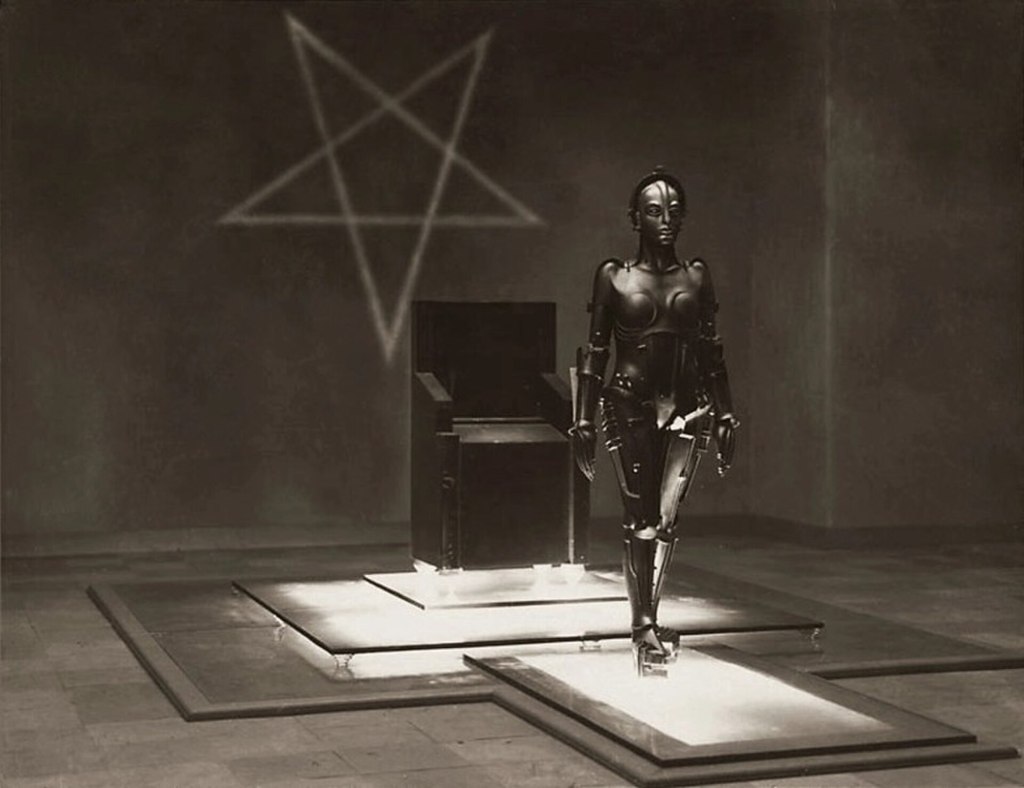
Then something happens that hasn’t for a long time, not since Father took me for a ride on the Wonder Wheel at Coney Island right after I’d eaten two Nathan’s hot dogs, a bag of popcorn, and two cups of clam chowder, topped off with a strawberry ice cream soda. I feel my head detaching from my body and I can’t control my neck. My eyes somersault in their sockets. The room spins, I’m deep breathing through my nose, focusing hard on the floor, on mother’s Edwardian rhinestone buckles she gave me to wear tonight, but when I look up, the massive spooky bookshelves suddenly crank apart, the crack of darkness widening until a gigantic glowing figure emerges— Oh my God—it’s Maria, the mad robot lady from Mr. Lang’s movie I saw with Father! She’s surrounded by a sea of men in coattails and black satin top hats, their expressions lewd, terrible, twisted. Combined, they have eight arms and sixteen meaty hairy hands, all reaching up to grab at the robot lady whose mouth and neck and body, also her nipples, are shooting billows of white steam. The men look equally insane, and their teeth gnash open and closed like ravenous animals to the rhythm of robot Maria swishing her hips in loopy figure eights. Beneath the men’s feet, piles of dead children in skimpy rags and torn dresses lie stacked on top of each other, their tongues dangling from their shocked-open mouths, like they’d be a choir singing if they weren’t ashen and rigor-mortised, their eyes wide and corpse-like. My stomach rumbles an unhappy soup of food jumbling around the grinding gears of my insides. I look up to Maria making an enormous angry screaming face, minus sound—an anguished monster—furious and in excruciating pain. When her eyes suddenly burst into flames, I sense a volcano of sand dabs, cherries, custard cream, and croquembouche pastry surge from the vaults of my stomach, leaping like a sick beast from my throat right onto Bert, the putrid wave heaved up all over his sloppy shirt and tie. “I am not your Whore of Babylon, you big jerk!” I hear myself scream, though I have no idea where that came from. Maria’s line from the movie? A nightmare blur. Bert jumps back like I just rammed him with the Packard which I totally will if I ever see him on the street, I swear, no matter how mad Father gets when he hears about this incident. “What the hell?!” Bert roars. “You little bitch—” But I’m already at the door, having grabbed my violin case, and on the way out, whacked Bert’s stupid camera and tripod over for good measure. I yank the knob, and a rush of laughter and loud voices from the party—cackling women and thunderous men mixed with high-pitched squeals from the spirited younger set—hits me hard and I swoon. The house is packed, the evening in full swing. I know I’m supposed to be somewhere performing for the guests soon. But what? And where? The roof? Every part of me shakes, crumbling like an old, dried block of rosin. I barely remember who I am and how I got here. How on earth will I play the Paganini?
Michelle Bitting was recently named a City of L.A. Department of Cultural Affairs Individual Master Artist Project Grantee and is the author of seven poetry collections, including Nightmares & Miracles (Two Sylvias Press, 2022), winner of the Wilder Prize and named one of Kirkus Reviews 2022 Best of Indie. She won the 2025 Banyan Review Poetry Prize, and her chapbook Dummy Ventriloquist was published in 2024 by C & R Press. She is a finalist for the 2026 Action Spectacle prose contest, has won Quarter After Eight’s Robert J. DeMott Short Prose Contest, and was a finalist for the Ruminate Magazine, Sonora Review, and New Millennium Flash Prose contests. Recent poetry, prose, and essays appear on The Slowdown, Thrush, Cleaver, The Poetry Society of New York’s Milk Press, The Glacier, Heavy Feather Review, Terrain, Split Lip, National Poetry Review, SWWIM, ONE ART, Gargoyle, and is featured as Poem of the Week in The Missouri Review. Her forthcoming collection Ruined Beauty will be published by Walton Well Press in spring 2026. Poetry is forthcoming on the Academy of American Poets’ Poem-A-Day . She is writing a hybrid novel that centers around Los Angeles and her stage and screen actor great grandmother and is Senior Lecturer in Creative Writing and Literature at Loyola Marymount University.
Image: Horst von Harbou, commons.wikimedia.org
Check out HFR’s book catalog, publicity list, submission manager, and buy merch from our Spring store. Follow us on Instagram, Bluesky, and YouTube. Disclosure: HFR is an affiliate of Bookshop.org and we will earn a commission if you click through and make a purchase. Sales from Bookshop.org help support independent bookstores and small presses.

