
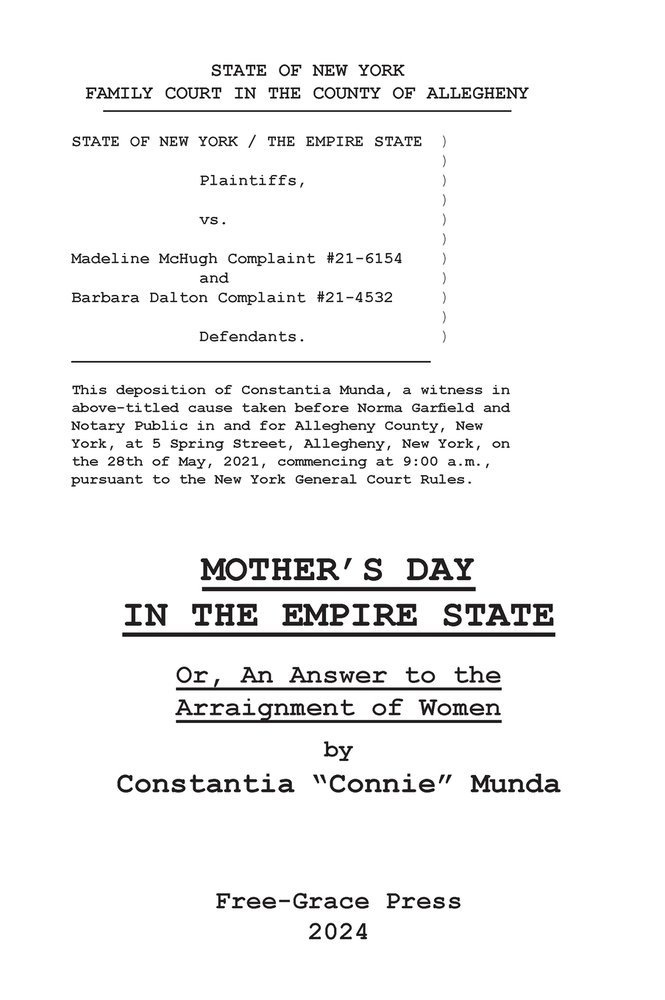

Constantia “Connie” Munda’s Mother’s Day in the Empire State: Or, an Answer to the Arraignment of Women is a family-court novel that dismisses the comforts of home and of an idealized narrative of motherhood. It sets forth its method early in its prose: this is, Munda writes, a “deposition novel discovered in the Public Records of the Allegheny Family Court.” This method of choice repeats, with intention, throughout the entirety of the book.
The text is anchored to evidence associated with two anonymous child-abuse complaints (both investigated on Mother’s Day, 2021) and filtered through the voice of a Child Protection Services officer Constantia “Connie” Munda. This anchored framing presents thematically throughout the text, with the deposition presenting as neither a stylistic choice nor a descriptive flourish. Instead, it is the book’s crux and core argument, representing both its thread and a thread woven through the text’s 274 pages (with over a dozen original illustrations). The choice of a deposition is deliberate and deeply effective at crafting the work’s central thesis. In many respects, the work’s form contributes as much to its storytelling and message-making as does the prose itself.
In practice, a deposition is an instrument of ordering: it converts lived disorder into numbered questions, exhibit lists, and an “official” sequence. Historically, author N.J. Williams writes in the Canadian Bar Review article “Discovery of civil litigation: trial preparation in Canada,” depositions developed in English equity as testimony taken by written interrogatories administered by court officers; the resulting depositions were signed and sealed, and their contents were kept secret from the parties until “publication,” typically after evidence-taking closed and near the hearing. Unlike the sealed “publication” practice of English equity, modern oral, discovery depositions are taken on notice to all parties, with examination and cross-examination on the record, and the transcript/recording is available to the parties. Pursuant to Rule 30 from the Federal Rules of Civil Procedure, this real-time questioning expands the examiner’s power to shape testimony and evidence as it unfolds. Similarly, Munda leans into and, skillfully, leverages this lineage: her narrator is both witness and instrument, the person who “sees” and the person who “files” (always a few degrees removed from trial, but on trial nonetheless).
The duality results in a narrative that feels like evidence yet functions like literature. The book opens with bureaucratic specificity (“This Deposition is from May 9th, 2021 …”), then swivels into direct address (“Dear Honorable Family Court and Good Reader …”), as if the public record has suddenly remembered it has an audience. The move is engaging in ways that work well for the text: it implicates us not as a sympathetic confidant, but as a quasi-juror, deputized by the text’s procedural posture. Beyond structure, Munda is also keenly attentive to the meaning and history embedded in dates and makes a compelling calendrical choice. May 9th is neither an accidental stamp nor a sweet sentiment.
On May 9, 1914, the Library of Congress shows that President Woodrow Wilson issued the Mother’s Day proclamation and, so, the novel’s deposition date (May 9, 2021) reads more like an intentional palimpsest, with one Mother’s Day “observance” shadowing another. Historically, the origins of Mother’s Day as a U.S. holiday are tangled. The text centers Anna Jarvis. Jarvis is the grandmother of Constantia “Connie” Munda and the one who drove the campaign for an anti-war holiday for women and mothers that culminated in 1914. Relatedly, Rachel Seidman, Curator for the Smithsonian American Women’s History Museum, shares, in her article “The History Mother’s Day: From Global Peace to Greeting Cards,” that abolitionist, women’s rights advocate, and “Battle Hymn of the Republic” author Julia Ward Howe earlier imagined a “Mother’s Day” oriented toward peace activism in her 1970 proclamation “An appeal to womanhood throughout the world.” Munda compresses and retools this history into a prosecutorial question: what do we do when the culture’s ceremonial “reverence” for mothers collides with the state’s routine suspicion and scrutiny of them? The book explicitly rejects any notion of a sentimental Mother’s Day mythology, claiming inspiration from Mother’s Day’s “original intent” and positioning itself against modern sentimentalization of the “holiday.”
Class is another leading character throughout the work, fully dressed and as far more than backdrop or secondary theme. Munda investigates mothers “within Appalachian and ‘Upstate’ poverty and luxury” and in a family court setting where socioeconomic status can function like an invisible evidentiary multiplier. Munda’s deposition format turns that multiplier into structure where the record itself becomes a scale if not of justice, of relative inquiry. Throughout the work, Lady Justice is depicted of both sword and scale, as an icon of authority and as a weigher of evidence. Munda’s novel is intent in the analysis of weighing, but not in the sense that the scales will “balance” if everyone just tells the truth. Rather, the novel presents the scale as dressed and loaded by what the court can recognize as evidence and what it dismisses as noise. Watercolor visuals submitted as “People’s Exhibits” and included throughout the work reinforce themes of societal scrutiny paired if not contrasted with the emotional, often unbalanced, state of motherhood. To read Mother’s Day in the Empire State as an “answer” to the “arraignment of women” (see Joseph Swetnam’s 1615 misogynist pamphlet) is to see how it stages motherhood as a standing trial category and an identity continually assessed against an ideal standard that law pretends is neutral, but culture keeps gendered. Munda’s mothers, presenting across scales of poverty and luxury, are processed through that binary.
While setting up the new federal judiciary system, George Washington famously wrote, in a September 28, 1789 letter to then nominee for Attorney General of the United States Edmund Randolph, that “the due administration of justice is the firmest pillar of good Government.” By the same token, Munda’s novel offers a necessary cross-examination of that pillar: asking what “due administration” looks like when the subject is motherhood, when the venue is family court, and when the evidence is inseparable from class and gender. As with any scale, balance is an important component. Here, the text’s prose feels, at times, intentionally and artfully unstable (part deposition transcript, part satire, part free-verse montage) and it often uses excess (lists, exhibits, surveillance imagery) to mimic the institutional overreach it describes. That instability is a primary point of the work: a deposition is not where anyone goes to be understood; it’s where stories are constrained until they can be used. Mother’s Day in the Empire State is not a comforting read and that’s partly the point. It’s also a read that will remain with you longer after the deposition ends. A point worth reading and then revisiting. This work offers a compulsory look, a procedural mirror, at the realities of motherhood in a culture that celebrates mothers one day a year and then scrutinizes them for the remaining 364.
Mother’s Day in the Empire State: Or, An Answer to the Arraignment of Women, by Constantia “Connie” Munda. Shenandoah, Pennsylvania: Free-Grace Press, May 2024. 274 pages. $18.95, paper.
Jen Schneider is a community college educator who lives, works, and writes in small spaces in and around Philadelphia.
Check out HFR’s book catalog, publicity list, submission manager, and buy merch from our Spring store. Follow us on Instagram, Bluesky, and YouTube. Disclosure: HFR is an affiliate of Bookshop.org and we will earn a commission if you click through and make a purchase. Sales from Bookshop.org help support independent bookstores and small presses.

