
“The door of the Café opens onto the most populous avenue, riotous with sun. Nevertheless, upon crossing this threshold hanging as if from the last rung of reality, one seems to enter the subway of dreams, ideations.”
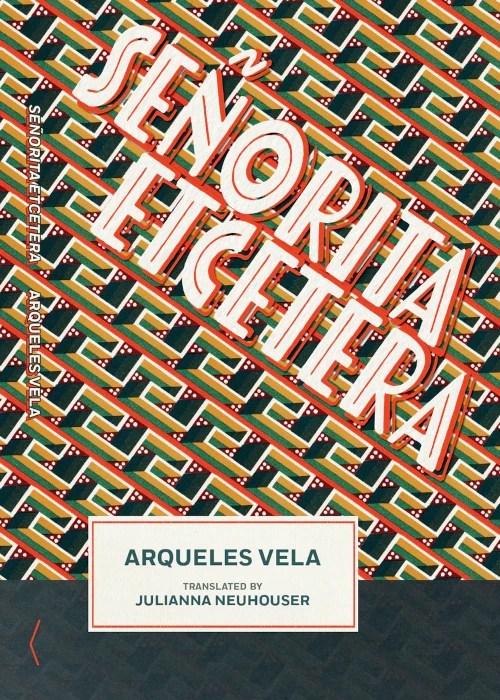
So begins this terrific translation by Julianna Neuhouser of Arqueles Vela’s formative work, Señorita Etcetera. This dual language volume from Insert Press collects three of Vela’s most consequential stories and serves as an indispensable artifact of the Latin American avant-garde and a joyous microcosm of Vela’s distinctive, enigmatic voice.
As outlined in Veka Duncan’s wonderful introduction, Arqueles Vela was believed to have been born in 1899 to Guatemalan parents in Tapachula in the state of Chiapas. However, as noted by Duncan, Vela’s own birth remained a topic of debate as some contemporaries argued he was born in Guatemala and later migrated to Mexico while some contended that he was born in Mexico, but spent his youth and pursued his education in Guatemala before crossing back into Mexico in 1919. Duncan underscores that this point of debate over Vela’s place of birth might seem inconsequential, but in fact it lends itself to the mystery and porousness of Vela’s origins, which only heightened the mystery of his overnight arrival at the storied El Universal Illustrado.
Under the stewardship of Carlos Noriega Hope, El Universal Illustrado served as a cornerstone for the Latin American avant garde and an essential springboard for the Stridentists, the artistic and literary movement spearheaded by the multi-hyphenate Manuel Maples Arce. The Stridentists called for upending the arts, literature, and society through an impertinent reinvention of art and language in the face of the swift technological, economic, and industrial changes that were sweeping through Mexico in the wake of the Revolution.
While Stridentism shared qualities with surrealism and futurism, it was also a distinct movement that sought to harness the discordant noise of rapid technological transformation while eschewing the reverence for the revolutionary sensibilities of artists and writers that arose out of the aftershocks of the Mexican Revolution. Joining the ranks of the Stridentists, Vela began his work at El Universal Illustrado in 1924 helping to shape the direction of the Latin American avant garde through his contributions as a columnist and editor and championing other writers and poets like Mariano Azuela and Gilberto Owen.
But it was Vela’s own idiosyncratic voice that helped to upend the staid, formalistic conventions of realism that had become characteristic of Latin American literature up to that point. Having published “Señorita Etcetera” a year before joining El Universal Illustrado, Noriega Hope arguably created a seismic shock by introducing readers to Vela’s writing. Both Duncan’s introduction and Neuhouser’s note on the translation of Señorita Etcetera highlight how Vela’s writing erases borders, confounds expectations, and leans into absurdity.
In the first story “Nobody’s Café,” a marvelous chronicle detailing the comings and goings of the denizens of the titular haunt, Vela routinely shifts the ground underneath us, never once allowing the dust to settle:
Its two regulars always enter together, the first one in is unknown. They’re equally dressed with a differing elegance, walking with a gesture of forgetfulness, a certainty they will never exit that labyrinth of female gazes in which they’re reflected as in a hall of mirrors.
In their usual booth, they take shelter in each other from the rain of recollections …
Based on the Café Europa, the regular retreat of the Stridentists, “Nobody’s Café” is punctuated with the vaporous, dream architecture that saturates each of the stories in this collection. The edges of one drama blend into the next without regard for our comfort. Vela wants us to feel disoriented, unsettled. He demonstrates a nimble fluency in the hallucinatory and the movement of the story is like a fever dream, wherein we never know which side of consciousness we remain on, instead always residing in a liminal state, where weather systems, conversations, personas, even gravity, are to be constantly questioned.
In the second story, “A Provisional Crime,” the offense alluded to in the title is never detailed and instead thrown into disarray and abstraction as soon as the story opens, as highlighted by this exchange between one of the servants and the investigating inspector:
“What was the position of the body when you penetrated the bedchamber?”
“No, sir, I’m innocent…”
“Why didn’t you immediately report the crime?”
“The master told me he couldn’t receive anyone…”
“How long have you known the deceased?”
“I only started working here yesterday…”
The absurdity of the crime and the unpredictable setting snowball as the frustrations of the inspector mount and the obfuscations of the staff and the perpetrator throw the investigation into further disarray:
Everything was getting entangled, becoming inexplicable. The doctors didn’t find and didn’t recognize anything but the mark of a subtle caress that had contuctioned the grace of her body and shaken the happiness of her smile …
The swirling miasma of the investigation toys with the structure of a classic noir but unfolds like some phantasmagoric parlor trick. Vela leaves us with the same frustrations and lingering questions that plague the inspector. But this is by design: The contours of Vela’s storytelling hinge on the distortion of assumptions, twisting logic until we can no longer determine which thread leads to which outcome. Vela is asking us to enjoy the deformations and by succumbing to the discomfort and suspending preconceived notions of structure, we can fully immerse ourselves in the language of the absurd.
In the titular story, “Señorita Etcetera,” the nameless narrator embarks on a journey crisscrossing an unidentified metropolis via trains, cafés, shops, trolleys, hotel rooms, elevators pursuing an amorphous woman who haunts the narrator’s decisions, informs his desires, and slowly mechanizes the narrator until he becomes a part of the city:
I was an inverse reflector prolonging all my visions of the outside world toward the unknown concavities of my consciousness. Ideas expounded upon themselves, converging on everything. I became mechanical.
As the narrator is further drawn into this mechanization and enmeshed with the object of his desire, he can feel himself sinking further into the absurdity of his situation, set adrift in the wilderness of his mind:
I had become more than just a vagabond in the streets in life; I was a vagabond of thought, unable to regulate the cells of my fanatical brain.
Vela foreshadows our own epoch of omniscient technology and passive embrace of a world where convenience, consumption, image, and desire feed intoxication. Here the strange creature of modernity can coldly subsume autonomy while our voracious appetite for innovation swallows the remnants of outmoded modes of communication and interconnection, leaving the us swimming in the miasma of a technocracy designed to dazzle and distract. This is the magic of Señorita Etcetera: Each story establishes characters and settings but then, as though compromised by unstable scaffolding, upsets our balance by bringing us crashing down and forcing us to suspend convention and embrace Vela’s bizarre constellations.
While today’s audiences might not be attuned to the unsettling nature of Vela’s writing, these stories mirror our own struggles and remain timely as we wrestle with the uncertainty that imbues our current epoch. This collection deftly captures the perplexing and violent intersection of identity and industrialization. Where we seek simple plots, facile characters, and binary themes, Vela brings us into the discomfort of uncertainty and tells us to deal with it. If one thing is certain, human beings loathe living in a world where borders aren’t clearly defined, characters aren’t black and white, and the ending is always easily understood. Hence, Señorita Etcetera is an essential read for anyone who is ready and willing to step into the abyss of language and let go.
Señorita Etcetera, by Arqueles Vela. Translated by Julianna Neuhouser. Insert Press, January 2025. 172 pages. $20.00, paper.
Adam Stutz is a neurodivergent poet and the author of one chapbook and three books of poetry including Compunctions + Thefts and The Sham Tapestry (White Stag Publishing, 2024). His work has appeared in various print and online publications and can be found at stutzwrites.com. He currently resides in Los Angeles, CA.
Check out HFR’s book catalog, publicity list, submission manager, and buy merch from our Spring store. Follow us on Instagram, Bluesky, and YouTube. Disclosure: HFR is an affiliate of Bookshop.org and we will earn a commission if you click through and make a purchase. Sales from Bookshop.org help support independent bookstores and small presses.

