
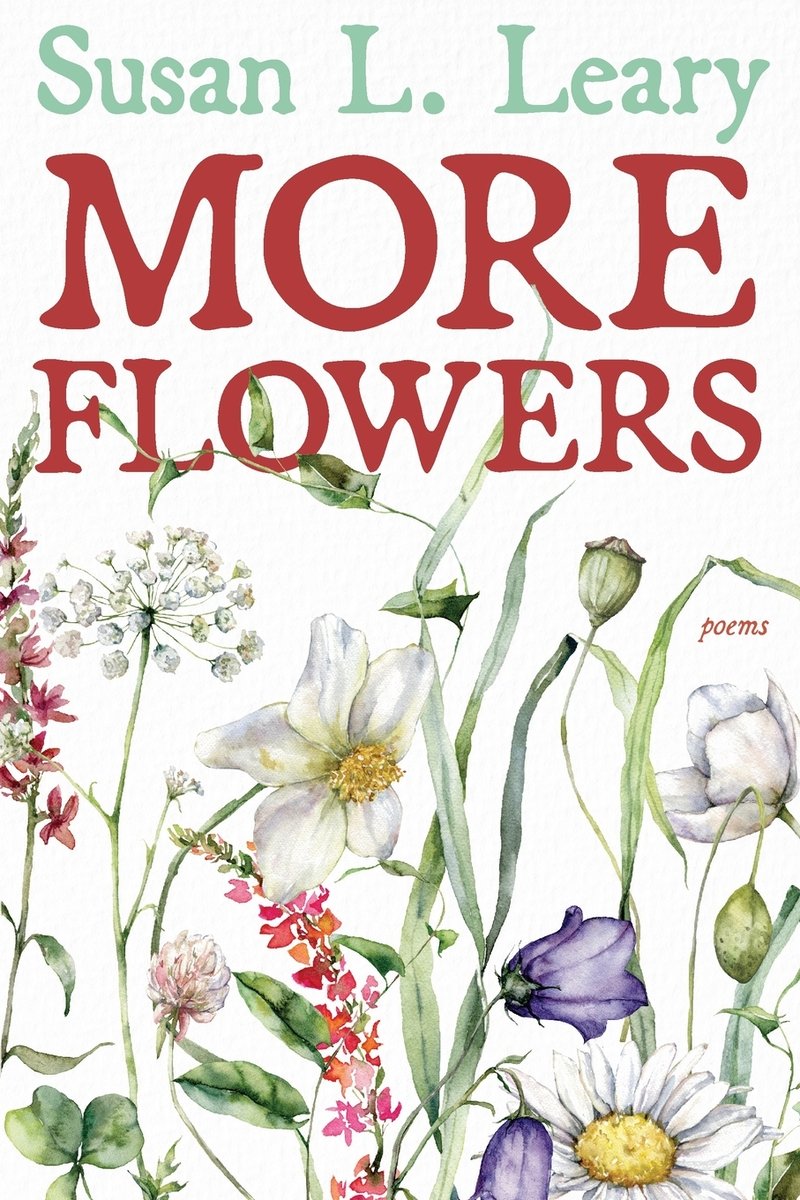

In More Flowers, Susan L. Leary doesn’t have to explain herself. Instead, she creates a psychological landscape in which the speaker careens between questioning and asserting, between the concrete and abstract, between lyric and plain speak. The absence of a traditional narrative structure is not a weakness, but a departure from her previous collection, Dressing the Bear, which explored the devastating death of Leary’s brother, Brian. In More Flowers, probable facts about the narrator’s life bubble up from time to time, but their actuality matters less than how they sit beside the book’s images, questions, and provocations.
In “Contemplating the Wrong Miracles,” Leary writes:
With sidewalk chalk, I draw the outline of a seesaw
against an open doorway. On one hand, I’m living paycheck
to paycheck & on the other, I’m keeping the orchids alive.
In the prose poem “The Kids These Days Want to Be Happy,” she writes about teaching a classroom of “eighteen-year-olds scrolling on their cellphones, who, someday, & mostly for money, wish to open you with their scalpels & manage your stocks.” She goes on to write, “Forget the career center & the proper advice. There’re only two options. Tell me about yourself, as in the Spartan formality of an interview, or, Tell me about yourself, as in soon my dead brother will make his way into the conversation.”
These glimpses ground us in the narrator’s life, sometimes in childhood, sometimes adolescence or adulthood. There are chicken nuggets, conversations with realtors, a power plant in the Midwest, term papers, empty pews. But the work of these images isn’t in their direct connection to the narrator. Rather, it’s in their portrait of growth, from girl to woman, in a particular slice of America. Without the hand-holding of confession or the comfort of narrative clarity, Leary’s work resists the expectation of explanation. Common girlhood demands such as likability, obedience, and apology surface throughout the collection, and at every turn, Leary counters them through form.
“Everything is a labor,” she writes in “We Examined Survival under a Microscope”:
Joy. Courtesy. The dying dog sunning in the grass, the attention
it troubles me to give her.
Further subverting feminine expectations, the flowers in this book are more than decoration or consolation. They appear as seed, weeds, cut, headless, in full bloom, floating around Ophelia.
In “I Don’t Want to Write about Flowers,” she begins:
So much has to happen before a thing can bloom
& so much of what happens we never see. A sprawling narrative
that unfolds beneath the earth before there are scissors
or a kitchen table or the human hand.
Ease and aesthetic pleasure are consistently complicated by unanswered questions and unpleasant truths:
I should say
defeat has made me
capable. Instead, it has terrified me
of endings & despite my efforts, the house
is going to pot.
There is no rose-petal path to wisdom or reprieve from the challenges of this world. Instead, the poems offer a more honest and devastating view of life, one where tenderness is not an escape, but a tool to confront the weight of existence.
In “God Makes Every Woman a Widow,” the narrator recalls her grandmother explaining the significance of the military burial flag: “An early lesson—myself, five-years-old & my grandmother / explaining the importance of a triangle.” By the poem’s end, Leary writes, “I think of faith, which my grandmother wants more / of these days, explaining how so much of love is believing ideas about the world that aren’t true. Mostly, that loss is fashioned into a three-point shape so God can prove his hands are clean.”
Elsewhere, the speaker asks, “Would anyone bat an eye if God went missing?” In another poem, she asserts, “Every question is another reframing of the problem.” Rather than resolving these tensions, the questions accumulate. There is no bow to tie the concerns of More Flowers together; no vase to contain them. In “Holding My Skeleton to the Light,” Leary writes:
It’s possible I watched myself fleeing the alleyway,
myself imagining a series of crueler
injuries to the original wound.
What does this mean? asks the poet.
It’s contextual! replies anyone without a clue.
This can be a way of describing a metaphor
or a way of describing psychology. This can also be helpful
or not. Listen. When I thought you hadn’t the desire
to understand me, I hadn’t the desire to be heard.
Leary’s narrator does not beg for permission to speak, even when her voice is uninvited. In the final poem, “Because My Tongue Is Not Welcome Here,” she writes, “For too long I’ve been headless, shame lugged behind me in my tightly capped skull.”
Leary writes into a world that demands women console, caretake, and make themselves useful. In More Flowers, she resists those demands through withholding: narrative closure, spiritual reassurance, explanatory arc. The collection unfolds as a series of small, deliberate rebellions, for each poem offers only what the speaker herself wishes to give.
More Flowers, by Susan L. Leary. Minneapolis, Minnesota: Trio House Press, February 2026. 100 pages. $18.00, paper.
Megan Nichols is the author of Animal Unfit (Belle Point Press, 2023). Her poems have appeared in The Threepenny Review, Plume, The Baltimore Review, Iron Horse Literary Review, and other journals, and have been featured on Poetry Daily. She serves as Managing Editor at Variant Literature and co-founded Lemon Grove Writers, a community for literary craft and connection. She lives in the Arkansas Ozarks.
Check out HFR’s book catalog, publicity list, submission manager, and buy merch from our Spring store. Follow us on Instagram, Bluesky, and YouTube. Disclosure: HFR is an affiliate of Bookshop.org and we will earn a commission if you click through and make a purchase. Sales from Bookshop.org help support independent bookstores and small presses.

