
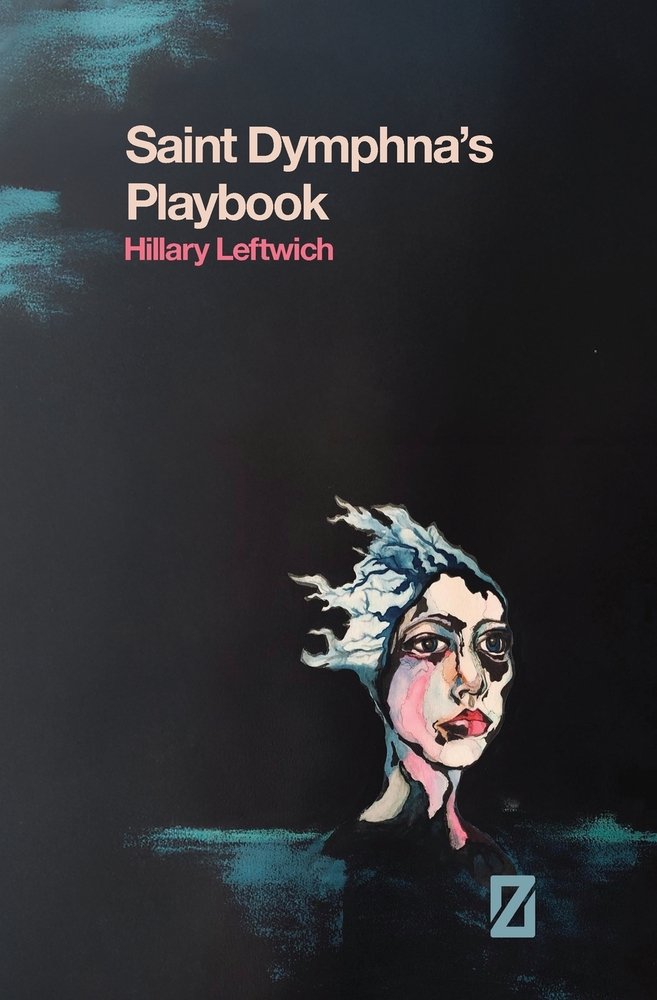
Poet and memoirist Hillary Leftwich’s most recent book, a genre-defiant work titled Saint Dymphna’s Playbook, is a devastating study in modalities of erasure. The book interrogates the almost unfathomably brutal erasure of female/femme voices and identities, as acts of deletion and blotting-out permeate the work via form and content. Resultingly, Saint Dymphna’s Playbook is both highly relevant to our times and an utterly wrenching read.
From the first page, violent cruelty obliterates the speaker’s sense of self and stability. She narrates her first experience of sexual assault, a grim torment tauntingly perpetrated by a male babysitter when she was a young girl:
I tell him my grandpa won a Purple Heart in WWII and he tells me to go get it he wants to see it he doesn’t believe me so I do and then he sticks it down his pants and tells me I won’t get it back unless I reach down and get it and boy won’t my mom be mad if I lose it so I do because I’m scared my mom will get mad at me [. . .]
He tells me to put my mouth on it or he’ll tell my mom and grabs the back of my head and pushes my face down and he tells me, “Ssshhh, shut up.”
Within a few devastating pages, her innocence is erased. The God-given identity she was born with and grew into—a sweet child with a sense of wonder and curiosity about the world—is defaced, effaced. Her first abuser has replaced that girl with a scared, humiliated child. From this tender age, the speaker must navigate lonely pain, shame, and confusion.
Later, a young man lures the speaker (now an adult) back to his apartment for a “party,” then spikes her drink and assaults her in his bathroom. Once he has rendered her incapacitated, “I thought he was finally done [but] two of his friends entered the bathroom and locked the door behind them and the last thing I heard was, ‘She’s just a stupid cunt.’” Eventually, she wakes up and attempts to escape; but the window is boarded shut. The carefree, happy young woman who had just enjoyed a night out with friends, singing karaoke, happily accepting a party invitation from a man who seems genuinely kind—has now been replaced by a woman dragging her bleeding body across a stranger’s floor. It is almost unspeakably painful to be in the moment with her when she realizes that she will not be able to escape; she has been abducted by men who are torturing her. They only release her days later, dumping her on a random street corner in the cold:
I will never find my way out of his bathroom. I will never find my way out of his bedroom and into a car that dumps me and my shame off on the corner of Corona Street and Downing. I will never find myself again.
Whatever identity she had built for herself as a young woman has had large pieces wrested from her, out of existence, and replaced with a new identity: she is now the woman who has survived this horrific act of torture.
Erasure becomes part of the form, here, too: pieces of police reports appear with names redacted—to protect the guilty, but really to protect the speaker from future violence against her by the guilty. These pages document the erasure of her experience in other ways, too, such as when the DA fails to bring charges due to a lack of evidence. A few pages, such as page 26 and 91, are entirely blank, save little blots and streaks of Xerox toner-smudge. The shadowy presence of this ghost-ink emphasizes the absence of all the words that should be there.
The speaker is confronted with other vicious erasures of women, girls, and femmes, including the heinous murder of a girl she’s been called to investigate as part of her job. As the speaker begins to lose her mind and her self under intense psychological turmoil, erasure takes the form of self-managed adaptation for survival—numbing herself with alcohol, dissociating from professional tasks, staying home from work to delete her presence, her psyche, from the workplace; to delete her own identity as a private investigator. Women learn to remain silent, to become less present, seeking the protection of invisibility.
The book gives way to a lengthy section in which each page contains a single word or phrase; all the usual context we might expect from a piece of prose or poetry has been removed. “Nasty,” reads the entirety of one page, while others, in litany, read: “Hag.” “Cougar.” “Baby boo.” “Feminazi.” “Cat Lady.” “Twat.” And on and on. The context in which an unpleasant person might have attempted to denigrate the speaker (or any woman) by referring to them with these names has been removed. Instead, bare key-words stare at us from the middle of each page, demanding confrontation. There is no cover, no softening the blow. And yet, we know the connotations of each insult. And so erasure becomes an act of empowerment, as we are left with only two choices—engage, or retreat.
The final piece in the book, the title poem, binds many thematic threads together. Saint Dymphna was a young woman who attempted to exercise autonomy over her body and her own identity, consecrating herself to Christ spiritually and taking a vow of holy virginity. She was erased—murdered—by her father, for refusing to marry him and bear his children. Saint Dymphna is the Patron Saint of those who struggle with mental illness, providing a definitive and very human connection between women who are sexually assaulted or tortured, even killed—and those who struggle with mental illnesses born of such trauma. And how does one survive such erasure, such violence? By following the playbook of the woman who lived on after her death to become a Saint, a figurehead who comforts, guides, and heals those who had suffered similar traumas to her own. It’s what this book sets out to do, and what it ultimately does beyond all reasonable expectation. St. Dymphna, wonder-worker in every affliction of mind and body, pray for us. St. Hillary of Poetry, word-worker of vision and survival, pray for us.
St. Dymphna’s Playbook, by Hillary Leftwich. San Diego, California: Limit Zero Publications, April 2025. 146 pages. $19.99, paper.
Fox Henry Frazier’s third full-length poetry collection, Break Blow Burn, comes out from White Stag Publishing in August 2026. Her debut novel, Francesca, is forthcoming in 2027. Her essays and reviews have appeared in Denver Quarterly, Border Crossing, Plume, and elsewhere. She holds an MFA from Columbia University and a PhD from the University of Southern California, where she was also a Provost’s Fellow. She created and manages Agape Editions. She and Rod Serling share a hometown.
Check out HFR’s book catalog, publicity list, submission manager, and buy merch from our Spring store. Follow us on Instagram, Bluesky, and YouTube. Disclosure: HFR is an affiliate of Bookshop.org and we will earn a commission if you click through and make a purchase. Sales from Bookshop.org help support independent bookstores and small presses.

