
dangerous humans
The newspapers will remark on how he was born just before Christmas; December 24, the time doesn’t really matter. His mother, a Catholic, will visit a psychic for reassurance. The old woman will tell her only great men are born so close to Christ. She will take this as a sign of his innocence. Take that hope to her grave. When he’s arrested, he’ll say the number’s bigger than it is, or that he doesn’t remember if it was fifteen or sixteen, only that he liked his victims clean-cut and boyish; the kind of guys he could chat up at bars in the late of night. The cops will describe his home like a hospital; meticulous, body parts divided in clean sections and blood in the in smell only, really; Clorox masking rot and piss and mold. The neighbors will describe him as quiet but friendly, not a sign in the world but the sounds and the smells and the phone calls from parents and the boys who go in his house but never come out. When he appears on TV, he won’t be unattractive, though everyone will insist there’s something evil hiding behind his eyes. You’ll be applying to college then, still innocent enough for the details to churn your stomach, but not the fact that such monsters exist. Ohio State will send your first acceptance when your mother tells you she’s fallen in love again; with the blond-haired beauty she sees on TV each day whose eyes are like the ocean and has a smile and charm and can’t possibly have torn people apart done all those terrible things. You’ll fight the first time she sends a letter to him, and you’ll always remember the address; whitehill correctional institute, 2215 grove ave, and you’ll fight hardest after the one where she calls him her angel, tells him about the dream she had where he was there and she told a joke that made everyone laugh. Your mother will call you crying the day he’s executed, how he was all alone with no one there for him and you’ll think about the fact you weren’t there for her when she dies in front of the TV on Christmas morning and it’s snowing outside and the news is playing a story about a man with a gun.
Mini-interview with John Sara
HFR: Can you share a moment that has shaped you as a writer (or continues to)?
JS: I would say getting the chance to be amongst fellow writers, be it in my undergrad or the residencies spent at Ashland University for my MFA. I think being in that environment helped to spark new ideas.
HFR: What are you reading?
JS: Right now—When Darkness Loves Us by Elizabeth Engstrom.
HFR: Can you tell us what prompted “dangerous humans”?
JS: Like a lot of my work, I would say bits and pieces of inspiration I sort of Frankensteined together, like the fact the serial killer Dean Corll was born on Christmas Eve. I watched a video recently about love letters sent to Jeffrey Dahmer in prison. There was one sent by what I assume was a single mother. In that letter, the woman mentioned how her son disapproved of her writings. That stuck with me, and I began this piece wondering how I might use that scenario as the backdrop for a story. Flash fiction like this is not something I write often, and so there was the additional challenge of crafting something more contained. For this, I think the story “Sticks” by George Saunders was at the back of my head too. That story is a gut punch.
HFR: What’s next? What are you working on?
JS: I hope this piece is the start of something new! As of writing this, I’ve published my first poetry collection, The Poet Who Cried Monster, releasing from Alien Buddha Press. The book is a series of 62 poems taking inspiration from each of the original Goosebumps books by R.L. Stine. I’m brainstorming the possibility of a second collection, be it a chapbook or full-length. With The Poet Who Cried Monster, there was the challenge of making something unified around a theme. I imagine my second book as something more personal, while still staying true to my love of horror and the weird. Working title: Death in the Cereal Aisle. I’m always writing new poems! Fiction too. My MFA thesis project, a novel, is still whispering to me from a Google doc.
HFR: Take the floor. Be political. Be fanatical. Be anything. What do you want to share?
JS: Read more. Write more. Healthcare is a human right.
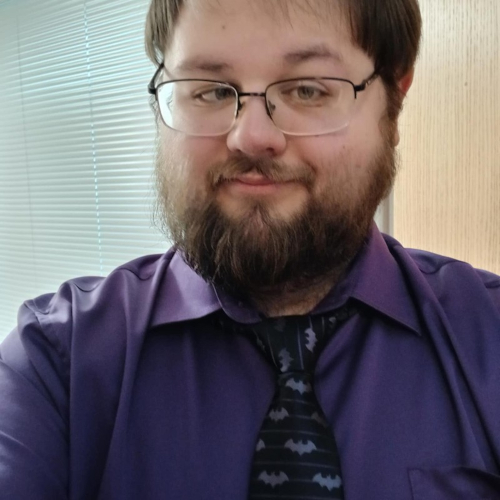
John Sara is a writer from Parma, Ohio. He received his MFA in Creative Writing from Ashland University, where he works as an adjunct professor and lead fiction editor for The Black Fork Review. His debut poetry collection, The Poet Who Cried Monster, will be published by Alien Buddha Press in January of 2026. His other work can be found in such places as Prairie Margins, Paper Dragon, Blood+Honey, Maudlin House, Bending Genres, Schlock! Webzine, Cul-de-sac of Blood, and more.
Check out HFR’s book catalog, publicity list, submission manager, and buy merch from our Spring store. Follow us on Instagram, Bluesky, and YouTube. Disclosure: HFR is an affiliate of Bookshop.org and we will earn a commission if you click through and make a purchase. Sales from Bookshop.org help support independent bookstores and small presses.

